
SNAP-8 (Acetyl Octapeptide-3): Sequence, SNARE Chemistry and Research Literature
By the TWO+DOS Research Team · Published 2026-08-13
For research use only. Not for human or veterinary use. Not for diagnostic or therapeutic use.
SNAP-8, catalogued as acetyl octapeptide-3, is a synthetic eight-residue peptide with the sequence Ac-Glu-Glu-Met-Gln-Arg-Arg-Ala-Asp-NH2. The string reproduces residues 12 through 19 of human SNAP-25, a component of the SNARE fusion machinery. Registry data list CAS 868844-74-0, PubChem CID 76283482, formula C41H70N16O16S and an average mass of 1075.2 g/mol.
This overview sets out what the published record supports about the molecule and, equally, where the record is thin. The mechanistic literature on SNAP-25-derived peptides is real and specific, and the analytical chemistry is well characterised. The permeation and formulation literature, however, is dominated by the shorter hexapeptide from the same span, and almost every wrinkle-related figure in circulation belongs to that shorter sequence or to multi-ingredient products rather than to the octapeptide alone. Findings below appear as their authors published them, named to the model system used.
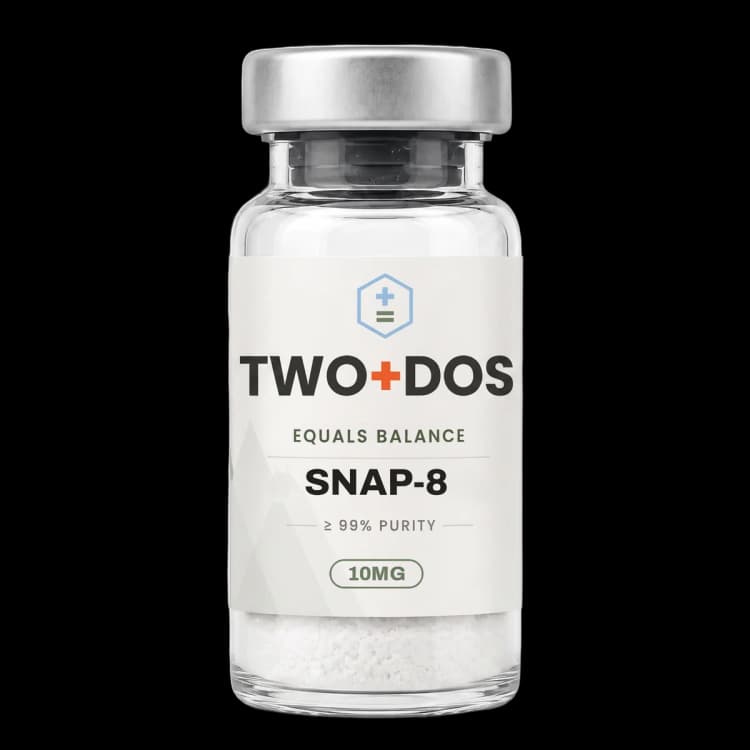
Chemical and physical properties of SNAP-8
| Peptide sequence | Ac-Glu-Glu-Met-Gln-Arg-Arg-Ala-Asp-NH2, eight residues, linear. Both termini are blocked: an acetyl group caps the amino terminus and a primary amide caps the carboxyl terminus. |
|---|---|
| Molecular formula | C41H70N16O16S, as catalogued at PubChem CID 76283482. The single sulfur atom belongs to the methionine side chain at position three. |
| Molecular weight | 1075.2 g/mol (PubChem computed average mass), well above the roughly 500 g/mol figure conventionally cited as the ceiling for efficient passive diffusion through intact stratum corneum |
| CAS registry number | 868844-74-0 |
| Parent protein segment | Residues 12 to 19 of human SNAP-25 (UniProt P60880), whose amino-terminal sequence reads MAEDADMRNEL-EEMQRRAD-QLADESLESTRR. The octapeptide reproduces the EEMQRRAD span exactly. |
| Relationship to acetyl hexapeptide-8 | Acetyl hexapeptide-8 is Ac-EEMQRR-NH2, the first six residues of the same span. SNAP-8 extends that sequence by alanine and aspartate, adding 42 g/mol and one further negative charge at neutral pH. |
| Ionisable side chains | Two glutamate carboxylates, one aspartate carboxylate and two arginine guanidinium groups, giving a zwitterionic, strongly hydrophilic molecule with no free amine or free carboxyl at the termini |
| Physical form | White to off-white lyophilized powder; freely water-soluble, consistent with the charged side-chain complement |
| Typical research-grade specification | Purity at or above 98% by reversed-phase HPLC, with identity confirmed by mass spectrometry against the 1075 g/mol expected mass |
| Published quantification limit | 0.0125 nanograms per millilitre by liquid chromatography with triple quadrupole mass spectrometry in multiple reaction monitoring mode (Ji et al., 2020) |
What is SNAP-8 and where does its sequence come from?
SNAP-8 is a synthetic octapeptide whose eight residues, Glu-Glu-Met-Gln-Arg-Arg-Ala-Asp, are lifted verbatim from positions 12 to 19 of human SNAP-25, the synaptosomal-associated protein of 25 kilodaltons catalogued at UniProt P60880. Chemical modification is confined to the two ends: an acetyl group on the amino terminus, a primary amide on the carboxyl terminus.
Both caps are deliberate synthetic choices rather than incidental. Removing the free alpha-amino group and the free alpha-carboxyl group eliminates the charges that aminopeptidases and carboxypeptidases recognise at peptide ends, and it also removes two zwitterionic termini that would otherwise sit at the boundaries of a sequence already carrying three acidic and two basic side chains. What remains is a molecule of 1075.2 g/mol whose net charge at neutral pH comes entirely from side chains.
The INCI-style naming around this compound is inconsistent enough to matter for procurement records. PubChem CID 76283482 lists acetyl octapeptide-3, acetyl octapeptide-1, acetyl octapeptide-8 and acetyl glutamyl heptapeptide-3 as synonyms for one and the same structure, alongside the trade designation SNAP-8. Recording CAS 868844-74-0 or the CID, rather than a trivial name, removes the ambiguity between catalogues.
How does the SNAP-25 sequence figure in SNARE complex assembly?
SNAP-8 borrows its sequence from a protein whose assembly biology is unusually well described. SNAP-25 contributes two of the four helices in the neuronal SNARE bundle, pairing with syntaxin-1 and the vesicle protein VAMP2. That four-helix trans complex zippers from its amino-terminal end toward its carboxyl-terminal end, drawing two lipid bilayers together closely enough to fuse.
Work published in the Journal of Neurochemistry in 2004 by Blanes-Mira and colleagues examined this directly with short synthetic peptides drawn from the SNAP-25 amino-terminal region. The segment spanning 22Ala to 44Ile proved essential to complex formation, and peptides designed from that region suppressed assembly in a manner that tracked how much alpha-helical structure each peptide adopted in solution. Critically, the peptides only abolished complex formation when added before assembly began; once the aggregate had formed, they could not disassemble it. The same peptides disrupted the binary SNAP-25 and syntaxin intermediate and inhibited calcium-dependent exocytosis from permeabilized cells.
That order-of-addition constraint is the mechanistically interesting result, because it distinguishes a competitive assembly modulator from a protease. Botulinum neurotoxins cleave SNAP-25 covalently; a peptide that competes for a docking interface does not, and any effect it produces reverses as the peptide is degraded or cleared.
The SNAP-25 assembly picture has continued to move. A 2026 report in Cell Reports found that SNAP25 undergoes liquid-liquid phase separation in vitro and in living cells, with the linker between its two SNARE motifs required for condensation and regulated by palmitoylation. Those condensates recruited syntaxin-1 and VAMP2 into ternary coacervates that facilitated complex assembly, and two encephalopathy-associated variants, I67N and I192N, blocked condensate fusion and suppressed assembly. Whether short amino-terminal peptides interact with this condensate step has not been reported.
What distinguishes SNAP-8 from acetyl hexapeptide-8?
SNAP-8 and acetyl hexapeptide-8 are nested sequences rather than independent molecules. Acetyl hexapeptide-8 is Ac-EEMQRR-NH2, covering SNAP-25 residues 12 to 17. SNAP-8 covers residues 12 to 19, appending alanine and aspartate. The extension adds roughly 42 g/mol, one additional carboxylate, and two more positions of contact with any binding surface the sequence engages.
The hexapeptide is the version with primary literature behind it. Blanes-Mira and colleagues reported in the International Journal of Cosmetic Science in 2002 that Ac-EEMQRR-NH2 inhibited neurotransmitter release with a potency described as comparable to botulinum neurotoxin A, though with much lower efficacy, and that the mechanism traced to interference with formation or stability of the SNARE complex. The same paper reported skin topography analysis on volunteers using a 10% oil-in-water emulsion over 30 days, with wrinkle depth reduced by up to 30%.
No equivalent peer-reviewed mechanistic characterisation of the octapeptide has been published. Comparative claims that the longer sequence engages the SNARE interface more effectively than the hexapeptide circulate widely in supplier literature and are repeated in the introduction of at least one analytical paper, but the underlying comparison does not appear as a peer-reviewed dataset. Treating the two peptides as equivalent in mechanism is an assumption from sequence homology, not a measured result.
One chemical difference is worth noting independently of biology. The added aspartate raises the net negative charge and the polar surface area of an already highly hydrophilic molecule, which works against passive transport across a lipid-rich barrier. Longer and more charged does not mean more permeant.
What has been measured about permeation of these sequences into skin?
Permeation is the dominant constraint on SNAP-8 and its shorter relative, and the numbers are stark. At 1075.2 g/mol the octapeptide sits roughly twice the mass conventionally cited as the practical ceiling for passive diffusion through intact stratum corneum, and its five ionisable side chains make it strongly hydrophilic against a lipid-ordered barrier.
The most concrete measurements come from Kraeling and colleagues, publishing in Cutaneous and Ocular Toxicology in 2015 on the hexapeptide. Working with flow-through diffusion cells on hairless guinea pig skin and human cadaver skin, the study applied a 10% cosmetic formulation and recovered most of the peptide from the surface wash. Retention in the stratum corneum reached 0.54% of the applied amount in guinea pig skin and 0.22% in human skin. Epidermal recovery was 0.01% in both species. No peptide was detected in the dermis or in the receptor fluid.
A 2025 review in the International Journal of Molecular Sciences reached the same conclusion from the wider literature: hydrophilicity and molecular size restrict passage through the lipophilic stratum corneum, low penetration limits bioavailability, and formulation strategy rather than the peptide itself is the variable that governs any measured effect. Any published figure for a finished product is therefore a statement about a delivery system as much as about a sequence.
The 2025 Expert Panel for Cosmetic Ingredient Safety review of acetyl hexapeptide-8 amide sits alongside this. The panel concluded that the available data supported cosmetic use at concentrations up to 0.005%, and judged the record insufficient to reach a conclusion at concentrations above that figure.
Which delivery systems appear in the recent literature?
Delivery work is where the recent publication record on SNAP-8 and its hexapeptide relative is concentrated, following one logic: if the barrier will not pass the molecule, the barrier or the carrier must change. Four approaches recur across 2020 to 2026 papers: dissolving microneedle arrays, ionic liquid co-assemblies, penetration-enhancing carrier peptides, and deep eutectic solvent systems.
Microneedle arrays are the only format in which the octapeptide itself appears in a clinical publication. Avcil and colleagues reported in the Journal of Cosmetic Dermatology in 2020 on hyaluronic acid microneedle patches containing acetyl octapeptide-3 together with palmitoyl tripeptide-5, an arginine and lysine polypeptide, adenosine and seaweed extracts. Over 12 weeks, instrumental measurement recorded fine lines and wrinkles decreased by 25.8%, hydration increased by 15.4%, and dermal density and thickness increased by 14.2% and 12.9% respectively. Because five actives were present, the octapeptide's individual contribution cannot be resolved from that design.
The 2026 work by Feng and colleagues in the International Journal of Biological Macromolecules shows how far the format has been pushed on the hexapeptide. A hyaluronic acid and polyvinyl alcohol matrix at a 3:2 ratio, cast by two-step vacuum-assisted micromolding, reached 20% loading for acetyl hexapeptide-8 and delivered 11.29% cumulative transdermal transfer across Bama miniature pig skin, higher than the aqueous solution comparator. In a UV and D-galactose photoaging mouse model the arrays raised superoxide dismutase activity and lowered malondialdehyde.
Solvent engineering is the other active line. Wang and colleagues reported in the Journal of Materials Chemistry B in 2025 that co-assembling the hexapeptide with a malic acid-derived ionic liquid produced 24-hour cumulative permeation 3.10 times that of the free peptide, with simulations attributing the gain to cation interactions with the lipid matrix. A 2026 Biomaterials Advances paper combined self-assembled tripeptide nanoparticles with a betaine, glycerol and propylene glycol deep eutectic solvent, reporting reduced acetylcholine secretion and suppressed sodium and calcium channel activity alongside weakened stratum corneum tight junctions.
Model systems have advanced in parallel. A 2025 paper in ACS Biomaterials Science and Engineering built a sensory neurone-integrated skin spheroid specifically to evaluate neuropeptide delivery systems, and is the closest published approximation to a functional readout for this peptide class outside a human study.
What are the limits of the published evidence for SNAP-8 specifically?
SNAP-8 has a strikingly small primary literature of its own. A PubMed search on acetyl octapeptide-3 returns only a handful of records, of which one clinical paper and one analytical paper actually concern the molecule. Everything else routinely cited in connection with the octapeptide is either about SNAP-25 biology or about the shorter hexapeptide.
That gap has three practical consequences for anyone reading the field. First, the widely repeated comparative potency claims against acetyl hexapeptide-8 have no peer-reviewed source that can be checked. Second, the single clinical dataset in which the octapeptide appears is a multi-ingredient patch, so no isolated effect size exists. Third, no published permeation study has measured the octapeptide itself across human skin, so its permeation is inferred from a shorter, smaller and less charged molecule that already penetrates poorly.
What is genuinely well established is narrower and more chemical: the sequence, mass and registry identity of the molecule; its exact correspondence to a defined span of SNAP-25; the assembly-stage mechanism by which SNAP-25 amino-terminal peptides interfere with SNARE complex formation in cell-free and permeabilized-cell systems; and a validated method for quantifying the octapeptide down to 0.0125 nanograms per millilitre.
SNAP-8 is supplied for laboratory research only. No regulatory authority has approved the octapeptide as a drug, and material sold to laboratories carries research-use labelling stating that it is not for human or veterinary use.
Summary of published research
Findings below are reported as published by the cited authors, in the model systems they used. They describe laboratory research, and none of them characterize use in humans.
Blanes-Mira C et al. Small peptides patterned after the N-terminus domain of SNAP25 inhibit SNARE complex assembly and regulated exocytosis. Journal of Neurochemistry. (2004)
- Model system
- Cell-free SNARE assembly assays, permeabilized secretory cells and hippocampal neurone cultures
- Conditions
- Synthetic peptides drawn from the SNAP-25 amino-terminal region, added before or after the onset of complex assembly
- Reported finding
- The SNAP-25 segment spanning 22Ala to 44Ile was essential to SNARE complex formation. Peptides patterned on that region suppressed assembly with potency tracking their alpha-helical content, abolished complex formation only when added before assembly began, disrupted the binary SNAP-25 and syntaxin intermediate, and inhibited calcium-dependent exocytosis from permeabilized cells.
Blanes-Mira C et al. A synthetic hexapeptide (Argireline) with antiwrinkle activity. International Journal of Cosmetic Science. (2002)
- Model system
- Neurosecretory preparations and healthy adult female volunteers
- Conditions
- Ac-EEMQRR-NH2, the six-residue subset of the SNAP-8 sequence, formulated at 10% in an oil-in-water emulsion and applied for 30 days
- Reported finding
- The hexapeptide inhibited neurotransmitter release with a potency reported as similar to botulinum neurotoxin A but with markedly lower efficacy, acting by interfering with formation or stability of the SNARE complex. Skin topography analysis recorded wrinkle depth reduced by up to 30% across 30 days. No oral toxicity or primary irritation was observed at high concentrations.
Kraeling ME, Zhou W, Wang P, Ogunsola OA. In vitro skin penetration of acetyl hexapeptide-8 from a cosmetic formulation. Cutaneous and Ocular Toxicology. (2015)
- Model system
- Hairless guinea pig skin and human cadaver skin in flow-through diffusion cells
- Conditions
- 10% acetyl hexapeptide-8 in a cosmetic formulation
- Reported finding
- Most applied peptide was recovered from the surface wash. Stratum corneum retention reached 0.54% of the applied amount in guinea pig skin and 0.22% in human skin, with 0.01% recovered from the epidermis of both species. No peptide was detected in the dermis or in the receptor fluid.
Ji M, Lee HS, Kim Y, Seo C, Choi S, Oh S, Min J, Park HJ, Kim JD, Jeong DH, Paik MJ. Method development for acetyl octapeptide-3 analysis by liquid chromatography-tandem mass spectrometry. Journal of Analytical Science and Technology. (2020)
- Model system
- Analytical method development on a liquid chromatograph coupled to a triple quadrupole mass spectrometer
- Conditions
- Multiple reaction monitoring with optimised mobile phase, collision energy and desolvation line temperature; applied to a biodegradable microneedle patch
- Reported finding
- The assay for acetyl octapeptide-3 achieved linearity of r at or above 0.9971, a quantification limit of 0.0125 nanograms per millilitre, repeatability between 0.02 and 0.12% relative standard deviation, and accuracy between minus 1.68 and 1.44% relative error.
Avcil M, Akman G, Klokkers J, Jeong D, Celik A. Efficacy of bioactive peptides loaded on hyaluronic acid microneedle patches: A monocentric clinical study. Journal of Cosmetic Dermatology. (2020)
- Model system
- Monocentric clinical study in human volunteers
- Conditions
- Hyaluronic acid microneedle patches containing acetyl octapeptide-3 together with palmitoyl tripeptide-5, an arginine and lysine polypeptide, adenosine and seaweed extracts, over 12 weeks
- Reported finding
- Instrumental assessment at 12 weeks recorded fine lines and wrinkles decreased by 25.8%, hydration increased by 15.4%, and dermal density and thickness increased by 14.2% and 12.9% respectively. The multi-ingredient design does not resolve the individual contribution of acetyl octapeptide-3.
Zdrada-Nowak J, Surgiel-Gemza A, Szatkowska M. Acetyl Hexapeptide-8 in Cosmeceuticals-A Review of Skin Permeability and Efficacy. International Journal of Molecular Sciences. (2025)
- Model system
- Narrative review of permeability and efficacy literature
- Reported finding
- The review concluded that hydrophilicity and molecular size restrict passage of acetyl hexapeptide-8 through the lipophilic stratum corneum, that low penetration limits its bioavailability, and that advanced delivery strategies rather than the peptide itself govern reported outcomes.
Johnson W Jr, Bergfeld WF, Belsito DV, Cohen DE, Klaassen CD, Liebler DC, Marks JG Jr, Peterson LA, Shank RC, Slaga TJ, Snyder PW, Fiume M, Heldreth B. Safety Assessment of Acetyl Hexapeptide-8 Amide as Used in Cosmetics. International Journal of Toxicology. (2025)
- Model system
- Expert panel review of the cosmetic ingredient data record
- Reported finding
- The Expert Panel for Cosmetic Ingredient Safety concluded that the available data supported use of acetyl hexapeptide-8 amide in cosmetics at concentrations up to 0.005%, and that the data were insufficient to reach a conclusion at concentrations above that level.
Wang Z, Zhang L, Wang B, Wang M, Zhang J. Dual-function supramolecular system of alpha-hydroxy acid-based ionic liquids and peptides for enhanced anti-aging transdermal delivery. Journal of Materials Chemistry B. (2025)
- Model system
- In vitro transdermal diffusion cells, cultured cells, molecular dynamics simulation and a human volunteer study
- Conditions
- Malic acid-derived ionic liquid co-assembled with acetyl hexapeptide-8; 24-hour permeation and 28 days of facial cream use
- Reported finding
- Cumulative 24-hour permeation from the co-assembly was 3.10 times that of the free peptide, a gain simulations attributed to cation interactions with the lipid matrix. Cell assays recorded higher collagen I production via TGF-beta signalling and stronger inhibition of acetylcholine release than peptide alone.
Martin BA, Viegas J, Dalmolin LF, Santos ES, Vatanabe IP, Lisboa SF, Lopez RFV, Sarmento B. Development of a Sensory Neuron-Integrated Skin Spheroid Model for the Evaluation of Neuropeptide-Based Topical Delivery Systems. ACS Biomaterials Science and Engineering. (2025)
- Model system
- Sensory neurone-integrated human skin spheroid and ex vivo human skin
- Conditions
- Acetyl hexapeptide-3 delivered from a topical film over 48 hours
- Reported finding
- The peptide was internalised by spheroid cells with preferential accumulation around sensory neurones and traversed the stratum corneum in ex vivo human skin. In the spheroid model it suppressed acetylcholine release, upregulated superoxide dismutase 2 and stimulated type I collagen synthesis.
Feng M, Wu C, Jiang Y, Zhao C. Thermostable hyaluronic acid-based dissolving microneedles with high-loading capacity: design, optimization, and transdermal delivery of anti-aging ingredients. International Journal of Biological Macromolecules. (2026)
- Model system
- Bama miniature pig skin in vitro permeation and a UV plus D-galactose photoaging mouse model
- Conditions
- Hyaluronic acid and polyvinyl alcohol matrix at 3:2, two-step vacuum-assisted micromolding, loaded to 20% acetyl hexapeptide-8 and 40% 3-O-ethyl ascorbic acid
- Reported finding
- The arrays delivered 11.29% cumulative transdermal transfer for acetyl hexapeptide-8 against pig skin, exceeding the aqueous solution comparator. In the photoaged mouse model they raised superoxide dismutase activity, lowered malondialdehyde and reversed pathological thickening of the skin.
Bai D, Wang Z, Liu T, Wang M, Zhang J. DES-mediated self-assembled polypeptides: Synergistic neuromuscular signaling inhibition for anti-aging. Biomaterials Advances. (2026)
- Model system
- Molecular dynamics simulation, in vitro permeation, in vivo rodent work and an exploratory clinical assessment
- Conditions
- Self-assembled nanoparticles combining acetyl hexapeptide-8, dipeptide diaminobutyroyl benzylamide diacetate and a conotoxin, carried in a betaine, glycerol and propylene glycol deep eutectic solvent
- Reported finding
- The co-assembled system inhibited sodium and calcium channel activity, reduced acetylcholine secretion and improved skin elasticity and wrinkle parameters. Simulations attributed the permeation gain to reduced transmembrane resistance at an appropriate nanostructure size, together with increased lipid mobility and weakened tight junctions in the stratum corneum.
Zhu M, Jin Y, Liu J, Kong X, Liu Y, Yu H. SNAP25 undergoes phase separation to facilitate the assembly of the synaptic vesicle fusion machinery. Cell Reports. (2026)
- Model system
- Purified recombinant protein assays and living cells
- Conditions
- SNAP25 condensate assays, palmitoylation state, and the encephalopathy-associated I67N and I192N variants
- Reported finding
- SNAP25 underwent liquid-liquid phase separation in vitro and in living cells, with the linker between its two SNARE motifs required for condensation and regulated by palmitoylation. Condensates recruited syntaxin-1 and VAMP2 into ternary coacervates that facilitated SNARE complex assembly, while the I67N and I192N variants blocked condensate fusion and suppressed assembly.
What laboratory handling information is published?
SNAP-8 is supplied as a white to off-white lyophilized powder and is freely water-soluble, which follows directly from its side-chain complement of three carboxylates and two guanidinium groups. Material catalogues list storage of the dry powder at minus 20 degrees Celsius, protected from light and moisture, with aqueous stocks held frozen and kept sealed against atmospheric water.
One structural feature governs most of the chemical caution around this sequence. Methionine at position three is the single sulfur-containing residue in the molecule, and thioether sulfur is the most readily oxidised side chain in the standard amino acid set. Oxidation to the sulfoxide adds 16 mass units and is detectable by mass spectrometry as an M plus 16 species, which is why identity confirmation on this peptide is normally run by mass spectrometry rather than by retention time alone. Exposure to peroxides, transition metal ions and prolonged air contact in solution all accelerate that route.
For quantification, the reference method is the liquid chromatography with tandem mass spectrometry procedure published by Ji and colleagues in the Journal of Analytical Science and Technology in 2020, which built a multiple reaction monitoring dataset specifically for acetyl octapeptide-3. Reported figures of merit were linearity of r at or above 0.9971, a quantification limit of 0.0125 nanograms per millilitre, repeatability of 0.02 to 0.12% relative standard deviation and accuracy between minus 1.68 and 1.44% relative error. Those numbers set a practical floor for detecting the peptide in formulation matrices and in permeation experiments.
Purity on research-grade material is normally specified at or above 98% by reversed-phase HPLC, with the expected molecular mass of 1075.2 g/mol confirmed against the C41H70N16O16S formula. Because acetyl hexapeptide-8 shares the first six residues, a truncated impurity from incomplete chain assembly differs from the target by only 187 mass units and is chromatographically close; separation conditions should be checked to resolve the two rather than assumed.
SNAP-8 is intended for laboratory research use only. It is not a drug, food or cosmetic ingredient supplied for consumer application, and it is not for human or veterinary use.
Frequently asked research questions
What is the sequence of SNAP-8?
SNAP-8 is Ac-Glu-Glu-Met-Gln-Arg-Arg-Ala-Asp-NH2, written Ac-EEMQRRAD-NH2. Those eight residues correspond exactly to positions 12 to 19 of human SNAP-25 as catalogued at UniProt P60880. The amino terminus is acetylated and the carboxyl terminus is a primary amide, so neither end carries a free charge.
How does SNAP-8 differ from acetyl hexapeptide-8?
Acetyl hexapeptide-8 is Ac-EEMQRR-NH2, the first six residues of the same SNAP-25 span. SNAP-8 adds alanine and aspartate at the carboxyl end, taking the mass from roughly 889 to 1075.2 g/mol and adding one further negative charge. The two are nested sequences from one protein region, not chemically unrelated compounds.
Which CAS number and PubChem CID belong to SNAP-8?
CAS 868844-74-0 and PubChem CID 76283482, which lists the formula C41H70N16O16S and an average mass of 1075.2 g/mol. The same CID carries acetyl octapeptide-3, acetyl octapeptide-1, acetyl octapeptide-8 and acetyl glutamyl heptapeptide-3 as synonyms, so the registry number is the reliable identifier across catalogues.
Does published work show SNAP-8 crossing human skin?
No study has measured permeation of the octapeptide itself across human skin. The closest published data concern the shorter hexapeptide, where a 2015 in vitro study recovered 0.22% of an applied 10% formulation from human stratum corneum and 0.01% from the epidermis, with none detected in the dermis or receptor fluid. The octapeptide is larger and more charged, so inference from that figure is directional at best.
Is SNAP-8 an approved drug product?
No. No regulatory authority has approved acetyl octapeptide-3 as a drug. It appears in chemical and cosmetic ingredient databases under several octapeptide synonyms, and material supplied to laboratories carries research-use labelling stating that it is not for human or veterinary use.
SNAP-8 at TWO+DOS
TWO+DOS supplies SNAP-8 as a research-use-only compound, third-party tested, with certificates of analysis emailed immediately on request.
View the SNAP-8 (10mg)listing →References
- PubChem CID 76283482: formula, mass, CAS and synonym record for acetyl octapeptide-3
- UniProt P60880: human SNAP-25 canonical sequence and domain annotation
- Blanes-Mira et al. 2004, Journal of Neurochemistry: SNAP25 N-terminus peptides and SNARE assembly (PMID 14675156)
- Blanes-Mira et al. 2002, International Journal of Cosmetic Science: A synthetic hexapeptide (Argireline) with antiwrinkle activity (PMID 18498523)
- Blanes-Mira et al. 2003, Biochemical Journal: SNARE complex modulators from a helix-constrained library (PMID 12852787)
- Ji et al. 2020, Journal of Analytical Science and Technology: LC-MS/MS method for acetyl octapeptide-3
- Avcil et al. 2020, Journal of Cosmetic Dermatology: hyaluronic acid microneedle patch clinical study (PMID 31134751)
- Kraeling et al. 2015, Cutaneous and Ocular Toxicology: in vitro skin penetration figures (PMID 24754410)
- Zdrada-Nowak et al. 2025, International Journal of Molecular Sciences: permeability and efficacy review (PMID 40565185)
- Johnson et al. 2025, International Journal of Toxicology: Cosmetic Ingredient Safety panel assessment (PMID 40673537)
- Feng et al. 2026, International Journal of Biological Macromolecules: dissolving microneedle loading and permeation (PMID 41628877)
- Zhu et al. 2026, Cell Reports: SNAP25 phase separation and SNARE assembly (PMID 41678336)
For research use only. Not for human or veterinary use. Not for diagnostic or therapeutic use.