
AOD-9604: Structure, Lipolytic Mechanism and Analytical Detection
By the TWO+DOS Research Team · Published 2026-08-13
For research use only. Not for human or veterinary use. Not for diagnostic or therapeutic use.
AOD-9604 is a synthetic 16-residue peptide of 1815.1 g/mol corresponding to the carboxy-terminal domain of human growth hormone, residues 177 to 191, carried on an N-terminal tyrosine. Its sequence, YLRIVQCRSVEGSCGF, closes into a single disulfide loop between the two cysteines, reproducing the small cyclic region at the hormone's tail.
The AOD series came out of a 1990s effort to separate the lipolytic chemistry of growth hormone from the rest of the molecule, on the hypothesis that the intact hormone acts partly as a pro-hormone whose C-terminal domain carries an activity distinct from somatotropic signalling. This overview covers the sequence and its one-residue difference from hGH 176-191, the enzyme and receptor evidence in adipose tissue, the metabolite chemistry used to detect the peptide, and its regulatory position.
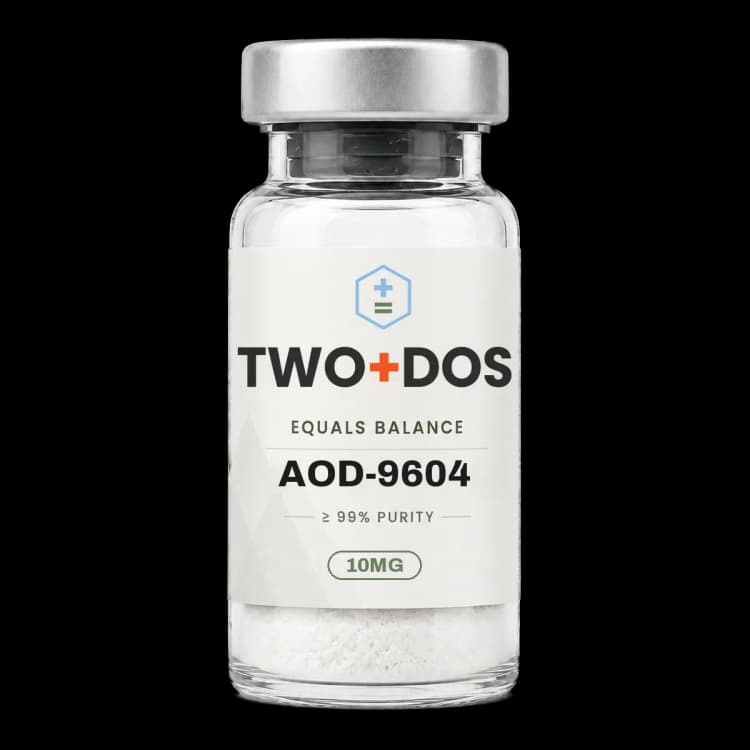
Chemical and physical properties of AOD-9604
| Peptide class | 16-residue carboxy-terminal domain analogue of human growth hormone |
|---|---|
| Amino acid sequence | YLRIVQCRSVEGSCGF, an N-terminal tyrosine followed by growth hormone residues 177 to 191 |
| Molecular formula | C78H123N23O23S2 |
| Molecular mass | 1815.1 g/mol average; exact and monoisotopic mass 1813.860 Da (PubChem computed) |
| CAS number | 221231-10-3 |
| PubChem CID | 71300630 |
| Other registry identifiers | UNII 7UP768IP4M; InChIKey GVIYUKXRXPXMQM-BPXGDYAESA-N |
| Disulfide topology | One intramolecular disulfide joining the two cysteines of the chain, positions 7 and 14, which correspond to Cys182 and Cys189 of the parent hormone and close a small cyclic loop |
| Relation to the unmodified fragment | Differs from hGH 176-191 by a single phenylalanine-to-tyrosine substitution at the N-terminal position, adding one oxygen atom |
| Computed polarity descriptors | XLogP minus 4.8; topological polar surface area 815 square angstroms; 28 hydrogen-bond donors; 28 acceptors; 45 rotatable bonds (PubChem computed) |
| Anti-doping status | Named among growth hormone fragments in section S2 of the World Anti-Doping Agency Prohibited List, prohibited at all times |
What is AOD-9604 and how does it differ from hGH 176-191?
AOD-9604 differs from the growth hormone fragment hGH 176-191 by one residue. Phenylalanine 176 is replaced by tyrosine, so the analogue carries a single extra oxygen atom and the formula C78H123N23O23S2 against C78H123N23O22S2 for the unmodified fragment. Everything from leucine 177 to phenylalanine 191, including the disulfide loop, is unchanged.
That one atom is a useful integrity check. PubChem CID 71300630 returns C78H123N23O23S2 at 1815.1 g/mol with a monoisotopic mass of 1813.860 Da, and a preparation whose mass spectrum centres 16 Da lower is the unmodified fragment rather than the tyrosine-bearing analogue. The two are sold under overlapping names, and mass alone distinguishes them.
Conformationally the molecule is small and constrained. Ogru and colleagues solved the solution structure of the cyclic domain by nuclear magnetic resonance in 2000 and reported defined beta-turn geometry in the disulfide-closed region, closely matching the corresponding segment of the published growth hormone crystal structure. The isolated domain therefore holds a shape it also adopts inside the intact hormone.
How was the lipolytic domain of growth hormone mapped to the C-terminus?
AOD-9604 traces to a mapping effort that located the lipolytic activity of human growth hormone in its carboxy-terminal tail rather than the receptor-binding helices. Natera, Jiang and Ng reported in 1994 that a synthetic hGH 177-191 peptide inhibited lipogenesis in adipose tissue of C57BL/6J ob/ob mice, isolating the domain from the intact hormone.
The mapping was then extended across species and preparations. Ogru and colleagues found that the cyclic domain stimulated lipolysis and inhibited lipogenesis in vitro in rodent, porcine and human adipose tissue, which established that the activity was not a rodent artefact. Heffernan and colleagues reported in 2000 that the closely related analogue AOD-9401, given orally to ob/ob mice for 30 days, reduced lipogenic activity and raised lipolytic activity in adipose tissue examined ex vivo, with the same directional effects reproduced in isolated human adipose tissue.
AOD-9604 is the version of that domain carried forward. Ng and colleagues reported in Hormone Research in 2000 that Zucker rats given the peptide orally at 500 micrograms per kilogram over 19 days showed increased adipose lipolytic activity with no adverse change in insulin sensitivity, which is the point of divergence from chronic exposure to the intact hormone.
Which enzymes and receptors does AOD-9604 act on in adipose tissue?
AOD-9604 and its close congener AOD9401 act on two enzymes that sit on opposite sides of adipocyte lipid handling. Ng and colleagues reported in the Journal of Molecular Endocrinology in 2000 that the synthesised domain stimulated hormone-sensitive lipase and inhibited acetyl-CoA carboxylase in isolated rat adipose tissue, matching the intact hormone.
The same work reported a morphological readout alongside the enzyme data. Mean adipocyte diameter in Zucker rats exposed for 20 days fell from 110 to 80 micrometres, and the peptide reproduced the effect of the intact hormone on diacylglycerol release in adipocytes. Acetyl-CoA carboxylase is the committed step of fatty acid synthesis and hormone-sensitive lipase hydrolyses stored triacylglycerol, so inhibition of one with stimulation of the other describes a coordinated shift rather than a single-enzyme effect.
A receptor requirement was established genetically. Heffernan and colleagues reported in Endocrinology in 2001 that both the intact hormone and AOD9604 raised beta-3 adrenergic receptor RNA in adipose tissue over 14 days, restoring the repressed levels seen in ob/ob animals toward those of lean controls, and that the chronic lipid effects were absent in beta-3 adrenergic receptor knockout mice. Knockout dependency is the strongest form of that claim available in the AOD literature, since it removes the candidate pathway rather than blocking it pharmacologically.
Does AOD-9604 engage the growth hormone receptor or change IGF-1?
AOD-9604 separates from intact growth hormone at the receptor itself. Heffernan and colleagues reported in 2001 that the fragment does not compete for the growth hormone receptor, and that chronic exposure produced neither hyperglycaemia nor reduced insulin secretion, whereas the intact hormone produced both in the same experimental animals.
Human data point the same way. Stier, Vos and Kenley pooled six randomised, double-blind, placebo-controlled trials in the Journal of Endocrinology and Metabolism in 2013 and reported no effect on serum IGF-1, oral glucose tolerance results showing no negative change in carbohydrate metabolism, and no anti-AOD9604 antibodies in the samples assayed for immunogenicity. Tolerability in those trials was described as indistinguishable from placebo.
Recent secondary literature is not consistent on this point, and the discrepancy is worth flagging. The 2026 orthopaedic review by Rahman, Lee and Seeds groups AOD-9604 with growth hormone secretagogues described as acting through IGF-1 signalling, which sits against the primary receptor-competition and IGF-1 measurements above. Where a review assigns a mechanism by class rather than by measurement, the underlying assay data should be checked before the assignment is carried forward.
How is AOD-9604 detected and what happens to it in biological matrices?
AOD-9604 is measured by liquid chromatography coupled to mass spectrometry. Cox and colleagues published a validated urine method in Drug Testing and Analysis in 2015 reaching a limit of detection of 50 pg/mL with 62 percent extraction recovery, and identified six candidate metabolites generated by incubation in serum and urine.
One of those fragments carries the analytical work. The nonapeptide CRSVEGSCG, produced by loss of the N-terminal and C-terminal residues while the disulfide loop survives, proved markedly more persistent than either the parent peptide or the other metabolites, so it became the preferred target for extending the detection window. Persistence tracks the constrained cyclic core, which is the part of the molecule least accessible to exopeptidases.
Circulating persistence of the intact peptide is short. Moré and Kenley reported a serum half-life of roughly 4 minutes in vitro, with intact peptide undetectable 56 minutes after spiking, and roughly 3 minutes in pigs following vascular delivery, alongside an oral availability estimate near 40 percent in rats derived from radioactivity distribution. The same report described no genotoxic activity in the bacterial reverse mutation assay up to 2,000 micrograms per plate.
Matrix handling matters as much as instrument sensitivity. Mazzarino and colleagues reported in The Analyst in 2026 that across a 54-compound prohibited panel, analytes held within 15 percent variation for two months at minus 20 degrees Celsius, while several degraded extensively in serum and plasma at raised temperatures. In dried matrices every compound stayed detectable for the full study, which is why dried blood spots are attractive where cold chain cannot be guaranteed.
What is the regulatory and anti-doping status of AOD-9604?
AOD-9604 appears by name in section S2 of the World Anti-Doping Agency Prohibited List, among growth hormone fragments alongside hGH 176-191. Substances in S2 are prohibited at all times, in and out of competition, which is why anti-doping laboratories have invested in detection chemistry for a peptide with no approved medicinal use.
Detection required purpose-built chemistry because the existing growth hormone test does not see it. Orlovius, Thomas, Schaenzer and Thevis reported in 2013 that AOD-9604 does not influence the World Anti-Doping Agency hGH isoform immunoassay, so a fragment-specific mass spectrometric method was necessary rather than optional. Vanhee and colleagues published a characterisation of AOD9604 in preparations seized by Belgian authorities in 2014, an early record of the material circulating outside regulated supply.
Secondary literature in 2026 places the compound in a wider survey. Mendias and Awan catalogued AOD-9604 among unapproved peptides in Sports Medicine, concluding that animal-model results across the class outrun the human safety record. Dominikowski and colleagues listed it as a growth hormone fragment in a Frontiers in Endocrinology review, and Coutinho and colleagues covered the 176-191 class in a critical review of peptide use in sport, noting that unregulated supply frequently yields mislabelled or contaminated material.
Summary of published research
Findings below are reported as published by the cited authors, in the model systems they used. They describe laboratory research, and none of them characterize use in humans.
Ogru E, Wilson JC, Heffernan M, Jiang WJ, Chalmers DK, Libinaki R, Ng FM. The conformational and biological analysis of a cyclic anti-obesity peptide from the C-terminal domain of human growth hormone. Journal of Peptide Research (2000)
- Model system
- Cell-free structural work with rodent, porcine and human adipose tissue
- Conditions
- Nuclear magnetic resonance structure of the 15-residue cyclic domain, compared against the intact hormone crystal structure
- Reported finding
- The cyclic region adopted defined beta-turn conformations that matched the corresponding segment of the intact hormone. The same peptide stimulated lipolysis and inhibited lipogenesis in vitro in rodent, porcine and human adipose tissue, identifying the C-terminal region as a self-contained functional domain.
Ng FM, Jiang WJ, Gianello R, Pitt S, Roupas P. Molecular and cellular actions of a structural domain of human growth hormone (AOD9401) on lipid metabolism in Zucker fatty rats. Journal of Molecular Endocrinology (2000)
- Model system
- Rodent, isolated adipose tissue and Zucker rats
- Conditions
- Solid-phase synthesis of the hGH 177-191 domain; enzyme assays in isolated rat adipose tissue; 20 days of exposure in Zucker rats
- Reported finding
- The synthesised domain stimulated hormone-sensitive lipase and inhibited acetyl-CoA carboxylase in isolated rat adipose tissue in the manner of the intact hormone, and reproduced its effect on diacylglycerol release in adipocytes. Mean adipocyte diameter fell from 110 to 80 micrometres, without the insulin resistance or glucose intolerance the intact hormone produced.
Heffernan M, Summers RJ, Thorburn A, et al. The effects of human GH and its lipolytic fragment (AOD9604) on lipid metabolism following chronic treatment in obese mice and beta(3)-AR knock-out mice. Endocrinology (2001)
- Model system
- Rodent (ob/ob mice and beta-3 adrenergic receptor knockout mice)
- Conditions
- 14 days of exposure to intact growth hormone or AOD9604, with beta-3 adrenergic receptor RNA quantified in adipose tissue and knockout animals testing pathway dependency
- Reported finding
- Both the intact hormone and AOD9604 raised beta-3 adrenergic receptor RNA in adipose tissue, restoring the repressed levels seen in ob/ob animals to levels comparable with lean animals. The chronic lipid effects required a functional beta-3 adrenergic receptor and did not occur in knockout mice.
Heffernan MA, Thorburn AW, Fam B, et al. Increase of fat oxidation and weight loss in obese mice caused by chronic treatment with human growth hormone or a modified C-terminal fragment. International Journal of Obesity (2001)
- Model system
- Rodent (ob/ob mice)
- Conditions
- Chronic exposure to intact growth hormone or the modified C-terminal fragment, assessing lipid oxidation, plasma glycerol, glycaemic measures and receptor competition
- Reported finding
- Lipid oxidation and plasma glycerol rose with both compounds. AOD9604 did not induce hyperglycaemia or reduce insulin secretion, and did not compete for the growth hormone receptor, which the authors read as support for the intact hormone acting in part as a pro-hormone for this domain.
Cox HD, Smeal SJ, Hughes CM, et al. Detection and in vitro metabolism of AOD9604. Drug Testing and Analysis (2015)
- Model system
- Analytical method development in human urine, with in vitro serum and urine metabolism
- Conditions
- Solid-phase extraction with liquid chromatography tandem mass spectrometry; metabolites generated by incubation in serum and urine
- Reported finding
- The validated urine method reached a limit of detection of 50 pg/mL with 62 percent extraction recovery and precision below 20 percent. Six candidate metabolites were characterised, and the nonapeptide CRSVEGSCG proved markedly more stable than the parent peptide, making it the preferred analytical target.
Mazzarino M, Colpaert T, Deventer K, Van Eenoo P. Rapid and harmonized analytical workflow for the determination of peptidic and non-peptidic doping agents in dried and liquid blood matrices. Analyst (2026)
- Model system
- Analytical method development in dried blood spots, serum and plasma
- Conditions
- Single microextraction with 500 microlitres of methanol and water at 8:2, then liquid chromatography high-resolution mass spectrometry across 54 prohibited compounds including AOD-9604
- Reported finding
- Detection limits across the panel ran from 0.05 to 1.25 ng/mL, with matrix effects of 5 to 33 percent, extraction yields of 15 to 80 percent and extract stability of at least 72 hours at 10 degrees Celsius. All analytes varied by under 15 percent over two months at minus 20 degrees Celsius, several degraded in serum and plasma at raised temperatures, and every compound stayed detectable throughout in dried matrices.
Mendias CL, Awan TM. Safety and Efficacy of Approved and Unapproved Peptide Therapies for Musculoskeletal Injuries and Athletic Performance. Sports Medicine (2026)
- Model system
- Narrative review
- Conditions
- Mechanisms, safety profiles and regulatory status of approved and unapproved peptides marketed to the public, AOD-9604 among them
- Reported finding
- AOD-9604 was catalogued within the unapproved group. The review concluded that animal-model tissue-repair and metabolic results across the class outrun the human safety record, and identified placebo response amplified by social media as a confounder.
Dominikowski A, Rekos Z, Olejarz M, et al. The emerging landscape of performance-enhancing peptides modulating GH-IGF1 axis: bridging the gap between clinical evidence and patient self-administration. Frontiers in Endocrinology (2026)
- Model system
- Narrative review
- Conditions
- Agents modulating the growth hormone and IGF-1 axis that circulate as research compounds, published evidence set against protocols found online
- Reported finding
- AOD9604 was catalogued as a growth hormone fragment within this class, alongside GHRH analogues and growth hormone secretagogues. Reported adverse findings for the group spanned endocrine and metabolic disturbance, fluid retention and local site reactions.
Rahman OF, Lee SJ, Seeds WA. Therapeutic Peptides in Orthopaedics: Applications, Challenges, and Future Directions. Journal of the American Academy of Orthopaedic Surgeons Global Research and Reviews (2026)
- Model system
- Narrative review
- Conditions
- Peptides considered against signalling networks including PI3K/Akt, mTOR, MAPK, TGF-beta and AMPK in orthopaedic research
- Reported finding
- AOD-9604 was grouped with growth hormone secretagogues characterised as acting through IGF-1 signalling, a class-level assignment that sits against primary reports of no growth hormone receptor competition and unchanged serum IGF-1. Clinical trial evidence across the class was described as lacking.
Coutinho LFD, de Oliveira Neves LF, Camilo RP. A new era of doping? Use of peptide and peptide-analog drugs in recreational and professional sport and bodybuilding: a critical review. Journal of Sports Medicine and Physical Fitness (2026)
- Model system
- Critical review
- Conditions
- Peptides circulating in sport, including GHRH analogues, growth hormone secretagogues and synthetic fragments such as the 176-191 sequence
- Reported finding
- The 176-191 fragment class was among the agents surveyed. Published studies were reported to use controlled regimens unlike those circulating in practice, the unregulated supply chain to yield mislabelled or contaminated product, and prevalence outside elite sport to be undocumented.
What laboratory handling information is published?
AOD-9604 is supplied as a lyophilized solid and carries one intramolecular disulfide between cysteine 7 and cysteine 14 of the 16-residue chain, corresponding to Cys182 and Cys189 of the parent hormone. That bond, rather than oxidation of a free thiol, is the structural feature that governs handling.
Disulfide chemistry sets the first liability. Reducing agents, residual thiols in glassware and alkaline buffers all favour ring opening, and a linearised chain has lost the beta-turn geometry Ogru and colleagues associated with activity. Purity work should resolve the reduced and scrambled species explicitly instead of reporting a single main-peak percentage, because a linear isomer co-elutes closely and shares the parent mass to within two hydrogen atoms.
Solution behaviour follows from the computed descriptors. An XLogP of minus 4.8 and a topological polar surface area of 815 square angstroms describe a strongly hydrophilic molecule that dissolves readily in aqueous buffer and will not cross lipid bilayers passively, so cell-uptake work needs an explicit uptake control rather than an assumption of free entry.
Stability data come from two directions. Moré and Kenley reported an in vitro serum half-life near 4 minutes with intact peptide undetectable by 56 minutes, so plasma sampling designs built around slower peptides will miss the parent entirely. Mazzarino and colleagues reported that panel analytes held within 15 percent for two months at minus 20 degrees Celsius while degrading in liquid serum and plasma at raised temperatures, which favours frozen aliquots or dried matrices over ambient shipment of liquid samples.
Frequently asked research questions
How does AOD-9604 differ from the hGH 176-191 fragment?
By one residue. AOD-9604 is Tyr-hGH 177-191, so the phenylalanine at the N-terminal position of hGH 176-191 is a tyrosine instead. The disulfide loop and all remaining residues are identical. The substitution adds one oxygen atom, giving C78H123N23O23S2 at 1815.1 g/mol against C78H123N23O22S2 for the unmodified fragment, a 16 Da separation visible by mass spectrometry.
Does AOD-9604 bind the growth hormone receptor?
Published receptor work says no. Heffernan and colleagues reported in 2001 that the fragment does not compete for the growth hormone receptor, and Stier, Vos and Kenley reported in 2013 that pooled results from six randomised, double-blind, placebo-controlled trials showed no effect on serum IGF-1. Some 2026 review literature nonetheless assigns the compound to an IGF-1 signalling class, an inconsistency worth checking against the primary assays.
Which metabolite do anti-doping methods target?
The nonapeptide CRSVEGSCG. Cox and colleagues identified six candidate metabolites from serum and urine incubation in 2015 and found this one, produced by loss of the terminal residues while the disulfide loop survives, markedly more stable than the parent peptide. Their urine method reached a 50 pg/mL limit of detection with 62 percent extraction recovery.
Is AOD-9604 prohibited in competitive sport?
Yes. Growth hormone fragments including AOD-9604 and hGH 176-191 are named in section S2 of the World Anti-Doping Agency Prohibited List, which applies at all times rather than in competition only. Orlovius and colleagues reported in 2013 that the compound does not register on the World Anti-Doping Agency hGH isoform immunoassay, which is why fragment-specific mass spectrometric methods were developed.
How persistent is the intact peptide in circulation?
Short. Moré and Kenley reported an in vitro serum half-life of roughly 4 minutes, with intact peptide undetectable 56 minutes after spiking, and roughly 3 minutes in pigs following vascular delivery. Oral availability in rats was estimated near 40 percent from radioactivity distribution. Sampling schedules designed for longer-lived peptides will return the metabolite rather than the parent.
AOD-9604 at TWO+DOS
TWO+DOS supplies AOD-9604 as a research-use-only compound, third-party tested, with certificates of analysis emailed immediately on request.
View the AOD 9604listing →Related research overviews
References
- PubChem CID 71300630: formula, mass and computed descriptors
- Ogru et al. 2000, Journal of Peptide Research (PMID 11152298)
- Ng et al. 2000, Journal of Molecular Endocrinology (PMID 11116208)
- Ng et al. 2000, Hormone Research (PMID 11146367)
- Heffernan et al. 2001, Endocrinology (PMID 11713213)
- Heffernan et al. 2001, International Journal of Obesity (PMID 11673763)
- Cox et al. 2015, Drug Testing and Analysis (PMID 25208511)
- Vanhee et al. 2014, Drug Testing and Analysis (PMID 24976118)
- Stier, Vos and Kenley 2013, Journal of Endocrinology and Metabolism
- More and Kenley 2014, Journal of Endocrinology and Metabolism
- Mazzarino et al. 2026, Analyst (PMID 42328738)
- World Anti-Doping Agency Prohibited List
For research use only. Not for human or veterinary use. Not for diagnostic or therapeutic use.