
Cagrilintide: Structure, Receptor Pharmacology and Chemistry
By the TWO+DOS Research Team · Published 2026-08-12 · Reviewed 2026-08-13
For research use only. Not for human or veterinary use. Not for diagnostic or therapeutic use.
Cagrilintide, also designated AM833 and NN0174-0833, is a lipidated 37-residue analogue of the pancreatic hormone amylin with a molecular weight of 4409 g/mol. It activates all three amylin receptors and the calcitonin receptor, making it a non-selective agonist across the calcitonin receptor family.
The molecule is unusually well characterized structurally for a peptide analogue. Cryo-electron microscopy structures published in 2025 and 2026 resolved its binding at four receptor complexes, and the substitutions that distinguish it from native amylin have documented, specific structural purposes. This overview covers the chemistry, those substitutions, and what the structural work established. It reports findings as published, in the systems used.
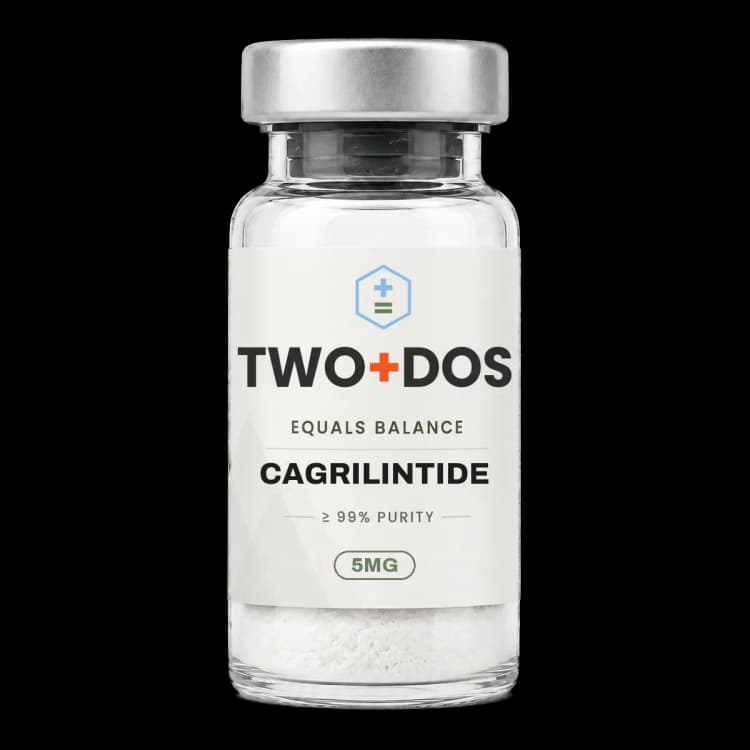
Chemical and physical properties of Cagrilintide
| Peptide class | Lipidated 37-residue amylin analogue with a C-terminal prolinamide |
|---|---|
| Molecular formula | C194H312N54O59S2 (free peptide) |
| Molecular weight | 4409 g/mol; exact mass 4408.258 Da; monoisotopic 4406.252 Da |
| CAS number | 1415456-99-3 (free peptide). The acetate salt is a separate PubChem record, CID 164618153. |
| PubChem CID | 171397054 (free peptide) |
| InChIKey | LDERDVMBIYGIOI-IZVMHKDJSA-N |
| Disulfide bridge | One intramolecular bridge between the two cysteine residues near the N-terminus |
| Lipidation | N-terminally acylated with a gamma-glutamate linker and a C20 fatty diacid (eicosanedioic acid) |
| Backbone substitutions | A25P, S28P and S29P (the pramlintide backbone), plus the helix-stabilizing pair N14E and V17R, and Y37P |
| Computed polarity descriptors | XLogP -12.5; topological polar surface area 1880 square angstroms; 60 hydrogen-bond donors; 137 rotatable bonds; 309 heavy atoms (PubChem computed) |
| Reported purity and form | Supplied as a solid at 98 percent or higher purity by HPLC per supplier specifications |
What is cagrilintide?
Cagrilintide is a synthetic analogue of human amylin, a 37-residue pancreatic peptide hormone. It was developed by Kruse and colleagues as compound 23 in a medicinal-chemistry series published in 2021, selected as a stable, lipidated, long-acting analogue. The design problem their paper describes is specific: native human amylin has a high propensity toward amyloid fibril formation, which makes it difficult to work with as a stable molecule.
The molecule sits on the pramlintide backbone, which carries proline substitutions at positions 25, 28 and 29. Cagrilintide adds further changes, and the structural literature is explicit about their purpose. Cao and colleagues state that a pair of helix-stabilizing substitutions, N14E and V17R, were incorporated specifically to counteract the amyloid fibril formation seen with human amylin. Position 37 carries proline in place of the tyrosine found in rat amylin.
The other defining structural feature is lipidation. The peptide is acylated at its N-terminus with a gamma-glutamate linker connected to a C20 fatty diacid. Fatty-acid conjugation of this kind is a well-established approach to extending circulating half-life through albumin association, and it is the feature that distinguishes cagrilintide from shorter-acting amylin analogues.
Which receptors does cagrilintide activate?
Cagrilintide is a non-selective agonist across the calcitonin receptor family. That family comprises the calcitonin receptor itself and the three amylin receptors, which are not separate gene products but heterodimers formed when the calcitonin receptor associates with one of three receptor activity-modifying proteins, RAMP1, RAMP2 or RAMP3, yielding AMY1R, AMY2R and AMY3R respectively.
Fletcher and colleagues profiled the pharmacology across 25 endpoints spanning receptor binding, activation and regulation, comparing cagrilintide against rat amylin, human calcitonin, salmon calcitonin, pramlintide and two other lipidated analogues. Their published conclusion was that the compound has a unique pharmacological profile across those diverse measures relative to every comparator tested, and their significance statement describes it as a novel non-selective agonist of calcitonin family receptors.
Because it engages both receptor classes, the compound is also classified in the literature as a dual amylin and calcitonin receptor agonist. Comparative work has shown that different molecules in this class differ in their balance between the two receptor types, meaning receptor selectivity ratio is itself a measurable property that distinguishes analogues rather than a fixed class characteristic.
Two later papers refine that picture from opposite directions. Gostynska and colleagues reported in 2025 that the calcitonin receptor and the RAMP subunits sit in a measurable association equilibrium rather than existing as fixed heterodimers, that peptide agonists shift that equilibrium, and that the shift tracks with the extent of downstream cAMP signalling. Their result reframes the amylin receptors as assemblies whose composition is itself ligand-sensitive.
From the selectivity side, the 2025 discovery report on eloralintide sharpened the contrast. In cell-based assays that molecule preferentially activated the human AMY1 receptor, reported as 12-fold over the calcitonin receptor and 11-fold over AMY3R, and the same paper refers to cagrilintide as a non-selective amylin receptor agonist. Placing a selective analogue beside a non-selective one puts a number on how wide the selectivity range within this class actually is.
What did the cryo-EM structures show?
Cao and colleagues determined structures of cagrilintide bound to active, Gs-coupled receptor complexes at four receptors: the calcitonin receptor at 2.2 angstrom resolution, AMY1R at 2.2 angstroms, AMY2R at 2.7 angstroms and AMY3R at 3.0 angstroms. The peptide adopts an amylin-like binding mode but induces conformational dynamics at these receptors that differ from other peptides in the family.
Three specific structural findings are worth recording. First, an intramolecular salt bridge between glutamate 14 and arginine 17, the residues introduced by the helix-stabilizing substitutions, stabilizes the N-terminal alpha-helix. Second, residues 19 through 25 adopt what the authors term a bypass conformation, and at the calcitonin receptor roughly 85 percent of imaged particles were stabilized in that conformation versus about 8 percent in a calcitonin-like conformation. Third, proline 37 occupies the same extracellular-domain pocket that tyrosine 37 of rat amylin occupies, but makes no direct contacts with RAMP1 or RAMP3, whereas the bulkier tyrosine of rat amylin does form interactions with RAMP2 residues.
Density for the conjugated lipid was limited in the maps, so modelling was restricted to the gamma-glutamate linker and a short adjacent segment of the fatty diacid. A separate control is informative here: a non-lipidated version of the peptide showed similar potency and maximal response in cells co-expressing the calcitonin receptor with RAMP3, indicating the lipid contributes to circulating persistence rather than to receptor engagement itself.
An independent 2026 cryo-EM study by Gu and colleagues reached consistent conclusions, describing the same bypass binding mode across both receptor classes, identifying phenylalanine 23 and proline 37 as stabilizing peptide positioning, and confirming the E14-R17 salt bridge as a contributor to helical stability.
How was the compound characterized dynamically?
Beyond static structures, the 2025 work applied three-dimensional variability analysis to the cryo-EM particle sets and molecular dynamics simulation to the complexes. Both approaches converged on the same observation: complexes with cagrilintide showed greater extracellular conformational motion than the equivalent complexes with rat amylin.
The measured motion is substantial for a receptor extracellular domain. RAMP3 extracellular-domain movement of approximately 7 angstroms was reported at the alpha-carbon of glutamate 123. Six microseconds of molecular dynamics simulation comparing cagrilintide and rat amylin at the AMY3R complex reproduced the greater extracellular-domain motion seen in the experimental data.
A 2026 study by Fairweather and colleagues approached receptor dynamics from the ligand-free side using hydrogen-deuterium exchange mass spectrometry, mapping the conformational flexibility of the calcitonin receptor on its own and paired with each of the three RAMPs. The three RAMPs were reported to influence the flexibility of the receptor extracellular domain, the transmembrane helices and the intracellular regions involved in G protein engagement to different extents, with each RAMP showing its own dynamic signature in its transmembrane and C-terminal regions. That work supplies a ligand-free baseline against which the agonist-bound motion described above can be read.
Coordinates and maps from that work are publicly deposited, which makes the findings independently examinable. Structures are available in the Protein Data Bank under accession codes including 9BP3, 9BLW, 9BQ3 and 9BTW, with corresponding density maps in the Electron Microscopy Data Bank.
What are the practical identity considerations?
Two identity issues matter when sourcing or documenting this compound. The first is salt form. The free peptide and the acetate salt are separate chemical entities with separate PubChem records, CID 171397054 and CID 164618153 respectively, and the free peptide CAS number 1415456-99-3 does not describe the acetate. Documentation should specify which form the material is.
The second is naming. The compound appears in the literature under at least four designations: cagrilintide, AM833, NN0174-0833, and as compound 23 in its originating medicinal-chemistry paper. A literature search on the common name alone will miss the discovery and pharmacology work published under the development codes.
On solubility, supplier specifications describe the acetate as slightly soluble in DMSO at 0.1 to 1 mg/mL and sparingly soluble in phosphate-buffered saline at pH 7.2 at 1 to 10 mg/mL, with one supplier listing 10 millimolar in DMSO. These are supplier specifications rather than published measurements. The computed descriptors, an XLogP of minus 12.5 and a topological polar surface area of 1880 square angstroms, are consistent with a highly polar lipopeptide.
A third consideration is analytical. Alhalabi and colleagues published in 2026 what they describe as the first systematic in vitro metabolic profiling of this molecule alongside pramlintide and KBP-066, using human skin S9 fraction, kidney S9 fraction and biological fluids, and cross-checking the predicted products against authentic rat samples. All three peptides underwent N-terminal and C-terminal degradation to multiple stable products, and validated LC-MS/MS methods were established for those products. For anyone documenting material identity or tracking degradation, that paper is the first published set of characteristic fragments for the compound.
Summary of published research
Findings below are reported as published by the cited authors, in the model systems they used. They describe laboratory research, and none of them characterize use in humans.
Kruse T, Hansen JL, Dahl K, Schaffer L, Sensfuss U, Poulsen C, Schlein M, Hansen AMK, Jeppesen CB, et al. Development of Cagrilintide, a Long-Acting Amylin Analogue. Journal of Medicinal Chemistry (2021)
- Model system
- Medicinal chemistry and structure-activity study; synthetic peptide analogue series
- Conditions
- Analogue series screened in receptor activation assays with physical-stability characterization
- Reported finding
- The paper reports the design and selection of the compound, identified as analogue 23 in the series, as a stable lipidated long-acting amylin analogue. The authors describe the high propensity of amylin toward amyloid fibril formation as the central design challenge the series addressed.
Fletcher MM, Keov P, Truong TT, Mennen G, Hick CA, Zhao P, Furness SGB, Kruse T, Clausen TR, Wootten D, Sexton PM. AM833 Is a Novel Agonist of Calcitonin Family G Protein-Coupled Receptors: Pharmacological Comparison with Six Selective and Nonselective Agonists. Journal of Pharmacology and Experimental Therapeutics (2021)
- Model system
- Cell-based recombinant receptor pharmacology across AMY1R, AMY2R, AMY3R and the calcitonin receptor
- Conditions
- 25 endpoints spanning receptor binding, activation and regulation; comparators rat amylin, human calcitonin, salmon calcitonin, pramlintide, AM1213 and AM1784
- Reported finding
- The compound was characterized as a non-selective agonist of calcitonin family receptors, with a pharmacological profile across the measured endpoints that differed from every comparator peptide tested.
Cao J, Belousoff MJ, Johnson RM, Keov P, Mariam Z, Deganutti G, Christopoulos G, Hick CA, Reedtz-Runge S, Glendorf T, et al. Structural and dynamic features of cagrilintide binding to calcitonin and amylin receptors. Nature Communications (2025)
- Model system
- Cell-free cryo-electron microscopy of purified receptor-Gs complexes, with 3D variability analysis and molecular dynamics simulation
- Conditions
- Structures at 2.2 angstroms (calcitonin receptor and AMY1R), 2.7 angstroms (AMY2R) and 3.0 angstroms (AMY3R); 6 microseconds of molecular dynamics on the AMY3R complex
- Reported finding
- The peptide adopted an amylin-like binding mode while inducing distinct conformational dynamics. An E14-R17 intramolecular salt bridge stabilized the N-terminal helix, residues 19 to 25 adopted a bypass conformation representing about 85 percent of calcitonin receptor particles, and proline 37 occupied the extracellular-domain pocket without contacting RAMP1 or RAMP3. Extracellular-domain motion of about 7 angstroms was measured at RAMP3.
Gu YM, Yuan QN, Li X, He Q, Xu HE, Zhao LH. Structural and mechanistic insights into dual activation of cagrilintide in amylin and calcitonin receptors. Acta Pharmacologica Sinica (2026)
- Model system
- Cell-free cryo-electron microscopy of amylin receptor and calcitonin receptor complexes
- Conditions
- Independent structural determination across both receptor classes
- Reported finding
- The compound was characterized as a dual amylin and calcitonin receptor agonist, with a distinctive bypass binding mode in both receptor classes, phenylalanine 23 and proline 37 stabilizing peptide positioning, and an E14-R17 intramolecular salt bridge enhancing helical stability.
Larsen AT, Mohamed KE, Sonne N, Bredtoft E, Andersen F, Karsdal MA, Henriksen K. Does receptor balance matter? Comparing the efficacies of the dual amylin and calcitonin receptor agonists cagrilintide and KBP-336 on metabolic parameters in preclinical models. Biomedicine and Pharmacotherapy (2022)
- Model system
- In vitro receptor-specific assays with comparison against a salmon-calcitonin-derived analogue
- Conditions
- Receptor-specific potency assays comparing an amylin-backbone analogue against a calcitonin-backbone analogue
- Reported finding
- Both peptides activated the amylin receptor and the calcitonin receptor. The comparator KBP-336 was reported as more potent and as showing a bias toward the calcitonin receptor, establishing that analogues within this class differ measurably in their balance between the two receptor types.
Gostynska SE, Karim JA, Ford BE, Gordon PH, Babin KM, Inoue A, Lambert NA, Pioszak AA. Amylin receptor subunit interactions are modulated by agonists and determine signaling. Science Signaling (2025)
- Model system
- Biochemical subunit-association assay with G protein coupling and cAMP accumulation readouts
- Conditions
- Calcitonin receptor paired with RAMP1, RAMP2 or RAMP3; peptide agonists including rat amylin, alpha-CGRP, human calcitonin and salmon calcitonin
- Reported finding
- The three amylin receptors were reported to have distinct basal subunit equilibria rather than behaving as fixed heterodimers. Peptide agonists shifted those equilibria, and the direction of the shift differed between agonists, with the resulting changes tracking the extent of cAMP signalling downstream of receptor activation.
Fairweather CJ, Zhang X, Fernando CD, Garama DJ, Sexton PM, Wootten D, Josephs TM. Conformational Dynamics of Amylin Receptors Revealed by Hydrogen-Deuterium Exchange Mass Spectrometry. Journal of the American Chemical Society (2026)
- Model system
- Hydrogen-deuterium exchange mass spectrometry on purified calcitonin receptor alone and in complex with each RAMP
- Conditions
- Apo, ligand-free state; comparison of the calcitonin receptor against each of the three RAMP-paired amylin receptors
- Reported finding
- The three RAMPs differentially influenced the flexibility of key calcitonin receptor regions, including the extracellular domain, the transmembrane helices and the intracellular regions involved in G protein engagement. Each RAMP showed a subtype-specific dynamic signature, particularly in its transmembrane and C-terminal regions, giving a ligand-free dynamic framework to sit alongside the static active-state structures.
Briere DA, Qu H, Lansu K, He MM, Moyers JS, Coskun T, Long A, Allen D, O'Farrell L, Bowen B, et al. Eloralintide (LY3841136), a novel amylin receptor agonist for the treatment of obesity: From discovery to clinical proof of concept. Molecular Metabolism (2025)
- Model system
- Cell-based receptor activation assays in lines expressing rat and human amylin and calcitonin receptors
- Conditions
- Comparative activation profiling of a selective amylin analogue against non-selective comparators
- Reported finding
- The selective analogue preferentially activated the human AMY1 receptor, reported as 12-fold over the calcitonin receptor and 11-fold over AMY3R. The same paper describes cagrilintide as a non-selective amylin receptor agonist, which places a quantitative bracket on the selectivity range achievable within this peptide class.
Gabery S, Glendorf T, Ballarin-Gonzalez B, Pedersen K, Kruse T, Raun K, Kuhre RE. Characterization of 0839 - A tool compound for pre-clinical mode-of-action studies of amylin analogues such as cagrilintide. Life Sciences (2025)
- Model system
- Peptide chemistry and comparative characterization of a rodent research tool compound
- Conditions
- Sequence and acylation comparison of the tool compound 0839 against cagrilintide, designated 0833
- Reported finding
- The tool compound was reported to share 95 percent sequence homology with cagrilintide and to carry an identical acylation sidechain. The authors state that it is obtainable through the originator's compound-sharing program, which matters because access to cagrilintide itself for mechanistic research is restricted under pharmacovigilance requirements.
Alhalabi H, Borschel L, Le Foll C, Thomas A, Bally L, Thevis M. In vitro metabolic profiling of weight-loss-inducing amylin receptor agonists in the context of preventive doping research. Journal of Pharmaceutical and Biomedical Analysis (2026)
- Model system
- In vitro biotransformation study using human skin S9 fraction, kidney S9 fraction and biological fluids, with confirmation in authentic rat samples
- Conditions
- Three amylin receptor agonists profiled in parallel: pramlintide, cagrilintide and KBP-066
- Reported finding
- All three peptides underwent N-terminal and C-terminal degradation, yielding multiple stable products suitable as analytical markers. Products predicted from the in vitro work were detected in authentic rat samples, and validated LC-MS/MS methods were established. The authors describe this as the first systematic metabolic investigation of these three compounds.
What handling information is published?
Storage and solubility figures for this compound come from supplier specifications rather than from peer-reviewed measurement. Suppliers specify storage of the solid at minus 20 degrees Celsius, with one listing 12 months at that temperature or 6 months at 4 degrees Celsius for the powder, and 6 months at minus 80 or minus 20 degrees Celsius in solvent. Solubility is described as 0.1 to 1 mg/mL in DMSO and 1 to 10 mg/mL in phosphate-buffered saline at pH 7.2.
One property of the parent hormone is directly relevant to laboratory work with any amylin analogue. Native human amylin aggregates readily into amyloid fibrils, which is the stability problem the whole analogue series was designed around. The N14E and V17R substitutions in this molecule were introduced specifically to stabilize the helix against that behavior, so the analogue is expected to be more tractable in solution than the native hormone.
For researchers working on mode of action, one practical note appears in the literature itself: a dedicated rodent tool compound sharing 95 percent sequence homology and an identical acylation sidechain was developed and described in 2025, because availability of cagrilintide for research is restricted under pharmacovigilance rules. Gabery and colleagues designate that tool compound 0839 and cagrilintide itself 0833, and state that 0839 is obtainable through the originator's compound-sharing program.
Frequently asked research questions
What receptors does cagrilintide bind?
All three amylin receptors, AMY1R, AMY2R and AMY3R, plus the calcitonin receptor itself. The amylin receptors are heterodimers of the calcitonin receptor with receptor activity-modifying proteins RAMP1, RAMP2 or RAMP3. Published pharmacology characterizes the compound as a non-selective agonist across this receptor family.
How does cagrilintide differ from native human amylin?
It carries the pramlintide proline substitutions at positions 25, 28 and 29, a helix-stabilizing pair at N14E and V17R introduced to counter amyloid fibril formation, proline at position 37, and N-terminal acylation with a gamma-glutamate linker joined to a C20 fatty diacid.
What does the lipidation contribute?
Circulating persistence rather than receptor engagement. Structural work found limited density for the lipid, and a non-lipidated control version showed similar potency and maximal response in cells co-expressing the calcitonin receptor with RAMP3, indicating the fatty diacid is not required for receptor activation itself.
Are structural coordinates publicly available?
Yes. The 2025 cryo-EM structures are deposited in the Protein Data Bank under accession codes including 9BP3, 9BLW, 9BQ3 and 9BTW, with corresponding maps in the Electron Microscopy Data Bank. That makes the reported binding modes independently examinable rather than dependent on the published figures.
Cagrilintide at TWO+DOS
TWO+DOS supplies Cagrilintide as a research-use-only compound, third-party tested, with certificates of analysis emailed immediately on request.
View the Cagrilintidelisting →Related research overviews
References
- PubChem CID 171397054: formula, mass, InChIKey and computed descriptors
- PubChem CID 164618153: the acetate salt record
- Guide to PHARMACOLOGY ligand 13768
- Kruse et al. 2021, Journal of Medicinal Chemistry (PMID 34288673)
- Fletcher et al. 2021, JPET: receptor pharmacology profile (PMID 33727283)
- Cao et al. 2025, Nature Communications: cryo-EM structures (PMID 40204768)
- Gu et al. 2026, Acta Pharmacologica Sinica (PMID 40847076)
- Larsen et al. 2022, Biomedicine and Pharmacotherapy (PMID 36242844)
- Gostynska et al. 2025, Science Signaling: amylin receptor subunit equilibria (PMID 40828907)
- Fairweather et al. 2026, Journal of the American Chemical Society: HDX-MS of calcitonin receptor and RAMP complexes (PMID 41991490)
- Briere et al. 2025, Molecular Metabolism: comparative amylin receptor selectivity (PMID 41109426)
- Gabery et al. 2025, Life Sciences: rodent tool compound 0839 (PMID 40628316)
- Alhalabi et al. 2026, Journal of Pharmaceutical and Biomedical Analysis: in vitro metabolite profiling (PMID 41702251)
For research use only. Not for human or veterinary use. Not for diagnostic or therapeutic use.