
MT-II (Melanotan II): Melanocortin Receptor Pharmacology and Structure
By the TWO+DOS Research Team · Published 2026-08-13
For research use only. Not for human or veterinary use. Not for diagnostic or therapeutic use.
MT-II, also written melanotan II, is a synthetic cyclic heptapeptide analog of α-melanocyte-stimulating hormone with the sequence Ac-Nle-cyclo[Asp-His-D-Phe-Arg-Trp-Lys]-NH2 and PubChem CID 92432. A 23-membered lactam macrocycle constrains the His-Phe-Arg-Trp recognition motif into a rigid conformation that four of the five melanocortin receptor subtypes bind with nanomolar or subnanomolar potency.
This overview assembles what the peer-reviewed record establishes about the molecule as a chemical and pharmacological entity: identifiers verified against PubChem, the lactam design programme that produced the scaffold, published potency across MC1R, MC3R, MC4R and MC5R, the structural biology that now shows how the receptor family reads the shared recognition motif, and the chromatographic and mass-spectrometric methods used to confirm identity, content and purity. Material described on this page is offered strictly for laboratory research use.
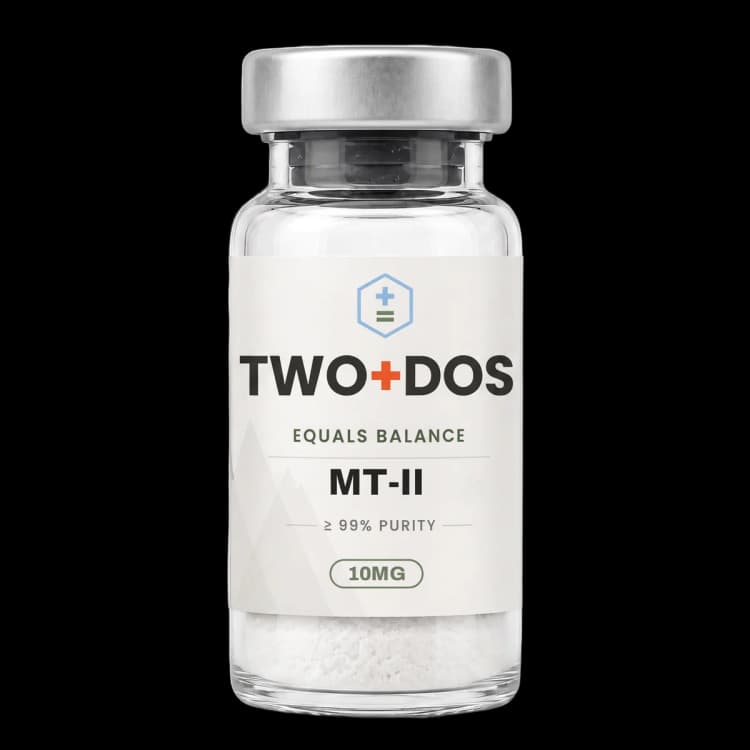
Chemical and physical properties of MT-II
| Compound class | Synthetic cyclic heptapeptide analog of α-melanocyte-stimulating hormone (α-MSH) |
|---|---|
| Macrocycle | 23-membered lactam ring closed between an aspartate side-chain carboxyl and a lysine side-chain amine |
| Recognition motif | His-Phe-Arg-Trp (HFRW), the four-residue core shared by α-MSH, β-MSH, γ-MSH and ACTH |
| Changes relative to α-MSH | Norleucine replaces methionine at position 4, D-phenylalanine replaces L-phenylalanine at position 7, and residues 4-10 are cyclized |
| Monoisotopic mass | 1023.5403 Da (PubChem CID 92432) |
| Diagnostic mass-spectrometric ion | Doubly protonated precursor at m/z 513, used in published LC-MS/MS confirmation methods |
| Computed XLogP | 0 (PubChem), consistent with a polar macrocycle rather than a membrane-partitioning solid |
| Topological polar surface area | 385 Ų (PubChem computed) |
| Hydrogen bonding | 13 donors and 11 acceptors (PubChem computed) |
| Rotatable bonds | 17 (PubChem computed), low for a heptapeptide because cyclization removes backbone freedom |
| Receptor coverage | Agonist at MC1R, MC3R, MC4R and MC5R; MC2R responds to ACTH and requires the accessory protein MRAP1 |
What is MT-II and how does its structure differ from α-MSH?
MT-II derives from α-melanocyte-stimulating hormone, a 13-residue neuropeptide carrying the sequence Ac-Ser-Tyr-Ser-Met-Glu-His-Phe-Arg-Trp-Gly-Lys-Pro-Val-NH2. Three changes produce the analog: methionine at position 4 becomes norleucine, L-phenylalanine at position 7 becomes D-phenylalanine, and a lactam bridge joins an aspartate side chain at position 5 to a lysine side chain at position 10.
Truncation accompanies those substitutions. The parent hormone is cut back to residues 4 through 10, leaving a seven-residue chain whose two side chains are then amide-linked to close a ring. Al-Obeidi and colleagues prepared seven such cyclic lactams in 1989 and bioassayed them in amphibian and reptilian skin preparations, reporting that the aspartate-lysine pairing gave a 23-membered ring roughly 90 to 100 times more potent than α-MSH, and that both enlarging and shrinking the ring away from 23 atoms reduced potency. The 23- and 24-membered analogs also showed prolonged residual activity where the 20-, 21- and 22-membered rings did not.
PubChem records the resulting molecule under CID 92432 with the formula C50H69N15O9, a molecular weight of 1024.2 g/mol and a monoisotopic mass of 1023.5403 Da. Computed descriptors describe a large, strongly polar macrocycle: topological polar surface area 385 Ų, 13 hydrogen bond donors, 11 acceptors, 17 rotatable bonds and an XLogP of 0. The registry number 121062-08-6 covers the peptide itself; commercial solids are usually salts, most often the acetate.
Nomenclature causes recurring confusion. MT-II is a cyclic seven-residue molecule; afamelanotide, sometimes called melanotan-1, is a linear 13-residue α-MSH peptidomimetic carrying the same norleucine and D-phenylalanine substitutions with no cyclization at all. The two differ in mass, formula and registry number, and results reported for one do not transfer to the other.
How does MT-II interact with the melanocortin receptor family?
MT-II presents the His-Phe-Arg-Trp tetrapeptide core that every melanocortin receptor recognizes, held in a constrained ring rather than a flexible chain. Published binding and functional work places the analog at MC1R, MC3R, MC4R and MC5R with nanomolar or better potency, while MC2R, which requires ACTH together with the accessory protein MRAP1, sits outside its range.
Structural work has made that motif concrete. Ma and colleagues reported three cryo-electron microscopy structures of MC1R coupled to heterotrimeric Gs in 2021, resolving a wide-open orthosteric pocket that accommodates the conserved HFRW sequence and identifying a calcium ion as an integral part of the ligand-binding site. The same study described an unexpected contact surface involving the Gβ subunit, a feature not typical of class A receptor complexes.
The calcium finding had emerged a year earlier at a different subtype. Yu and colleagues determined the crystal structure of human MC4R bound to the cyclic antagonist SHU9119 at 2.8 Å resolution and showed that a divalent calcium ion is complexed by residues contributed jointly by the receptor and the peptide. Extracellular calcium raised the affinity of α-MSH at MC4R by 37-fold and its potency by 600-fold, which reframed a decade of binding data collected without controlled divalent ion concentrations.
MC2R is the family exception and the reason MT-II selectivity discussions normally cover four subtypes rather than five. That receptor recognizes ACTH and depends on MRAP1 for trafficking and activation, so α-MSH-derived macrocycles are not part of its pharmacology. Selectivity questions for MT-II therefore concern the spread between MC1R, MC3R, MC4R and MC5R, not the full set.
What potency values are published for MT-II across the subtypes?
MT-II potency figures published across the melanocortin subtypes cluster in the subnanomolar to low-nanomolar band, with the widest spread appearing at the human receptors. A 2024 survey of melanocortin tool compounds compiled literature values at mouse MC1R, MC3R, MC4R and MC5R and at their human counterparts, showing how much the number depends on assay format and expression system.
At the mouse receptors the compiled ranges are tight. Weirath and Haskell-Luevano list half-maximal effective concentrations of 0.020 to 0.06 nM at mouse MC1R, 0.011 to 0.18 nM at mouse MC3R, 0.083 to 0.15 nM at mouse MC4R and 0.14 to 0.17 nM at mouse MC5R. Values in that compilation come predominantly from HEK293 lines stably expressing a single recombinant subtype and read out by cyclic AMP accumulation.
Human receptor figures scatter far more widely: 0.032 to 0.30 nM at MC1R, 0.20 to 34 nM at MC3R, 0.011 to 8.6 nM at MC4R and 2.8 to 34 nM at MC5R. Three orders of magnitude separate the extremes at MC3R and MC4R. Anyone comparing a single quoted value against another laboratory's number is comparing assay conditions as much as molecules, which is exactly why the survey was assembled as a reference set.
Aggregated affinity data in the IUPHAR/BPS Guide to Pharmacology follow the same rank ordering, listing MT-II as a full agonist with pIC50 values of 9.4 at MC1 and 9.0 at MC5, and pKi values of 8.3 at MC3 and 8.2 to 8.8 at MC4. MC1R sits highest in essentially every dataset; the practical point is that the separation between subtypes is under two log units, which is not enough to call the molecule selective.
Why does the 23-membered lactam ring matter for selectivity?
MT-II binds all four responsive melanocortin subtypes with high potency and discriminates poorly among them, which is precisely what made its macrocyclic scaffold useful to medicinal chemists. Ring size, ring chemistry and the identity of the position-7 aromatic residue have each been varied against the same template to build subtype-preferring ligands.
The most consequential single change is at position 7. Replacing D-phenylalanine with the bulkier D-2-naphthylalanine, while keeping the identical lactam cyclization, converts the agonist scaffold into SHU9119, a compound that behaves as an antagonist at MC3R and MC4R. One aromatic substitution flips functional direction without touching the ring, which is why SHU9119 appears alongside MT-II in almost every melanocortin structure-activity paper as the paired control.
Ring dimension has been revisited with modern chemistry. Merlino and colleagues designed and synthesized 14 macrocyclic peptide analogs spanning 19- to 23-membered rings, built on the MT-II, SHU-9119 and PG-901 scaffolds, and profiled them at human MC1R, MC3R, MC4R and MC5R. Two compounds, FM648 and FM636, emerged as potent and selective hMC4R antagonists, and a third, FM635, showed agonist activity with pronounced selectivity for the same subtype. Contracting the ring below the 23 atoms that Al-Obeidi identified is therefore not simply destructive; it redistributes subtype preference.
Alternative macrocyclization chemistries have also been tested against this template. Todorovic and colleagues condensed a 5-hydroxypyrroloindoline with either a cysteine thiol or a tryptophan indole to form tryptathionine and 2,2'-bis-indole staples, motifs borrowed from amatoxins and staurosporine, and applied the chemistry to α-MSH and to melanotan-II. Both classes of stapled peptide retained nanomolar inhibition constants, with one construct reaching a sub-nanomolar value, showing that the lactam is one solution to conformational constraint rather than the only one.
What have recent structural and signaling studies added?
MT-II research now sits inside a structural literature that did not exist a decade ago. Cryo-electron microscopy and crystallography have resolved all five human melanocortin receptors in complex with heterotrimeric Gs, in ligand-bound and unliganded states, giving the constrained macrocycle a concrete binding pocket rather than an inferred pharmacophore model.
Subtype discrimination was addressed directly in 2023. Feng and colleagues reported three cryo-electron microscopy structures, MC3R-Gs bound to γ-MSH and MC5R-Gs bound to either α-MSH or the synthetic agonist PG-901. Both endogenous peptides adopt a U-shaped conformation, penetrate a wide-open orthosteric pocket and form extensive shared contacts through the HFRW motif. Selectivity was traced to the peptide C-terminus: that of γ-MSH occupies an MC3R-specific complementary groove, whereas the α-MSH C-terminus contributes negligible contact. PG-901 matches α-MSH potency at shorter length by cyclizing to mimic an intramolecular salt bridge, the same logic that produced MT-II.
Basal receptor behaviour was mapped in 2025. Feng and colleagues determined unliganded structures of MC1R, MC2R, MC3R, MC4R and MC5R with Gs at global resolutions of 2.98, 3.01, 2.75, 3.12 and 2.86 Å, and found binding poses and Gs interactions closely resembling agonist-bound states. Extracellular helix ends differed, with variable shifts of transmembrane helix 3 and outward displacement of helix 4. The study also reported that zinc, but not calcium, positively regulated MC4R activity in a concentration-dependent fashion, adding a second divalent ion to the picture.
Signaling readouts have grown more granular alongside the structures. Dai and colleagues examined SHU9119 and MBP10 at wild-type human MC4R and at six naturally occurring constitutively active variants, reporting that both peptides produced no or negligible Gαs-cyclic AMP agonism yet stimulated ERK1/2 phosphorylation. Mechanisms diverged: SHU9119 acted through phosphatidylinositol 3-kinase, MBP10 through both PI3K and β-arrestin. The authors classify SHU9119 as a biased ligand and MBP10 as a biased allosteric modulator, meaning a compound scored inactive on a cyclic AMP assay may be active on another branch.
How is MT-II identified and quantified in analytical work?
MT-II identification in published analytical work rests on three orthogonal measurements: chromatographic retention on a reversed-phase column, ultraviolet absorbance from its tryptophan and histidine residues, and accurate-mass detection of the doubly protonated molecular ion near m/z 513. Method papers combine all three because no single one is specific enough alone.
Breindahl and colleagues developed and validated exactly that combination, using liquid chromatography with ultraviolet detection at 218 nm and tandem mass spectrometry after collision-induced fragmentation of the doubly charged precursor at m/z 513, with identity confirmed by retention time plus the relative abundance ratios of five qualifier fragment ions. Applied to vials from three online vendors, the method found unknown impurities of 4.1 to 5.9 percent in material from two of them and total content between 4.32 and 8.84 mg where every vendor declared 10 mg. Label declaration and measured content are separate quantities.
Distribution work has used imaging mass spectrometry. Chen and colleagues took the molecule as a proof-of-concept cyclic peptide and paired matrix-assisted laser desorption/ionization imaging with droplet-based liquid microjunction surface sampling coupled to high-resolution LC-MS, mapping distribution in tissue while profiling structural information on parent and metabolite species.
Degradation chemistry for this peptide class has been characterized on the linear analog. Chawathe and Sharma subjected afamelanotide to acidic, basic, neutral, oxidative, photolytic and 60 °C thermal stress under ICH Q1A(R2) and Q5C, separated fourteen distinct degradation products by gradient reversed-phase HPLC on a Zorbax SB C18 column (300 Å, 4.6 × 150 mm, 3.5 µm) and characterized them by UHPLC coupled to high-resolution tandem mass spectrometry. Truncation, methylation, deacetylation and oxidation were among the pathways identified.
Summary of published research
Findings below are reported as published by the cited authors, in the model systems they used. They describe laboratory research, and none of them characterize use in humans.
Al-Obeidi F, Castrucci AM, Hadley ME, Hruby VJ. Potent and prolonged acting cyclic lactam analogues of alpha-melanotropin: design based on molecular dynamics. Journal of Medicinal Chemistry (1989)
- Model system
- amphibian and reptilian skin bioassay (Rana pipiens, Anolis carolinensis)
- Conditions
- seven cyclic lactam analogs of α-MSH residues 4-10 and 4-13, varying the bridging residues (Glu or Asp paired with Lys, Orn, Dab or Dpr) across ring sizes of 20 to 24 atoms
- Reported finding
- Cyclic melanotropins built on a 23-membered ring reached roughly 90- to 100-fold the potency of α-MSH in the lizard skin assay, and both increasing and decreasing ring size away from 23 atoms reduced potency; the 23- and 24-membered analogs alone showed prolonged residual activity in both assay systems.
Breindahl T, Evans-Brown M, Hindersson P, McVeigh J, Bellis M, Stensballe A, Kimergård A. Identification and characterization by LC-UV-MS/MS of melanotan II skin-tanning products sold illegally on the Internet. Drug Testing and Analysis (2015)
- Model system
- cell-free analytical chemistry (vialed material from three online vendors)
- Conditions
- validated liquid chromatography with ultraviolet detection at 218 nm and tandem mass spectrometry of the doubly charged precursor at m/z 513, identity confirmed by retention time and five qualifier fragment ion ratios
- Reported finding
- Vials from two vendors carried unknown impurities of 4.1 to 5.9 percent while impurities from the third fell below the quantification limit, and total melanotan II content ranged from 4.32 to 8.84 mg against a uniform 10 mg declaration, establishing that declared and measured content diverge substantially in unverified material.
Chen B, Vavrek M, Gundersdorf R, Zhong W, Cancilla MT. Combining MALDI mass spectrometry imaging and droplet-base surface sampling analysis for tissue distribution, metabolite profiling, and relative quantification of cyclic peptide melanotan II. Analytica Chimica Acta (2020)
- Model system
- rodent tissue sections analyzed by label-free mass spectrometry
- Conditions
- matrix-assisted laser desorption/ionization mass spectrometry imaging run in parallel with droplet-based liquid microjunction surface sampling coupled to high-resolution liquid chromatography-mass spectrometry
- Reported finding
- The imaging technique mapped molecular distribution of melanotan II and its metabolites across tissue while droplet sampling supplied structural detail on parent and metabolite species; the authors reported that running both in parallel yielded a more complete dataset than either technique alone.
Yu J, Gimenez LE, Hernandez CC, Wu Y, Wein AH, Han GW, McClary K, Mittal SR, Burdsall K, Stauch B, Wu L, Stevens SN, Peisley A, Williams SY, Chen V, Millhauser GL, Zhao S, Cone RD, Stevens RC. Determination of the melanocortin-4 receptor structure identifies Ca2+ as a cofactor for ligand binding. Science (2020)
- Model system
- cell-free structural biology (X-ray crystallography) with cell-based pharmacology
- Conditions
- crystal structure of human MC4R bound to the cyclic lactam antagonist SHU9119 solved at 2.8 Å, with binding and functional assays run at controlled extracellular calcium concentrations
- Reported finding
- A calcium ion was resolved within the orthosteric site, complexed jointly by receptor residues and the peptide ligand; extracellular calcium increased α-MSH affinity at MC4R by 37-fold and its potency by 600-fold, and the crystallized construct coupled to the Kir7.1 channel while lacking cyclic AMP stimulation.
Ma S, Chen Y, Dai A, Yin W, Guo J, Yang D, Zhou F, Jiang Y, Wang MW, Xu HE. Structural mechanism of calcium-mediated hormone recognition and Gβ interaction by the human melanocortin-1 receptor. Cell Research (2021)
- Model system
- cell-free structural biology (cryo-electron microscopy of receptor-Gs complexes)
- Conditions
- three structures of human MC1R in complex with heterotrimeric Gs, bound to α-MSH, to the linear analog afamelanotide, or to the cyclic lactam SHU9119
- Reported finding
- The structures resolved a wide orthosteric pocket that reads the conserved HFRW motif shared across melanocortin peptides and established a calcium ion as integral to ligand binding, alongside an unusual interaction surface involving the Gβ subunit that the authors interpret as a general feature of melanocortin receptor activation.
Feng W, Zhou Q, Chen X, Dai A, Cai X, Liu X, Zhao F, Chen Y, Ye C, Xu Y, Cong Z, Li H, Lin S, Yang D, Wang MW. Structural insights into ligand recognition and subtype selectivity of the human melanocortin-3 and melanocortin-5 receptors. Cell Discovery (2023)
- Model system
- cell-free structural biology (cryo-electron microscopy of receptor-Gs complexes)
- Conditions
- MC3R-Gs bound to γ-MSH, and MC5R-Gs bound to either α-MSH or the cyclic synthetic agonist PG-901, with parallel assays of divalent ion modulation
- Reported finding
- Both endogenous peptides adopted a U-shaped conformation and formed extensive shared contacts through the HFRW motif, with subtype discrimination traced to the C-terminus: the γ-MSH tail occupies an MC3R-specific complementary groove while the α-MSH tail makes negligible contact; PG-901 matched α-MSH potency at shorter length by cyclizing to reproduce an intramolecular salt bridge, and calcium density was resolved in both receptors.
Weirath NA, Haskell-Luevano C. Recommended Tool Compounds for the Melanocortin Receptor (MCR) G Protein-Coupled Receptors (GPCRs). ACS Pharmacology & Translational Science (2024)
- Model system
- review and comparative compilation of recombinant receptor pharmacology
- Conditions
- literature potency values for melanocortin reference ligands including NDP-MSH, MTII and SHU9119, drawn largely from HEK293 lines stably expressing a single mouse or human subtype with cyclic AMP readout
- Reported finding
- Compiled half-maximal effective concentrations for MTII were 0.020-0.06 nM at mouse MC1R, 0.011-0.18 nM at mouse MC3R, 0.083-0.15 nM at mouse MC4R and 0.14-0.17 nM at mouse MC5R, against far wider human ranges of 0.032-0.30, 0.20-34, 0.011-8.6 and 2.8-34 nM respectively; the review also records that MTII retained full activity after 60 minutes of peptidase exposure.
Todorovic M, Blanc A, Wang Z, Lozada J, Froelich J, Zeisler J, Zhang C, Merkens H, Bénard F, Perrin DM. 5-Hydroxypyrroloindoline Affords Tryptathionine and 2,2'-bis-Indole Peptide Staples: Application to Melanotan-II. Chemistry - A European Journal (2024)
- Model system
- synthetic chemistry with cell-free receptor binding assays
- Conditions
- condensation of a 5-hydroxypyrroloindoline with a cysteine thiol or a tryptophan indole to install tryptathionine or 2,2'-bis-indole staples, applied chemoselectively to α-MSH and to the melanotan-II scaffold
- Reported finding
- Both stapled peptide classes retained nanomolar inhibition constants at melanocortin receptors and one construct reached a sub-nanomolar value, indicating that natural-product-derived staples can substitute for the aspartate-lysine lactam as the conformational constraint without loss of affinity.
Dai HC, Ji RL, Tao YX. SHU9119 and MBP10 are biased ligands at the human melanocortin-4 receptor. Biochemical Pharmacology (2024)
- Model system
- cell line (HEK293 expressing wild-type and six naturally occurring constitutively active human MC4R variants)
- Conditions
- parallel measurement of Gαs-cyclic AMP signaling and ERK1/2 phosphorylation, with pathway dissection using phosphatidylinositol 3-kinase inhibition and β-arrestin manipulation
- Reported finding
- Both cyclic lactam antagonists produced no or negligible cyclic AMP agonism at wild-type MC4R yet stimulated ERK1/2 activation at wild-type and mutant receptors, with SHU9119 acting through PI3K and MBP10 through both PI3K and β-arrestin; the authors classify SHU9119 as a biased ligand and MBP10 as a biased allosteric modulator.
Feng W, Zhou Q, Zheng C, Yang D, Wang MW. Structural basis for the constitutive activity of the melanocortin receptor family. Structure (2025)
- Model system
- cell-free structural biology (cryo-electron microscopy) with cell-based ion modulation assays
- Conditions
- unliganded MC1R, MC2R, MC3R, MC4R and MC5R in complex with Gs, plus divalent ion titration at MC4R
- Reported finding
- Global resolutions of 2.98, 3.01, 2.75, 3.12 and 2.86 Å were obtained for MC1R through MC5R, with binding poses and Gs interactions resembling agonist-bound states and distinct extracellular rearrangements involving shifted transmembrane helix 3 and outward displacement of helix 4; zinc ions, but not calcium, positively regulated MC4R activity in a concentration-dependent fashion.
Merlino F, Jia L, Boccino I, Carotenuto A, Tammaro F, Santoro F, Thompson PE, Grieco P. Goldilocks-Inspired Design of Mid-Size Macrocycles for Selective Targeting of Human Melanocortin Receptors. Journal of Medicinal Chemistry (2026)
- Model system
- synthetic chemistry with recombinant human receptor pharmacology
- Conditions
- 14 macrocyclic peptide analogs spanning 19- to 23-membered rings, designed on the MT-II, SHU-9119 and PG-901 scaffolds and profiled at human MC1R, MC3R, MC4R and MC5R
- Reported finding
- FM648 and FM636 emerged as potent and selective hMC4R antagonists while FM635 showed agonist activity with pronounced selectivity for the same subtype, demonstrating that contracting the macrocycle below the 23-membered lactam redistributes subtype preference rather than simply reducing affinity.
Chawathe A, Sharma N. Investigation of the stability profile of therapeutic α-MSH analogue: Insights from liquid chromatography-high resolution mass spectrometry analysis of afamelanotide. Journal of Pharmaceutical and Biomedical Analysis (2026)
- Model system
- cell-free forced-degradation and analytical characterization
- Conditions
- afamelanotide, the linear 13-residue α-MSH analog, held under acidic, basic, neutral and oxidative stress, ultraviolet exposure and 60 °C thermal stress per ICH Q1A(R2) and Q5C, resolved on a Zorbax SB C18 column (300 Å, 4.6 × 150 mm, 3.5 µm)
- Reported finding
- Degradation occurred under every stress condition applied, generating fourteen distinct products separated by gradient reversed-phase HPLC and structurally elucidated by UHPLC coupled to high-resolution tandem mass spectrometry; truncation, methylation, deacetylation and oxidation were identified among the pathways for this peptide class.
What laboratory handling information is published?
MT-II is supplied as a lyophilized solid, most often the acetate salt, and its computed descriptors explain that format. PubChem lists a topological polar surface area of 385 Ų, thirteen hydrogen bond donors, eleven acceptors and a computed XLogP of 0, describing a strongly polar macrocycle that dissolves in water and dilute aqueous acid.
Weighed mass and net peptide are different quantities for any solid-phase product. Preparative reversed-phase purification leaves a counterion, commonly trifluoroacetate or acetate, and lyophilized peptides retain bound water. Lot documentation therefore separates gravimetric mass from peptide content, and a molar concentration calculated from weighed mass alone will read high.
Identity confirmation follows the pattern set in the published methods. Electrospray ionization is checked against a monoisotopic mass of 1023.5403 Da, with the doubly protonated ion near m/z 513 serving as the working precursor rather than the singly charged species near m/z 1024.5, because the 2+ envelope dominates for a peptide of this size. Chromatographic purity is measured by reversed-phase HPLC with ultraviolet detection in the 214 to 220 nm region, and the tryptophan residue supplies a second absorbance near 280 nm useful as a confirmatory channel.
Stability expectations follow from the chemistry. The lactam macrocycle removes the free termini that exopeptidases attack, which is the structural basis for the reported retention of full activity after 60 minutes of peptidase exposure, but tryptophan, histidine and methionine-free though the sequence is, the indole and imidazole side chains remain oxidation-sensitive. Forced-degradation work on the linear analog afamelanotide identified truncation, methylation, deacetylation and oxidation as active pathways across acid, base, peroxide, ultraviolet and 60 °C thermal stress. Lyophilized material is normally held frozen, desiccated and shielded from light, with aqueous stocks divided into single-use aliquots so that repeated freeze-thaw cycling is avoided.
Material described here is offered strictly for in vitro laboratory research and analytical reference. It is not a drug, not a food, not a cosmetic, and is not intended for human or veterinary use.
Frequently asked research questions
What is the chemical difference between MT-II and afamelanotide?
MT-II is a cyclic heptapeptide, Ac-Nle-cyclo[Asp-His-D-Phe-Arg-Trp-Lys]-NH2, formula C50H69N15O9, molecular weight 1024.2 g/mol, PubChem CID 92432. Afamelanotide, also called melanotan-1, is a linear 13-residue α-MSH peptidomimetic carrying the same norleucine and D-phenylalanine substitutions but no macrocycle. Different mass, different registry number, different conformational behaviour.
Which melanocortin receptor subtypes does MT-II activate?
Published pharmacology places MT-II as a full agonist at MC1R, MC3R, MC4R and MC5R, with MC1R generally the most potent in the rank ordering. MC2R falls outside that set: it recognizes ACTH and depends on the accessory protein MRAP1 for trafficking and activation, so α-MSH-derived macrocycles are not part of its pharmacology.
Why is the 23-membered lactam ring significant?
Al-Obeidi and colleagues varied the bridging residues to produce rings of 20 to 24 atoms and found that the 23-membered aspartate-lysine lactam gave the largest potency gain over α-MSH, with both larger and smaller rings performing worse and only the 23- and 24-membered analogs showing prolonged residual activity. Ring size is a design variable in its own right, not a byproduct of cyclization.
How is MT-II purity verified in published analytical work?
Validated methods combine reversed-phase liquid chromatography with ultraviolet detection at 218 nm and tandem mass spectrometry of the doubly charged precursor at m/z 513, confirming identity by retention time plus the relative abundance ratios of several qualifier fragment ions. Applying that approach to unverified vialed material, one study measured 4.1 to 5.9 percent unknown impurities and content of 4.32 to 8.84 mg against a declared 10 mg.
Which model systems dominate the MT-II literature?
Four recur across the citations above: recombinant receptor lines, most often HEK293 stably expressing a single mouse or human melanocortin subtype with cyclic AMP readout; cell-free structural biology by cryo-electron microscopy and crystallography; analytical and forced-degradation chemistry; and, historically, amphibian and reptilian skin preparations used in the original 1989 design work.
MT-II at TWO+DOS
TWO+DOS supplies MT-II as a research-use-only compound, third-party tested, with certificates of analysis emailed immediately on request.
View the MT-II (Melanotan II) (10mg)listing →Related research overviews
References
- PubChem CID 92432: Melanotan II compound summary
- IUPHAR/BPS Guide to Pharmacology, ligand 1323 (melanotan II)
- Potent and prolonged acting cyclic lactam analogues of alpha-melanotropin: design based on molecular dynamics (J Med Chem 1989)
- Identification and characterization by LC-UV-MS/MS of melanotan II skin-tanning products sold illegally on the Internet (Drug Test Anal 2015)
- Combining MALDI mass spectrometry imaging and droplet-base surface sampling analysis for tissue distribution, metabolite profiling, and relative quantification of cyclic peptide melanotan II (Anal Chim Acta 2020)
- Determination of the melanocortin-4 receptor structure identifies Ca2+ as a cofactor for ligand binding (Science 2020)
- Structural mechanism of calcium-mediated hormone recognition and Gβ interaction by the human melanocortin-1 receptor (Cell Res 2021)
- Structural insights into ligand recognition and subtype selectivity of the human melanocortin-3 and melanocortin-5 receptors (Cell Discov 2023)
- Recommended Tool Compounds for the Melanocortin Receptor (MCR) G Protein-Coupled Receptors (GPCRs) (ACS Pharmacol Transl Sci 2024)
- 5-Hydroxypyrroloindoline Affords Tryptathionine and 2,2'-bis-Indole Peptide Staples: Application to Melanotan-II (Chemistry 2024)
- Structural basis for the constitutive activity of the melanocortin receptor family (Structure 2025)
- Goldilocks-Inspired Design of Mid-Size Macrocycles for Selective Targeting of Human Melanocortin Receptors (J Med Chem 2026)
For research use only. Not for human or veterinary use. Not for diagnostic or therapeutic use.