
PT-141 (Bremelanotide): Melanocortin Receptor Selectivity and Peptide Chemistry
By the TWO+DOS Research Team · Published 2026-08-13
For research use only. Not for human or veterinary use. Not for diagnostic or therapeutic use.
PT-141, known generically as bremelanotide, is a synthetic cyclic heptapeptide analog of α-melanocyte-stimulating hormone. A lactam bridge joins an aspartate side chain to a lysine side chain, constraining seven residues into a macrocycle. Published research characterizes the molecule as a broadly acting agonist across four of the five melanocortin receptor subtypes.
The material below is confined to receptor pharmacology, structural chemistry and analytical characterization: verified identifiers and computed descriptors, comparative affinity across MC1R through MC5R, the cryo-electron microscopy pose of the peptide inside the MC4R orthosteric pocket, what the His-D-Phe-Arg-Trp motif contributes, and forced-degradation chemistry reported in 2026. Everything described is for laboratory research use only.
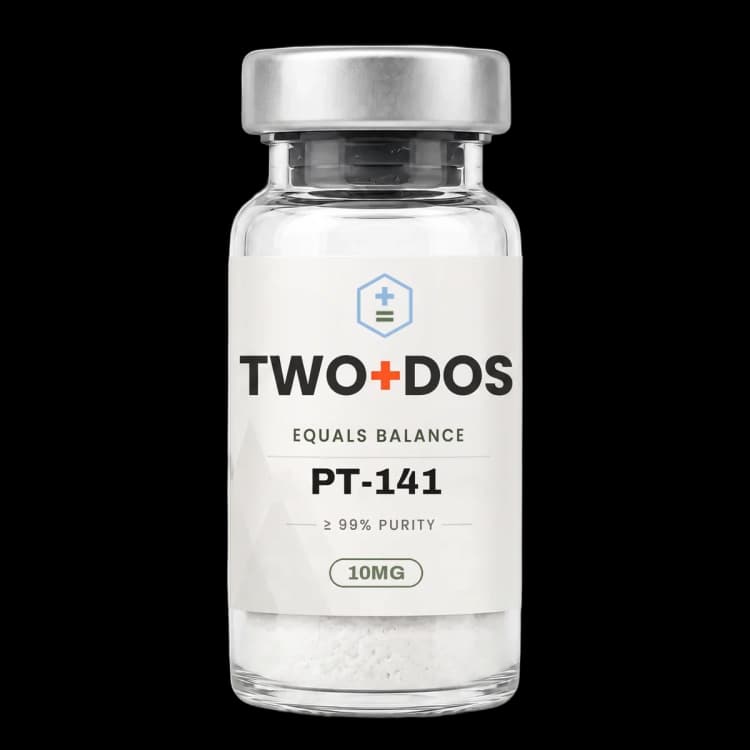
Chemical and physical properties of PT-141
| Compound class | Synthetic cyclic heptapeptide; side-chain lactam analog of α-melanocyte-stimulating hormone |
|---|---|
| Written structure | Ac-Nle-cyclo(Asp-His-D-Phe-Arg-Trp-Lys)-OH, acetylated at the N-terminus with a free acid at the C-terminus |
| Parent-hormone mapping | Ac-Nle4-cyclo[Asp5, D-Phe7, Lys10]-α-MSH(4-10)-OH, spanning residues 4 to 10 of the 13-residue parent hormone |
| Macrocycle | 23-membered ring closed by a lactam between the aspartate β-carboxyl and the lysine ε-amino group (PubChem IUPAC name: hexazacyclotricosane core) |
| Monoisotopic mass | 1024.5243 Da (PubChem CID 9941379) |
| Computed XLogP | 0.7 (PubChem), near-neutral partitioning despite the large polar surface |
| Topological polar surface area | 379 Ų (PubChem computed), far above the range typical of orally absorbed small molecules |
| Hydrogen bonding | 13 donors and 12 acceptors (PubChem computed) |
| Conformational freedom | 17 rotatable bonds across 74 heavy atoms (PubChem computed); the lactam bridge removes backbone freedom the linear parent retains |
| Relationship to melanotan II | Identical macrocycle; the two differ only at the C-terminus, a free acid in bremelanotide against a primary amide in melanotan II |
| Receptor family engaged | Class A G protein-coupled melanocortin receptors MC1R, MC3R, MC4R and MC5R, which couple to Gs and raise intracellular cyclic AMP |
What is PT-141 (bremelanotide) and how is its structure written?
PT-141, also called bremelanotide, is a synthetic cyclic heptapeptide with the molecular formula C50H68N14O10 and a molecular weight of 1025.2 g/mol for the free base. PubChem records the molecule under CID 9941379 and CAS registry number 189691-06-3, with a monoisotopic mass of 1024.5243 Da.
The written structure is Ac-Nle-cyclo(Asp-His-D-Phe-Arg-Trp-Lys)-OH. Read against the parent hormone, that expands to Ac-Nle4-cyclo[Asp5, D-Phe7, Lys10]-α-MSH(4-10)-OH. α-Melanocyte-stimulating hormone runs Ac-Ser-Tyr-Ser-Met-Glu-His-Phe-Arg-Trp-Gly-Lys-Pro-Val-NH2, so the seven-residue fragment keeps positions 4 through 10 and makes four changes: norleucine replaces the oxidation-prone methionine at position 4, aspartate replaces glutamate at 5, the phenylalanine at 7 is inverted to the D configuration, and lysine replaces glycine at 10.
Those last two substitutions carry the ring. A lactam forms between the aspartate β-carboxyl and the lysine ε-amino group, and the PubChem IUPAC name confirms the resulting macrocycle as a hexazacyclotricosane, meaning a 23-membered ring containing six nitrogen atoms. Cyclization is the structural point of the molecule: it locks the message residues into a presentation the linear hormone samples only transiently.
One functional group separates bremelanotide from melanotan II. Both share Ac-Nle-cyclo(Asp-His-D-Phe-Arg-Trp-Lys); melanotan II terminates in a primary amide while bremelanotide terminates in a free carboxylic acid. That single change is the entire chemical distinction between the two, and it is the reason literature searches conflate them so often. Naming compounds the problem, since the same molecule is indexed as PT-141, PT 141, PT141, bremelanotide, bremelanotidum and under UNII 6Y24O4F92S.
Computed descriptors from PubChem describe an unusual physicochemical profile. XLogP sits at 0.7, close to neutral partitioning, yet topological polar surface area reaches 379 Ų with 13 hydrogen bond donors and 12 acceptors distributed across 74 heavy atoms. Seventeen rotatable bonds remain despite cyclization. A molecule carrying that much polar surface does not cross membranes passively, which is why delivery route rather than intrinsic permeability dominates the applied literature.
Which melanocortin receptor subtypes does bremelanotide bind?
PT-141 acts on the melanocortin receptor family, five Class A G protein-coupled receptors designated MC1R through MC5R. Four of the five respond to a shared set of endogenous melanocortin agonists and signal primarily through Gs, raising intracellular cyclic AMP. MC2R stands apart, responding only to adrenocorticotropic hormone.
Weirath and Haskell-Luevano set out the reference framework in a 2024 survey of melanocortin tool compounds, describing NDP-MSH, melanotan II and SHU9119 as the ligands used to validate stably expressing cell lines, anchor structure determination and calibrate screening campaigns. Bremelanotide sits inside that scaffold lineage rather than outside it, which is why its subtype profile tracks melanotan II closely.
A 2022 comparative table in Biomolecules, assembled by Yuan and Tao, lists bremelanotide displacement values of 3.4 nM at MC1R, 220 nM at MC3R, 29 nM at MC4R and 190 nM at MC5R, reported as IC50. Melanotan II, tabulated from the same source in the same row format, gives 0.2, 20, 1.5 and 23 nM respectively. Two observations follow. Bremelanotide is roughly an order of magnitude weaker than melanotan II at every subtype measured, and in that binding assay its tightest interaction is at MC1R rather than at MC4R.
Functional potency tells a different story, and the disagreement between laboratories is worth stating plainly. A 2026 Frontiers in Endocrinology review compiled cyclic AMP potencies from two groups: values attributed to Palatin Technologies give EC50 figures of 0.095 nM at human MC1R, 2.4 nM at human MC3R and 4.07 nM at human MC4R, while the review authors' own measurements give 0.22 nM at human MC4R with 99 percent maximal response and 5.5 nM at human MC3R with 92 percent maximal response. A roughly 19-fold spread in reported MC4R potency across two laboratories is a reminder that melanocortin potency values are assay-dependent and should be compared only within a single study.
What the numbers agree on is the absence of clean subtype discrimination. The IUPHAR/BPS Guide to PHARMACOLOGY describes bremelanotide as showing little selectivity across the melanocortin receptor family with the exception of MC2R, and attributes its characterized activity to agonism at MC3R and MC4R. Selectivity in this family is a design target, not a property bremelanotide possesses.
What does the cryo-EM structure of bremelanotide bound to MC4R show?
PT-141 was one of four ligands captured in a 2021 cryo-electron microscopy study of the human melanocortin-4 receptor coupled to heterotrimeric Gs protein. The bremelanotide complex was resolved at 3.1 Å and deposited in the Protein Data Bank as entry 7F55, alongside structures bound to α-MSH, afamelanotide and a small molecule.
Zhang and colleagues reported that the His-D-Phe-Arg-Trp core of bremelanotide occupies an orthosteric pocket formed by transmembrane helices 2 through 7. Contacts identified include E100 at position 2.60, D122 at 3.25, D126 at 3.29, I185 at 4.61, F261 at 6.51, H264 at 6.54, L265 at 6.55, F284 at 7.35 and L288 at 7.39 in Ballesteros-Weinstein numbering. Because bremelanotide omits the flanking residues that α-MSH carries at both termini, it forms fewer peripheral contacts than the full hormone while engaging the same core pocket.
The structure also placed a calcium ion inside the binding site. The ion is coordinated by two backbone carbonyl oxygens of the ligand together with three negatively charged receptor residues, forming a bridge between peptide and receptor rather than sitting at an allosteric periphery. Functional support came from chelation: adding EGTA abolished cyclic AMP production for bremelanotide as it did for the other peptide agonists tested. Divalent cation content is therefore a variable in any melanocortin binding experiment, not an incidental buffer component.
Feng and colleagues extended the structural picture to the whole family in 2025, determining unliganded cryo-EM structures of MC1R, MC2R, MC3R, MC4R and MC5R in complex with Gs at global resolutions of 2.98 Å, 3.01 Å, 2.75 Å, 3.12 Å and 2.86 Å. Binding poses and Gs interactions in the unliganded receptors resembled the agonist-bound forms, with distinct shifts of transmembrane helix 3 and outward displacement of helix 4 marking the constitutively active states. The same work reported that zinc ions, but not calcium, positively regulated MC4R activity in a concentration-dependent manner, adding a second divalent cation to the picture the 2021 structures began.
Receptor availability at the cell surface is regulated independently of ligand. Parashara and colleagues reported in 2025 that the membrane-tethered E3 ubiquitin ligase MGRN1, recruited by the transmembrane adapters attractin and attractin-like 1, promotes ubiquitylation and degradation of both MC1R and MC4R. Removing MGRN1 or attractin raised surface and ciliary localization of MC4R in fibroblasts and elevated MC1R levels in melanocytes, meaning that measured agonist responses depend on receptor turnover as much as on affinity.
Why does the His-D-Phe-Arg-Trp core determine melanocortin activity?
PT-141 carries the His-D-Phe-Arg-Trp sequence that melanocortin pharmacology identifies as the minimal message motif. Ac-His-Phe-Arg-Trp-NH2 is the shortest fragment of α-melanocyte-stimulating hormone that retains agonist activity in classical skin bioassays, and the synthetic melanocortin peptides that reached clinical study are built around some version of it.
How much the motif can be tuned was tested directly by Zhou and colleagues in 2023. Introducing Ψ and χ angle constraints at the C-terminal tryptophan of the tetrapeptide produced Ac-His-D-Phe-Arg-Aia, reaching an EC50 of 11.2 nM at human MC1R with at least 15-fold selectivity over other subtypes, and Ac-His-pCF3-D-Phe-Arg-Aia, reaching an EC50 of 4.1 nM at human MC4R with at least ninefold selectivity. Docking indicated the constrained residue flips to contact helices 6 and 7. Four residues, correctly constrained, therefore achieve subtype discrimination that the unconstrained parent motif does not.
The D-configured phenylalanine at position 7 is the other structural lever. Tran and colleagues surveyed approved peptide drugs incorporating D-amino acids in 2026, counting more than 20 and listing bremelanotide among them. The review credited D-residues with resistance to proteolytic degradation, greater conformational rigidity and reduced immunogenicity, and identified solid-phase peptide synthesis and mirror-image phage display as the enabling technologies. Inverting a single stereocenter is a low-cost route to metabolic stability in a peptide, and the melanocortin field adopted it early.
Ring size is a third variable. Merlino and colleagues reported in 2026 on 14 macrocyclic peptide analogs spanning 19- to 23-membered rings, built on the melanotan II, SHU-9119 and PG-901 scaffolds and profiled against human MC1R, MC3R, MC4R and MC5R. FM648 and FM636 emerged as potent, selective human MC4R antagonists while FM635 showed agonist activity with marked selectivity for the same subtype. The authors framed mid-size macrocycles as a chemical class balancing the properties of small molecules and biologics, naming bremelanotide as one of the entries that established the class.
A parallel line of work shows how far selectivity can be pushed with the same pharmacophore. Guo and colleagues reported in 2026 that a C-terminal lysine conferred a greater than 20-fold solubility increase in a setmelanotide-derived series while retaining potency, and that manipulation of the core pharmacophore produced greater than 100-fold selectivity over MC1R and MC3R. The resulting compound SC19 reached an EC50 of 0.12 nM at MC4R, a pEC50 of 9.93. Set against bremelanotide's flat subtype profile, that gap illustrates how much of the melanocortin design problem is selectivity rather than potency.
Accessory proteins complicate the simple ligand-plus-receptor account. Jamaluddin and colleagues reviewed MC4R regulation in 2026, noting that structural studies established calcium as a critical cofactor for agonist binding, that several transmembrane proteins modulate receptor activity, and that Gs and Gq/11 coupling produce differing downstream consequences. The review also covered MC4R localization at primary cilia, receptor oligomerization, and newly identified regulators of cell-surface expression.
How does bremelanotide degrade under forced stress conditions?
PT-141 stability was profiled comprehensively for the first time in a 2026 Analytical Methods study that put bremelanotide acetate through the full International Council for Harmonisation stress panel. Acidic, basic, neutral hydrolytic, oxidative, thermal and photolytic conditions were each applied, and the products were separated by reversed-phase HPLC.
Yuvaraaj and Sharma developed the separation on a YMC Pack C8 column with 10 mM ammonium formate buffer at pH 3.0 against acetonitrile containing 0.1 percent formic acid, run in gradient mode. The method was partially validated with satisfactory system suitability, precision and accuracy, and showed linearity from 25 to 150 µg per mL with a coefficient of determination of 0.9993. Those figures define the working analytical window for purity assessment of the acetate salt.
Eight degradation products were detected and characterized by LC-HRMS/MS. Degradation was lower under acidic conditions than under basic conditions, and susceptibility to oxidative stress was significant. Loss also occurred under thermal and photolytic stress. The major routes reported were deacetylation, peptide-bond hydrolysis, oxidation and epimerization, which together map onto four chemical vulnerabilities the molecule carries: an N-terminal acetyl group, the backbone and lactam amide bonds, an electron-rich tryptophan indole, and α-carbon stereocenters open to base-mediated inversion.
Epimerization received specific attention because it produces isobaric products that mass alone cannot distinguish. Probable stereochemical sites were predicted by steric-energy minimization, correlating computed steric values with the relative intensities of MS/MS fragments. In silico toxicity prediction using ProTox-3.0 placed most degradation products in toxicity class 5, with two hydrolytic products assigned to class 4. The oxidative result is the practically important one, since it implicates ordinary atmospheric exposure rather than an extreme condition.
Where does bremelanotide appear in recent 2024-2026 research?
PT-141 appears in the 2024 to 2026 literature mostly as a reference melanocortin agonist rather than as the object of study. Recent work uses bremelanotide to interrogate receptor-dependent signaling in tumor cell lines, to benchmark peptide delivery devices, and as a structural anchor in macrocycle design programs.
Suzuki and colleagues examined the peptide in human glioblastoma cell lines in 2024, reporting reduced survivin expression and induced cell death at concentrations that were not toxic to normal human cells. The receptor attribution came from a control arm rather than from inference: both effects were canceled in the presence of an antagonist of melanocortin receptors 3 and 4, which places the observed activity at those two subtypes. The study identified MC3R and MC4R as candidate targets in that tumor type.
Delivery research uses bremelanotide as a mid-size model peptide. Krupke and colleagues reported in 2025 on a biodegradable suction patch built from thermally crosslinked copolyesters, validated ex vivo on porcine buccal tissue and in beagle dogs. The device achieved a relative bioavailability of 26 percent for bremelanotide, a 1.03 kDa peptide, measured against the parenteral reference route, with patch degradation confirmed in aqueous medium and in simulated waste. Permeation of a poorly permeable dye rose when a chemical permeation enhancer was combined with the device.
What the recent record does not contain is much new receptor-level characterization of bremelanotide itself. Its binding constants trace back to work done before 2010, its structural pose to a single 2021 determination, and its degradation chemistry to one 2026 study. The active experimental frontier in this family sits with newer macrocycles and with the receptors themselves, where five-subtype structural coverage arrived only in 2025.
Summary of published research
Findings below are reported as published by the cited authors, in the model systems they used. They describe laboratory research, and none of them characterize use in humans.
Yuvaraaj VK, Sharma N. Comprehensive characterization of bremelanotide acetate and its degradants by LC-HRMS/MS and predicting epimerization through computational modelling. Analytical Methods (2026)
- Model system
- Cell-free (forced degradation of bulk peptide)
- Conditions
- ICH-guided stress under acidic, basic, neutral hydrolytic, oxidative, thermal and photolytic conditions; RP-HPLC on a YMC Pack C8 column with 10 mM ammonium formate at pH 3.0 against acetonitrile containing 0.1 percent formic acid
- Reported finding
- Eight degradation products were detected and characterized by LC-HRMS/MS. Degradation was lower under acidic than basic conditions and significant under oxidative stress, with further loss under thermal and photolytic stress. Major routes were deacetylation, peptide-bond hydrolysis, oxidation and epimerization. Linearity spanned 25 to 150 µg per mL with a coefficient of determination of 0.9993, and probable epimerization sites were predicted by steric-energy minimization correlated with MS/MS fragment intensities.
Zhang H, Chen LN, Yang D, Mao C, Shen Q, Feng W, et al. Structural insights into ligand recognition and activation of the melanocortin-4 receptor. Cell Research (2021)
- Model system
- Cell-free cryo-EM with cell-based cyclic AMP assays
- Conditions
- Human MC4R-Gs-Nb35 complexes bound separately to α-MSH, afamelanotide, bremelanotide and the small molecule THIQ
- Reported finding
- The bremelanotide-MC4R-Gs complex was resolved at 3.1 Å and deposited as PDB 7F55. The His-D-Phe-Arg-Trp core occupied a pocket formed by transmembrane helices 2 through 7, contacting E100 (2.60), D122 (3.25), D126 (3.29), I185 (4.61), F261 (6.51), H264 (6.54), L265 (6.55), F284 (7.35) and L288 (7.39). A calcium ion was coordinated by two ligand backbone carbonyl oxygens and three acidic receptor residues, and cyclic AMP production was lost when EGTA was added.
Feng W, Zhou Q, Zheng C, Yang D, Wang MW. Structural basis for the constitutive activity of the melanocortin receptor family. Structure (2025)
- Model system
- Cell-free (cryo-EM of purified receptor-Gs complexes)
- Conditions
- Unliganded human MC1R, MC2R, MC3R, MC4R and MC5R in complex with Gs protein
- Reported finding
- Global resolutions reached 2.98 Å for MC1R, 3.01 Å for MC2R, 2.75 Å for MC3R, 3.12 Å for MC4R and 2.86 Å for MC5R. Binding poses and Gs interactions resembled those of agonist-bound receptors, while the extracellular regions showed distinct shifts of transmembrane helix 3 and outward displacement of helix 4. Unassigned electron densities were observed within the orthosteric pockets, and zinc ions, but not calcium, positively regulated MC4R activity in a concentration-dependent manner.
Merlino F, Jia L, Boccino I, Carotenuto A, Tammaro F, Santoro F, et al. Goldilocks-Inspired Design of Mid-Size Macrocycles for Selective Targeting of Human Melanocortin Receptors. Journal of Medicinal Chemistry (2026)
- Model system
- Cell line (human MC1R, MC3R, MC4R and MC5R)
- Conditions
- Fourteen macrocyclic peptide analogs with 19- to 23-membered rings, designed on the melanotan II, SHU-9119 and PG-901 scaffolds
- Reported finding
- Ring size and scaffold choice separated receptor subtypes. FM648 and FM636 acted as potent and selective human MC4R antagonists, while FM635 showed agonist activity with marked selectivity for the same subtype. The authors positioned mid-size macrocyclic peptides, naming bremelanotide and setmelanotide as established examples, as a chemical class balancing the affinity, stability and pharmacokinetic properties of small molecules and biologics.
Guo C, Luo T, Dong Y, Lu J, Xu Z, Bian J, et al. SAR investigation and synergistic optimization of setmelanotide yields a potent, selective, and soluble MC4R agonist. Bioorganic Chemistry (2026)
- Model system
- Cell line and rodent
- Conditions
- Structure-activity series around the setmelanotide macrocycle, varying the C-terminal residue and the core pharmacophore
- Reported finding
- A C-terminal lysine conferred a greater than 20-fold solubility increase while potency was retained, and rational manipulation of the core pharmacophore imparted greater than 100-fold selectivity over MC1R and MC3R. The lead compound SC19 reached an EC50 of 0.12 nM at MC4R, corresponding to a pEC50 of 9.93.
Jamaluddin A, McClellan A, Raffan E, Gorvin CM. The role of accessory proteins and co-factors in regulation of melanocortin-4 receptor signalling: An update. Journal of Neuroendocrinology (2026)
- Model system
- Review
- Conditions
- Synthesis of genomic approaches, protein-interaction screens and structural studies bearing on MC4R trafficking and signalling
- Reported finding
- Structural work identified calcium as a critical cofactor for agonist binding and receptor function, and several transmembrane proteins were reported to modulate MC4R activity. The review covered MC4R expression at primary cilia, receptor oligomerisation, newly identified proteins regulating cell-surface expression, and the differing downstream consequences of Gs versus Gq/11 coupling.
Parashara P, Gao L, Riglos A, Lartey D, Sidhu SB, Marks T, et al. The E3 ubiquitin ligase MGRN1 targets melanocortin receptors MC1R and MC4R via interactions with transmembrane adapters. Journal of Cell Science (2025)
- Model system
- Cell line (fibroblasts and melanocytes)
- Conditions
- Co-immunoprecipitation and functional assays of the membrane-tethered E3 ligase MGRN1 with the transmembrane adapters attractin and attractin-like 1
- Reported finding
- Attractin interacted with the RING domain of MGRN1, and both adapters worked with MGRN1 to promote ubiquitylation and degradation of MC1R and MC4R. Loss of MGRN1 or attractin raised surface and ciliary localization of MC4R in fibroblasts and elevated MC1R levels in melanocytes, indicating that receptor turnover sets the available receptor pool independently of ligand.
Suzuki S, Kitanaka C, Okada M. Melanocortin Receptor Agonist Bremelanotide Induces Cell Death and Growth Inhibition in Glioblastoma Cells via Suppression of Survivin Expression. Anticancer Research (2024)
- Model system
- Cell line (human glioblastoma lines and normal human cells)
- Conditions
- Bremelanotide alone and in combination with chemotherapeutic agents, with an antagonist of melanocortin receptors 3 and 4 as the control arm
- Reported finding
- Bremelanotide reduced survivin expression and induced cell death in glioblastoma cells at concentrations that were not toxic to normal human cells. Both effects were canceled in the presence of the MC3R/MC4R antagonist, attributing the observed activity to those two receptor subtypes.
Krupke H, Zoratto N, Rabut L, Gao D, Paunović N, Klein Cerrejon D, et al. A biodegradable suction patch for sustainable transbuccal peptide delivery. Journal of Controlled Release (2025)
- Model system
- Ex vivo porcine buccal tissue and beagle dogs
- Conditions
- Thermally crosslinked, functionalized copolyester suction patches produced by scalable mold casting, with bremelanotide among the model peptides evaluated
- Reported finding
- The patch achieved a relative bioavailability of 26 percent for bremelanotide, a 1.03 kDa peptide, measured against the parenteral reference route in beagle dogs. Patch degradation was confirmed in aqueous medium and in simulated waste, and permeation of a poorly permeable dye increased when the device was combined with a chemical permeation enhancer.
Tran L, Nguyen TD, Gad AG, Shaaban E, Tai TH, Tram NT, et al. FDA-Approved Drugs Containing D-Amino Acids: A Historical and Developmental Perspective. Drug Development Research (2026)
- Model system
- Review
- Conditions
- Survey of approved peptide drugs incorporating at least one D-configured amino acid residue
- Reported finding
- More than 20 approved drugs were found to carry at least one D-amino acid, bremelanotide among them. D-residues were credited with resistance to proteolytic degradation, enhanced conformational rigidity and reduced immunogenicity, with solid-phase peptide synthesis and mirror-image phage display identified as the enabling technologies.
Zhou Y, Mowlazadeh Haghighi S, Sawyer JR, Hruby VJ, Cai M. Ψ and χ Angle Constrains at the C-Terminus Trp Position of the Melanotropin Tetrapeptide Ac-His-d-Phe-Arg-Trp-NH2 Lead to Potent and Selective Agonists at hMC1R and hMC4R. Journal of Medicinal Chemistry (2023)
- Model system
- Cell line (human MC1R, MC3R, MC4R and MC5R)
- Conditions
- Ψ and χ angle constraints introduced at the C-terminal tryptophan of the nonselective tetrapeptide agonist Ac-His-D-Phe-Arg-Trp-NH2
- Reported finding
- Peptide 1, Ac-His-D-Phe-Arg-Aia, reached an EC50 of 11.2 nM at human MC1R with at least 15-fold selectivity over the other subtypes. Peptide 3, Ac-His-pCF3-D-Phe-Arg-Aia, reached an EC50 of 4.1 nM at human MC4R with at least ninefold selectivity. Molecular docking indicated the constrained Aia residue flips to interact with transmembrane helices 6 and 7, which the authors proposed as the source of subtype selectivity.
Weirath NA, Haskell-Luevano C. Recommended Tool Compounds for the Melanocortin Receptor (MCR) G Protein-Coupled Receptors (GPCRs). ACS Pharmacology and Translational Science (2024)
- Model system
- Review
- Conditions
- Survey of reference ligands used across the five melanocortin receptor subtypes
- Reported finding
- Four of the five subtypes were described as responding to a shared set of endogenous agonists, with MC2R the exception. NDP-MSH (melanotan I), melanotan II and SHU9119 were designated the core reference ligands used to validate stably expressing melanocortin receptor cell lines, anchor cryo-EM determination of active and inactive complexes, and calibrate high-throughput screening.
What laboratory handling information is published?
PT-141 handling practice follows from its published stability profile rather than from any single guideline. Forced degradation work reported marked susceptibility to oxidative stress and measurable loss under thermal and photolytic conditions, so light-protected, cold, dry storage of the lyophilized solid is the arrangement most consistent with the analytical record.
The photolytic result argues for amber glass or opaque secondary packaging, and the oxidative result argues for minimizing headspace and exposure of solutions to ambient air. Tryptophan and histidine are both oxidizable residues, and the 2026 degradation study placed oxidation among the four major routes observed. Deacetylation of the N-terminal acetyl group was reported alongside it, meaning the protecting group that blocks aminopeptidase attack is itself a labile feature under stress.
Solution work has an established analytical benchmark. The published reversed-phase method runs at pH 3.0 in 10 mM ammonium formate against acetonitrile with 0.1 percent formic acid, and demonstrated linearity across 25 to 150 µg per mL. Acidic conditions produced less degradation than basic conditions in the same study, which is consistent with the choice of a mildly acidic mobile phase for routine purity checks.
Because eight degradation products were characterized and two of them are epimers rather than mass-shifted species, mass spectrometry alone will not resolve a compromised sample. Chromatographic separation is the discriminating step, and any purity figure quoted without a stated method and column is uninterpretable. Material described in this article is supplied and intended for laboratory research use only, and is not for human or veterinary use.
Frequently asked research questions
What is PT-141 (bremelanotide)?
PT-141, also called bremelanotide, is a synthetic cyclic heptapeptide analog of α-melanocyte-stimulating hormone with the formula C50H68N14O10 and a free-base molecular weight of 1025.2 g/mol. It is written Ac-Nle-cyclo(Asp-His-D-Phe-Arg-Trp-Lys)-OH and is recorded under PubChem CID 9941379 and CAS 189691-06-3.
How does bremelanotide differ chemically from melanotan II?
The two share an identical macrocycle, Ac-Nle-cyclo(Asp-His-D-Phe-Arg-Trp-Lys), and differ only at the C-terminus: bremelanotide carries a free carboxylic acid where melanotan II carries a primary amide. That single functional group is the entire chemical distinction between them, which is why the two compounds are frequently conflated in secondary sources.
Which melanocortin receptor does bremelanotide bind most tightly?
It depends on the assay. A 2022 comparative table lists displacement IC50 values of 3.4 nM at MC1R, 29 nM at MC4R, 190 nM at MC5R and 220 nM at MC3R, ranking MC1R first. Cyclic AMP potency data compiled in 2026 rank MC4R first, with reported EC50 values ranging from 0.22 to 4.07 nM depending on the laboratory. The Guide to PHARMACOLOGY describes little selectivity across the family apart from MC2R.
Has the bremelanotide-receptor complex been solved structurally?
Yes. A 2021 Cell Research study resolved the bremelanotide-MC4R-Gs complex by cryo-electron microscopy at 3.1 Å, deposited as PDB entry 7F55. The His-D-Phe-Arg-Trp core sits in a pocket formed by transmembrane helices 2 through 7, and a calcium ion bridges ligand backbone carbonyls to three acidic receptor residues.
What degradation pathways have been reported for bremelanotide?
A 2026 forced-degradation study characterized eight degradation products by LC-HRMS/MS and identified four major routes: deacetylation, peptide-bond hydrolysis, oxidation and epimerization. Degradation was lower under acidic than basic conditions, significant under oxidative stress, and also observed under thermal and photolytic stress.
PT-141 at TWO+DOS
TWO+DOS supplies PT-141 as a research-use-only compound, third-party tested, with certificates of analysis emailed immediately on request.
View the PT-141 (10mg)listing →Related research overviews
References
- PubChem CID 9941379 — bremelanotide compound summary
- RCSB PDB 7F55 — Cryo-EM structure of bremelanotide-MC4R-Gs_Nb35 complex
- IUPHAR/BPS Guide to PHARMACOLOGY — bremelanotide ligand page
- IUPHAR/BPS Guide to PHARMACOLOGY — melanocortin receptor family
- Zhang H et al. Structural insights into ligand recognition and activation of the melanocortin-4 receptor. Cell Research 2021
- Feng W et al. Structural basis for the constitutive activity of the melanocortin receptor family. Structure 2025
- Yuvaraaj VK, Sharma N. Comprehensive characterization of bremelanotide acetate and its degradants by LC-HRMS/MS. Analytical Methods 2026
- Merlino F et al. Goldilocks-Inspired Design of Mid-Size Macrocycles for Selective Targeting of Human Melanocortin Receptors. J Med Chem 2026
- Weirath NA, Haskell-Luevano C. Recommended Tool Compounds for the Melanocortin Receptor (MCR) GPCRs. ACS Pharmacol Transl Sci 2024
- Yuan XC, Tao YX. Ligands for Melanocortin Receptors: Beyond Melanocyte-Stimulating Hormones and Adrenocorticotropin. Biomolecules 2022
- Jamaluddin A et al. The role of accessory proteins and co-factors in regulation of melanocortin-4 receptor signalling: An update. J Neuroendocrinol 2026
- Prindle CR et al. The melanocortin receptors as targets for general obesity: contextualizing clinical failures and analyzing future perspectives. Front Endocrinol 2026
For research use only. Not for human or veterinary use. Not for diagnostic or therapeutic use.