
CJC-1295 with DAC: Albumin Conjugation Chemistry and Circulating Half-Life
By the TWO+DOS Research Team · Published 2026-08-13
For research use only. Not for human or veterinary use. Not for diagnostic or therapeutic use.
CJC-1295 with DAC is a synthetic 30-residue analogue of human growth hormone-releasing hormone, formula C165H269N47O46 and molecular weight 3647.2 g/mol, carrying a lysine-linked maleimide at its C-terminus. That maleimide couples to the free thiol of serum albumin, converting a short-lived peptide into a long-circulating albumin adduct.
The compound is one of the few molecules in this class with a published human pharmacokinetic record. Two placebo-controlled trials reported in 2006 measured a circulating half-life of 5.8 to 8.1 days, and the underlying bioconjugation chemistry was characterised in rats a year earlier. This overview summarises that chemistry, those measurements, and the analytical methods built around the molecule since.
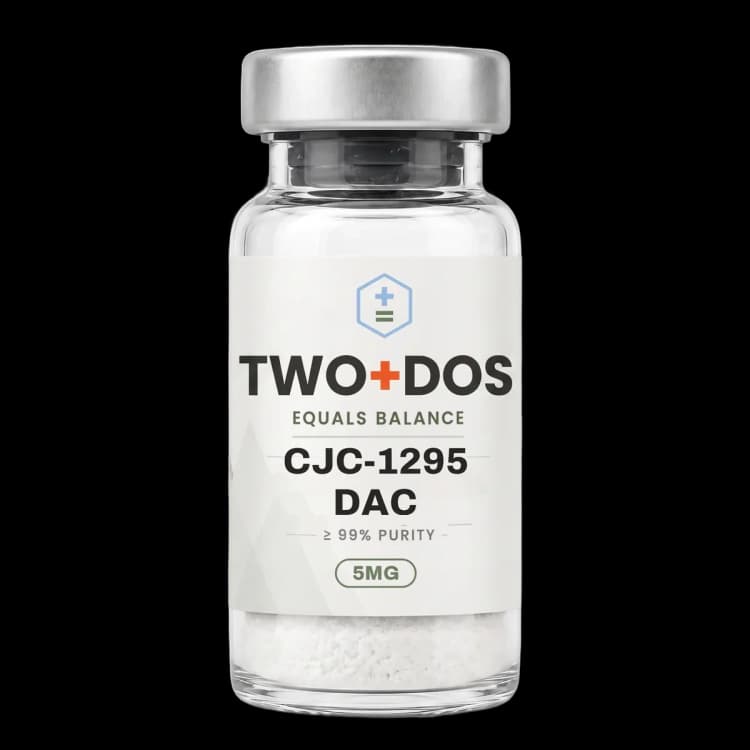
Chemical and physical properties of CJC-1295 with DAC
| Peptide class | Thirty-residue analogue of human growth hormone-releasing hormone, C-terminally amidated, carrying a lysine-linked maleimide as residue 30 |
|---|---|
| Molecular formula | C165H269N47O46, unconjugated peptide, containing no sulfur |
| Molecular weight | 3647.2 g/mol; exact mass 3646.019 Da; monoisotopic mass 3645.015 Da (PubChem computed) |
| PubChem CID | 91971820, verified against the PubChem name endpoint |
| Registry identifiers | CAS 446262-90-4; UNII 62RC32V9N7; DSSTox DTXSID501027567 |
| InChIKey | ZUQGTWKGESAQCD-ZGFIGYLBSA-N |
| Backbone substitutions | D-Ala at 2, Gln at 8, Ala at 15 and Leu at 27, relative to human GHRH(1-29)-NH2, all four confirmed by the PubChem systematic name |
| Drug affinity complex | Lys30 bearing an N-epsilon-3-maleimidopropionamide group; the reactive ring appears in the systematic name as 3-(2,5-dioxopyrrol-1-yl)propanoylamino |
| Conjugation partner | Cysteine 34 of human serum albumin, a 585-residue carrier of roughly 66.5 kDa; the resulting adduct is approximately 70 kDa |
| Molecular target | GHRH receptor (GHRHR), a class B1 G-protein-coupled receptor coupled to Gs and adenylate cyclase |
| Computed polarity descriptors | XLogP -11.7; topological polar surface area 1540 square angstroms; 54 hydrogen-bond donors; 52 acceptors; 128 rotatable bonds; 258 heavy atoms (PubChem computed) |
What does the DAC in CJC-1295 with DAC actually denote?
DAC abbreviates drug affinity complex, the bioconjugation platform developed at ConjuChem Biotechnologies. In CJC-1295 with DAC the complex is a single appended residue: a lysine at position 30 whose epsilon-amine carries a 3-maleimidopropionyl group. Everything preceding that lysine is a tetrasubstituted growth hormone-releasing hormone fragment, amidated at the C-terminus.
PubChem record 91971820 confirms the whole construct independently of any supplier description. Reading the systematic name residue by residue gives L-tyrosine followed by a D-configured alanine, then aspartate, alanine, isoleucine, phenylalanine and threonine, with glutamine appearing at position 8, alanine at 15 and leucine at 27. The terminal fragment reads 1-amino-6-[3-(2,5-dioxopyrrol-1-yl)propanoylamino]-1-oxohexan-2-yl, which is a lysine amide bearing a maleimide on its side chain.
Elemental arithmetic ties the two halves together and offers a quick identity check. The unappended tetrasubstituted backbone is C152H252N44O42 at 3367.9 g/mol. Subtracting that from C165H269N47O46 leaves C13H17N3O4, a difference of 279.3 g/mol, which is exactly one lysine residue plus one maleimidopropionyl acyl group after loss of water. A sample whose deconvoluted mass sits 279 units above the backbone carries the appendage; a sample matching the backbone alone does not.
How does the maleimide capture serum albumin in circulation?
The maleimide ring of CJC-1295 with DAC is an electron-poor alkene that undergoes Michael addition with thiolate anions, and human serum albumin presents exactly one accessible thiol. Cysteine 34 is the only free sulfhydryl among the 35 cysteines of the mature 585-residue protein, the other 34 locked into seventeen disulfide bridges.
Coupling at that residue is therefore selective by default rather than by design, and two properties of the carrier make it an unusually effective anchor. Albumin circulates at roughly 35 to 50 grams per litre, a molar concentration near 0.6 millimolar that vastly exceeds any peptide alongside it, so the maleimide meets Cys34 far more often than any competing nucleophile. Albumin also persists about nineteen days in circulation, a longevity attributable to pH-dependent capture by the neonatal Fc receptor, which diverts endocytosed albumin away from lysosomal degradation and returns it to the extracellular space.
The thiosuccinimide formed by that addition is durable but not inert. Bioconjugation chemists have documented a retro-Michael pathway in which the adduct reverts to free maleimide and free thiol, allowing exchange onto other thiol-bearing molecules, and a competing hydrolysis that opens the succinimide ring irreversibly and locks the linkage in place. Which route dominates depends on the local electronic environment of the linker, one reason newer albumin-binding chemistries have moved toward bromomaleimides and related ring systems.
What did the founding preclinical work measure?
CJC-1295 with DAC emerged from a 2005 screen of maleimido derivatives of hGRF(1-29) reported by Jetté and colleagues in Endocrinology. Three candidate structures were coupled to human serum albumin outside the animal and compared against the parent fragment for protease resistance, for growth hormone release from cultured rat anterior pituitary cells, and for persistence in rat plasma.
Each conjugate resisted dipeptidyl peptidase IV better than unmodified hGRF(1-29) and still triggered growth hormone secretion in the pituitary cell assay, establishing that a bulky albumin tether at the C-terminus does not abolish recognition at a receptor whose critical contacts lie at the peptide N-terminus. In Sprague-Dawley rats the selected candidate quadrupled the two-hour growth hormone area under the curve against the parent fragment and stayed detectable in plasma past 72 hours. Western blotting placed an immunoreactive species on the albumin band from fifteen minutes onward, direct evidence that capture happens in vivo rather than only in a tube.
A 2006 study in the GHRH knockout mouse tested whether sustained receptor occupancy could substitute for the missing hypothalamic signal. Animals received 2 micrograms at 24, 48 or 72 hour intervals for five weeks beginning at one week of age. The 24-hour schedule restored growth to the range of heterozygous littermates in both mass and body length, while the wider intervals fell short, giving a crude in vivo measure of how long a single quantity of the conjugate keeps the axis engaged.
What did the human trials of CJC-1295 with DAC report?
Human data for CJC-1295 with DAC come from two randomised, placebo-controlled, double-blind ascending-level trials in healthy adults aged 21 to 61, published by Teichman and colleagues in 2006. The trials ran 28 and 49 days across two investigational sites, the second repeating exposure two or three times at weekly or biweekly spacing.
The pharmacokinetic result is the number the compound is known for. Estimated half-life was 5.8 to 8.1 days, an interval that matches the timescale of albumin turnover rather than the timescale of a free peptide. Downstream, mean plasma growth hormone rose two- to tenfold for six days or longer and mean plasma IGF-I rose 1.5- to threefold for nine to eleven days, both scaling with the quantity given. Under the repeated schedule IGF-I stayed above baseline for as long as 28 days. The authors reported no serious adverse reactions, with tolerability described as acceptable at the 30 and 60 microgram per kilogram levels.
A companion study by Ionescu and Frohman asked what continuous receptor stimulation does to the shape of growth hormone output. Healthy men aged 20 to 40 received 60 or 90 micrograms per kilogram and were sampled every 20 minutes for 12 hours one week later. Basal growth hormone rose 7.5-fold, mean growth hormone rose 45 percent and IGF-I rose 45 percent, yet pulse frequency and amplitude were preserved. Sustained agonist presence raised the floor of the rhythm without erasing the rhythm itself, which is a statement about pituitary physiology rather than about any outcome.
How does the conjugate differ from the unappended backbone?
CJC-1295 with DAC and the same tetrasubstituted backbone without the appendage are catalogued as separate materials because their kinetics diverge. The four backbone substitutions govern how fast proteases degrade the peptide. The maleimide governs whether a plasma protein carries it at all, and only the second mechanism operates over a timescale of days.
Nomenclature obscures this more than the chemistry does. In the primary literature the designation CJC-1295 refers to the conjugating molecule described in 2005, so a database search on the bare name returns work on the DAC form. The no-DAC label was applied afterwards to distinguish the backbone sold separately, which means published half-life figures, trial results and receptor pharmacology attached to the name CJC-1295 describe the albumin-binding compound unless a source states otherwise.
The distinction also shows up in what degradation studies can and cannot say. A 2023 stability investigation of growth hormone-releasing peptides and GHRH-related fragments found that only some synthetic fragments survived incubation in human blood, trypsin and chymotrypsin well enough to serve as internal standards. Those measurements characterise free peptide in matrix. For the DAC form, the relevant question is how long the albumin carrier lasts, and the carrier outlives any of these fragments by more than an order of magnitude.
How is CJC-1295 with DAC identified in analytical laboratories?
CJC-1295 with DAC is a named target in anti-doping analytical chemistry, listed by the World Anti-Doping Agency under growth hormone releasing factors within section S2 of the Prohibited List effective 1 January 2026. That status has driven most of the published method development, and the resulting papers are where quantitative detection figures for this molecule exist.
Equine work supplied the first confirmation method aimed squarely at the conjugate. Timms and colleagues reported in 2019 that immuno-affinity capture followed by tryptic digestion and liquid chromatography tandem mass spectrometry identified CJC-1295 down to 180 picograms per millilitre in one millilitre of plasma. The same group had published an immuno-polymerase chain reaction screen for the wider GHRH analogue family the previous year.
Human urine methods have since converged on high-resolution instruments at nanolitre flow rates. A 2026 method from Uçaktürk and Nemutlu combined ultrafiltration with solid-phase extraction ahead of nano-liquid chromatography on a quadrupole-Orbitrap analyser, covering GHRH and its synthetic analogues including CJC-1295, and reported detection limits at or below 0.5 nanograms per millilitre with identification limits between 0.5 and 0.75 nanograms per millilitre. Separately, capillary electrophoresis with a dimethyl-beta-cyclodextrin selector has been used to resolve GHRH analogues that differ only in the configuration of a single residue, the structural feature that D-alanine at position 2 introduces into this family.
Summary of published research
Findings below are reported as published by the cited authors, in the model systems they used. They describe laboratory research, and none of them characterize use in humans.
Jette L, Leger R, Thibaudeau K, Benquet C, Robitaille M, Pellerin I, Paradis V, van Wyk P, Pham K, Bridon DP. Human growth hormone-releasing factor (hGRF)1-29-albumin bioconjugates activate the GRF receptor on the anterior pituitary in rats: identification of CJC-1295 as a long-lasting GRF analog. Endocrinology (2005)
- Model system
- Cultured rat anterior pituitary cells and normal male Sprague-Dawley rats
- Conditions
- Three maleimido derivatives of hGRF(1-29) coupled to human serum albumin ex vivo; GH secretion assay, plasma sampling to 72 hours, anti-albumin Western blot
- Reported finding
- Every conjugate resisted dipeptidyl peptidase IV better than the parent fragment and stayed active in the pituitary cell assay. The lead structure quadrupled the two-hour GH area under the curve, remained measurable in plasma past 72 hours, and generated an immunoreactive band running with albumin from fifteen minutes.
Teichman SL, Neale A, Lawrence B, Gagnon C, Castaigne JP, Frohman LA. Prolonged stimulation of growth hormone (GH) and insulin-like growth factor I secretion by CJC-1295, a long-acting analog of GH-releasing hormone, in healthy adults. Journal of Clinical Endocrinology and Metabolism (2006)
- Model system
- Randomised, placebo-controlled, double-blind trials in healthy adults aged 21 to 61
- Conditions
- Two ascending-level trials of 28 and 49 days at two investigational sites, the second repeating exposure two or three times
- Reported finding
- Estimated half-life was 5.8 to 8.1 days. Mean plasma GH rose two- to tenfold for six days or longer and mean plasma IGF-I rose 1.5- to threefold for nine to eleven days, both scaling with the quantity given. Repeated exposure held IGF-I above baseline for up to 28 days.
Alba M, Fintini D, Sagazio A, Lawrence B, Castaigne JP, Frohman LA, Salvatori R. Once-daily administration of CJC-1295, a long-acting growth hormone-releasing hormone (GHRH) analog, normalizes growth in the GHRH knockout mouse. American Journal of Physiology Endocrinology and Metabolism (2006)
- Model system
- GHRH knockout mice compared with heterozygous littermates
- Conditions
- 2 micrograms delivered at 24, 48 or 72 hour intervals for five weeks, beginning at one week of age
- Reported finding
- The 24-hour schedule returned growth-deficient animals to the mass and body length of heterozygous controls, while the 48- and 72-hour schedules produced partial correction only. The result bounded how long one quantity of the conjugate keeps the somatotroph axis engaged in a rodent lacking endogenous GHRH.
Ionescu M, Frohman LA. Pulsatile secretion of growth hormone (GH) persists during continuous stimulation by CJC-1295, a long-acting GH-releasing hormone analog. Journal of Clinical Endocrinology and Metabolism (2006)
- Model system
- Healthy men aged 20 to 40
- Conditions
- 60 or 90 micrograms per kilogram, with blood sampled every 20 minutes across 12 hours one week later
- Reported finding
- Basal GH rose 7.5-fold (P less than 0.0001), mean GH rose 45 percent (P less than 0.01) and IGF-I rose 45 percent (P less than 0.001). Pulse frequency and amplitude were unchanged, showing that continuous agonist presence lifted the trough of the rhythm without flattening the rhythm itself.
Sackmann-Sala L, Ding J, Frohman LA, Kopchick JJ. Activation of the GH/IGF-1 axis by CJC-1295, a long-acting GHRH analog, results in serum protein profile changes in normal adult subjects. Growth Hormone and IGF Research (2009)
- Model system
- Serum proteomics in eleven healthy young adult men
- Conditions
- Two-dimensional gel electrophoresis of serum drawn before and one week after a single exposure
- Reported finding
- Serum protein profiles shifted measurably one week later, with decreases in apolipoprotein A1 and in transthyretin isoforms among the changes resolved. The study demonstrated that a single exposure leaves a detectable proteomic signature well after the peptide itself would have cleared if unconjugated.
Gonzalez-Lopez NM, Huertas-Ortiz KA, Leguizamon-Guerrero JE, Arias-Cortes MM, Tello-Ospina C, Sierra-Barrera R, Rivera-Monroy ZJ, Garcia-Castaneda JE. In-house standards derived from doping peptides: Enzymatic and serum stability and degradation profile of GHRP and GHRH-related peptides. Biomedical Chromatography (2023)
- Model system
- Cell-free incubation in human blood and with purified proteases
- Conditions
- Solid-phase synthesised GHRP-4, GHRP-5, GHRP-6 and sermorelin fragments 1-11, 13-20 and 22-29, tracked by HPLC-DAD against trypsin and chymotrypsin
- Reported finding
- GHRP-4, GHRP-6 and the sermorelin 22-29 fragment survived incubation well enough to serve as internal standards, while other fragments degraded. The work quantified how quickly free peptides of this family disappear in serum, the liability that carrier conjugation sidesteps.
Otin J, Sanz-Nebot V, Benavente F. Online large volume sample staking preconcentration and separation of enantiomeric GHRH analogs by capillary electrophoresis. Electrophoresis (2023)
- Model system
- Analytical method development in desalted human urine
- Conditions
- Capillary electrophoresis with a dimethyl-beta-cyclodextrin chiral selector and polarity-switching preconcentration
- Reported finding
- Four GHRH-family analogues were resolved, including a pair differing only in the configuration of a single amino acid, with detection limits between 75 and 200 nanograms per millilitre. The separation shows that the D-configured residue at position 2 shared across this family is itself an analytically distinguishing feature.
Halmos G, Szabo Z, Dobos N, Juhasz E, Schally AV. Growth hormone-releasing hormone receptor (GHRH-R) and its signaling. Reviews in Endocrine and Metabolic Disorders (2025)
- Model system
- review
- Conditions
- Survey of receptor architecture, splice variants and downstream cascades across pituitary and extrapituitary tissue
- Reported finding
- The review characterised GHRH-R as a seven-transmembrane G-protein-coupled receptor whose activation drives GH secretion from the pituitary, and reported that splice variant 1 most closely resembles the full-length receptor, remains functional, and produces both cAMP signaling and mitogenic activity when stimulated.
Ucakturk E, Nemutlu E. Analysis of growth hormone releasing hormone and its analogs in urine using nano liquid chromatography coupled with quadrupole/orbitrap mass spectrometry. Journal of Pharmaceutical and Biomedical Analysis (2026)
- Model system
- Analytical method development in human urine
- Conditions
- Ultrafiltration cleanup combined with solid-phase extraction ahead of nano-LC quadrupole/Orbitrap mass spectrometry, validated to anti-doping criteria
- Reported finding
- Detection limits at or below 0.5 nanograms per millilitre and identification limits of 0.5 to 0.75 nanograms per millilitre were reported for GHRH and its synthetic analogues, CJC-1295 among them. The authors judged the sensitivity adequate for both screening and confirmatory work.
Shao H, Li W, Wang Y, Chen J, Zhang Y, Sun X, Zhu H. Peptidomimetic Long-Acting Growth Hormone-Releasing Hormone Agonists Promote Tissue Perfusion in Hindlimb Ischemia. Journal of Medicinal Chemistry (2026)
- Model system
- Cultured endothelial cells and a mouse hindlimb ischemia model
- Conditions
- Hybrid GHRH analogues built by peptidomimetic optimisation, assessed for receptor activation, serum stability and tissue perfusion
- Reported finding
- The optimised analogues activated GHRH-R and released growth hormone more potently than earlier structures while showing serum half-lives beyond 24 hours. In the ischemic limb they raised perfusion and promoted collateral vessel formation, with in vitro angiogenic activity traced to ERK pathway activation.
Dominikowski A, Kanarek-Lizik D, Piatkowski T, Smolarczyk R, Grabowska M, Zwierzchowska A. The emerging landscape of performance-enhancing peptides modulating GH-IGF1 axis: bridging the gap between clinical evidence and patient self-administration. Frontiers in Endocrinology (2026)
- Model system
- review
- Conditions
- Narrative review of GHRH analogues and growth hormone secretagogues distributed outside regulatory approval
- Reported finding
- The review treated CJC-1295 with DAC and the same backbone without DAC as separate entries, reflecting their distinct kinetics, and catalogued reported endocrine and metabolic disturbances, fluid retention and musculoskeletal complaints associated with unapproved use of this class.
Mendias CL, Awan TM. Safety and Efficacy of Approved and Unapproved Peptide Therapies for Musculoskeletal Injuries and Athletic Performance. Sports Medicine (2026)
- Model system
- review
- Conditions
- Survey of approved and unapproved peptides marketed directly to consumers, CJC-1295 among the compounds covered
- Reported finding
- The authors reported that many unapproved peptides show favourable tissue repair and metabolic outcomes in animal models while rigorous human safety data remain scarce, and concluded that the gap between preclinical signal and controlled human evidence is the defining feature of this literature.
What laboratory handling information is published?
Published handling guidance specific to CJC-1295 with DAC is limited, and the useful constraints come from maleimide chemistry rather than from any stability study of this molecule. The material is supplied as a lyophilized powder in a 5 mg presentation. Storage figures in supplier catalogues are specifications, not peer-reviewed measurements.
The reactive group is the part that fails first. A maleimide ring hydrolyses in aqueous base to the corresponding maleamic acid, an open-chain product that no longer undergoes Michael addition, so alkaline buffers quietly convert the conjugating peptide into a non-conjugating one with no change in appearance. Neutral to slightly acidic aqueous conditions slow that reaction. Free thiols introduced from any source, including reducing agents left over from other workflows, will consume the maleimide directly and compete with whatever carrier protein the experiment intends to label.
For identity confirmation, mass spectrometry gives the cleanest checks. The monoisotopic mass to verify against a deconvoluted electrospray spectrum is 3645.015 Da, with an average molecular weight of 3647.2 g/mol. Two negative controls are worth running alongside. The molecule contains no sulfur, so any sulfur signature in elemental analysis points to an unsubstituted GHRH fragment rather than this analogue. And a species 18 units heavier than expected indicates ring-opened maleamic acid, while a species 279 units lighter indicates the bare tetrasubstituted backbone with no appendage at all. The computed descriptors, XLogP of minus 11.7 and a topological polar surface area of 1540 square angstroms, describe a highly polar molecule with no expectation of passive membrane permeability.
Frequently asked research questions
What is the difference between CJC-1295 with DAC and the same peptide without DAC?
One appended residue. The DAC form carries a lysine at position 30 bearing a 3-maleimidopropionyl group that couples covalently to cysteine 34 of serum albumin; the no-DAC form ends at residue 29 with a simple amide. The masses differ by 279.3 g/mol, and the published half-life differs by roughly two orders of magnitude.
Why does albumin conjugation extend circulation time so dramatically?
Albumin itself survives about nineteen days in circulation because the neonatal Fc receptor binds it in acidified endosomes and returns it to the extracellular space instead of routing it to lysosomes. A peptide covalently attached to that carrier inherits the recycling behaviour, along with a hydrodynamic radius far above the glomerular filtration threshold.
Which PubChem record and CAS number describe this compound?
PubChem CID 91971820, verified through the PubChem name endpoint, gives formula C165H269N47O46 and molecular weight 3647.2 g/mol. The associated registry identifiers are CAS 446262-90-4 and UNII 62RC32V9N7. Supplier catalogues sometimes attach a different CAS number to this name, which is one reason documentation is more reliable when it cites the CID and InChIKey.
Does continuous receptor stimulation abolish growth hormone pulsatility?
The published measurement says no. Sampling every 20 minutes across 12 hours, one week after exposure at 60 or 90 micrograms per kilogram, found basal growth hormone raised 7.5-fold and mean growth hormone raised 45 percent, with pulse frequency and amplitude preserved. The rhythm's floor moved upward while the rhythm itself persisted.
What detection sensitivity has been published for this molecule?
Two anchors exist. Immuno-affinity capture with tryptic digestion and liquid chromatography tandem mass spectrometry identified CJC-1295 at 180 picograms per millilitre in one millilitre of equine plasma in 2019. A 2026 nano-LC quadrupole/Orbitrap method in human urine reported detection limits at or below 0.5 nanograms per millilitre across the GHRH analogue panel.
CJC-1295 with DAC at TWO+DOS
TWO+DOS supplies CJC-1295 with DAC as a research-use-only compound, third-party tested, with certificates of analysis emailed immediately on request.
View the CJC-1295 – With DAC (5mg)listing →Related research overviews
References
- PubChem CID 91971820: formula, mass, InChIKey, systematic name and computed descriptors
- Jette et al. 2005, Endocrinology (PMID 15817669)
- Teichman et al. 2006, Journal of Clinical Endocrinology and Metabolism (PMID 16352683)
- Alba et al. 2006, American Journal of Physiology Endocrinology and Metabolism (PMID 16822960)
- Ionescu and Frohman 2006, Journal of Clinical Endocrinology and Metabolism (PMID 17018654)
- Sackmann-Sala et al. 2009, Growth Hormone and IGF Research (PMID 19386527)
- Timms et al. 2019, Drug Testing and Analysis: LC-MS/MS confirmation in equine plasma (PMID 30938069)
- Timms et al. 2019, Drug Testing and Analysis: immuno-PCR screen for GHRH analogs (PMID 30489688)
- Gonzalez-Lopez et al. 2023, Biomedical Chromatography (PMID 37688464)
- Halmos et al. 2025, Reviews in Endocrine and Metabolic Disorders (PMID 39934495)
- Ucakturk and Nemutlu 2026, Journal of Pharmaceutical and Biomedical Analysis (PMID 41138283)
- World Anti-Doping Agency Prohibited List
For research use only. Not for human or veterinary use. Not for diagnostic or therapeutic use.