
CJC-1295 No DAC: GHRH(1-29) Chemistry and Receptor Pharmacology
By the TWO+DOS Research Team · Published 2026-08-12
For research use only. Not for human or veterinary use. Not for diagnostic or therapeutic use.
CJC-1295 No DAC, catalogued in the chemical literature as modified GRF (1-29), is a synthetic 29-residue analogue of human growth hormone-releasing hormone with the molecular formula C152H252N44O42 and a molecular weight of 3367.9 g/mol. Four amino acid substitutions separate it from the native GHRH(1-29) fragment, and it carries no albumin-binding appendage.
The compound occupies an unusual position in the literature. Its receptor is structurally solved to 2.6 angstroms, its proteolytic degradation route was mapped enzymatically in the early 1990s, and it appears repeatedly in anti-doping analytical chemistry through 2026, where quantified detection limits are published. What follows summarises that chemistry and those measurements in the systems where they were recorded.
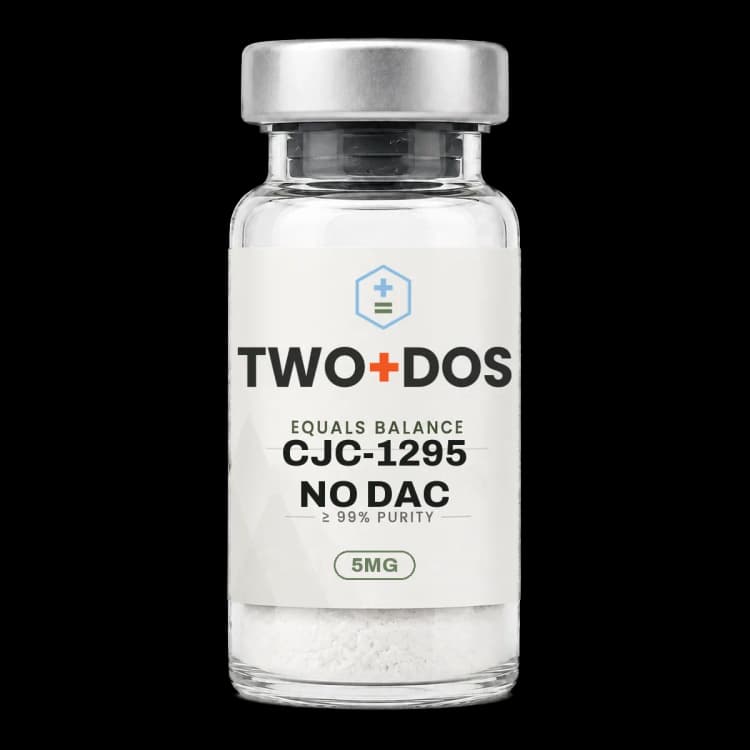
Chemical and physical properties of CJC-1295 No DAC
| Peptide class | Tetrasubstituted 29-residue analogue of the N-terminal fragment of human growth hormone-releasing hormone, C-terminally amidated |
|---|---|
| Molecular formula | C152H252N44O42 (free peptide, no sulfur) |
| Molecular weight | 3367.9 g/mol; exact mass 3366.897 Da; monoisotopic mass 3365.894 Da (PubChem computed) |
| PubChem CID | 56841945. A second PubChem record, CID 91976842, carries the identical formula and mass |
| InChIKey | XOZMWINMZMMOBR-HRDSVTNWSA-N |
| Backbone substitutions | D-Ala at position 2, Gln at 8, Ala at 15 and Leu at 27, relative to human GHRH(1-29)-NH2 |
| Parent fragment | GHRH(1-29)-NH2, also named sermorelin: C149H246N44O42S, 3357.9 g/mol, PubChem CID 16132413 |
| C-terminus | Primary amide with no appended drug affinity complex, which is the single structural difference from the albumin-conjugating analogue of the same backbone |
| Molecular target | GHRH receptor (GHRHR), a class B1 G-protein-coupled receptor coupled to Gs and adenylate cyclase |
| Computed polarity descriptors | XLogP -10.7; topological polar surface area 1450 square angstroms; 52 hydrogen-bond donors; 48 acceptors; 118 rotatable bonds; 238 heavy atoms (PubChem computed) |
| Published urine detection limits | 5 to 25 pg/mL by nanoLC-HRMS/MS, 0.2 ng/mL by triple-quadrupole UHPLC-MS/MS, 0.5 ng/mL or lower by nano-LC Q/Orbitrap MS |
| Supplied form | Lyophilized powder, 5 mg and 10 mg vial presentations |
What is CJC-1295 No DAC?
CJC-1295 No DAC is a synthetic 29-residue peptide corresponding to the biologically active N-terminal fragment of human growth hormone-releasing hormone, carrying four deliberate substitutions. Written as modified GRF (1-29) or tetrasubstituted GRF (1-29), the molecule has the formula C152H252N44O42, a molecular weight of 3367.9 g/mol, and a C-terminal primary amide.
The naming is a frequent source of confusion, and the confusion is chemically meaningful. In the primary literature, the designation CJC-1295 belongs to the compound reported by Jetté and colleagues in 2005: the same tetrasubstituted backbone with an N-epsilon-3-maleimidopropionamide derivative of lysine appended at the C-terminus. That appendage is the drug affinity complex. Material sold as No DAC is the backbone without it, which is why suppliers list the two as separate items and why literature searches on the bare name return work on the conjugate.
Registry identity is unsettled. Two CAS numbers circulate in supplier catalogues for this structure, and both appear as synonyms on the same PubChem record. Because sources disagree on which registry number describes the unconjugated peptide, this overview does not assert one. The unambiguous identifiers are the PubChem CID 56841945, the InChIKey XOZMWINMZMMOBR-HRDSVTNWSA-N, and the formula and mass, all of which are internally consistent with the published sequence.
Which four substitutions define modified GRF (1-29)?
Modified GRF (1-29) differs from human GHRH(1-29)-NH2 at four positions. D-alanine replaces L-alanine at residue 2, glutamine replaces asparagine at residue 8, alanine replaces glycine at residue 15, and leucine replaces methionine at residue 27. Everything else, including the C-terminal amide, is the native GHRH sequence.
Each change addresses a specific chemical liability documented in the peptide literature. The D-alanine at position 2 removes the stereochemistry that dipeptidyl peptidase IV requires at the P1 site, so the Ala2-Asp3 bond is no longer cleaved. Glutamine at position 8 replaces the asparagine residue that is prone to deamidation and backbone rearrangement in aqueous storage. Leucine at position 27 removes the only sulfur in the molecule, eliminating methionine sulfoxide formation as an oxidative degradation pathway. Alanine at position 15 comes from the medicinal-chemistry series that produced the [X2,Ala15]-GRF(1-29)-NH2 analogues used in the enzymology work described below.
The elemental arithmetic confirms the description. Native GHRH(1-29)-NH2 is C149H246N44O42S at 3357.9 g/mol. Exchanging methionine for leucine subtracts one sulfur and adds one carbon and two hydrogens; the asparagine-to-glutamine and glycine-to-alanine exchanges each add a single methylene. The result is C152H252N44O42 at 3367.9 g/mol, exactly the mass on the PubChem record, and a 10.0 g/mol offset from the unmodified fragment.
The full sequence, using standard three-letter codes, reads Tyr-D-Ala-Asp-Ala-Ile-Phe-Thr-Gln-Ser-Tyr-Arg-Lys-Val-Leu-Ala-Gln-Leu-Ser-Ala-Arg-Lys-Leu-Leu-Gln-Asp-Ile-Leu-Ser-Arg-NH2. The single D-amino acid at position 2 is the reason the molecule cannot be produced by straightforward recombinant expression and is made by solid-phase synthesis.
How does the GHRH receptor recognise the peptide N-terminus?
The GHRH receptor is a class B1 G-protein-coupled receptor on anterior pituitary somatotrophs, and modified GRF (1-29) retains the complete GHRH recognition sequence that engages it. Zhou and colleagues determined a 2.6 angstrom cryo-electron microscopy structure of the human receptor bound to GHRH and heterotrimeric Gs, reconstructed from 307,018 particles, resolving how the peptide N-terminus inserts into the transmembrane core.
The contacts are specific and measurable. The Tyr1 hydroxyl hydrogen-bonds to His210 and Thr213 in transmembrane helix 3, while the Tyr1 main-chain amide contacts Arg357 in helix 7. The Ala2 side chain makes hydrophobic contacts with Leu362 in helix 7 and Asp350 in extracellular loop 3. Asp3 forms a salt bridge with Lys182, a residue the authors describe as fully conserved. Mutagenesis quantified the hierarchy: substituting alanine for Lys182 reduced GHRH potency in cAMP accumulation by roughly 200-fold, whereas the corresponding change at Asp3 reduced it about 4-fold.
That structural picture supplies a rationale for why position 2 tolerates the D-alanine swap while position 3 does not tolerate much at all. The residue-2 side chain contributes only a small hydrophobic contact, so inverting its stereocentre perturbs the binding interface far less than losing the Asp3 salt bridge would. This is an interpretation drawn from the structure rather than a measurement reported for the modified analogue itself, and no published cryo-EM structure of modified GRF (1-29) bound to the receptor exists at the time of writing.
Downstream, the receptor signals through Gs to adenylate cyclase. A 2026 review by Ben-Shlomo and Melmed describes GH transcription and secretion, along with somatotroph lineage development, proliferation and differentiation, as mediated by GHRH signaling through the receptor and driven by raised intracellular cyclic AMP. A 2025 review by Halmos and colleagues extends the picture beyond the pituitary, reporting that splice variant 1 of the receptor retains the greatest similarity to the full-length form, remains functional, and elicits both cAMP signaling and mitogenic activity when stimulated by GHRH. Work published in 2026 on rodent retinal ganglion cells illustrates how consequential that extrapituitary expression can be, with receptor deficiency and receptor activation producing measurably different outcomes in the same injury models.
Why does the native GHRH fragment degrade so quickly in plasma?
Native human GHRH is cleaved between residues 2 and 3 by dipeptidyl peptidase IV, and that reaction is the liability modified GRF (1-29) was engineered around. Frohman and colleagues measured an in vivo half-life of 6.8 minutes for GHRH(1-44)-NH2 by HPLC, and the resulting GHRH(3-44)-NH2 metabolite retained under one-thousandth of parent activity.
Bongers and colleagues then measured the reaction directly with purified human placental dipeptidyl peptidase IV. At pH 7.8 and 37 degrees Celsius with an initial substrate concentration of 0.15 mM, initial rates of Ala2-Asp3 cleavage were approximately 5 micromoles per minute per milligram of enzyme, and were essentially identical for GRF(1-44)-NH2, GRF(1-29)-NH2 and GRF(1-20)-NH2. Chain length, in other words, does not protect the bond.
The same study established what does. Peptides carrying a D-configuration residue at P2, P1 or P1', together with desamino-Tyr1 and N-methyl-Tyr1 analogues, were not cleaved at all. Across the [X2,Ala15]-GRF(1-29)-NH2 series, catalytic efficiency ordered as Abu greater than Pro greater than Ala, much greater than Ser, then Gly and Val, with leucine at position 2 by far the poorest substrate. The optimum was a hydrophobic P1 side chain about 0.25 nm long. The D-alanine substitution used in modified GRF (1-29) falls in the not-cleaved category rather than the merely slow one.
One methodological detail from the 1986 work is worth carrying forward into any assay design. Incubating GHRH(1-44)-NH2 with human plasma gave a half-life of 17 minutes when the parent peptide was tracked by HPLC, but 63 minutes when total immunoreactivity was tracked by radioimmunoassay, because the antibody also counted the inactive cleaved product. Immunoassay and chromatography answer different questions about this peptide family.
What separates the no-DAC peptide from the albumin-binding conjugate?
CJC-1295 No DAC carries no drug affinity complex, and that absence is the entire distinction. The 2005 conjugate appends an N-epsilon-3-maleimidopropionamide derivative of lysine to the C-terminus of this same tetrasubstituted backbone. That maleimide reacts covalently with the free cysteine 34 thiol of serum albumin. Without the appendage, covalent albumin capture cannot occur.
The 2005 work quantified what the appendage buys. Three maleimido derivatives of hGRF(1-29) were bioconjugated to human serum albumin ex vivo; all three showed enhanced in vitro stability against dipeptidyl peptidase IV and were bioactive in a GH secretion assay in cultured rat anterior pituitary cells. In normal male Sprague-Dawley rats, the selected compound produced a 4-fold increase in GH area under the curve over a 2-hour window compared with hGRF(1-29), was still detectable in plasma beyond 72 hours, and appeared on Western blot as an immunoreactive species co-migrating with serum albumin from 15 minutes onward and persisting past 24 hours.
For the unconjugated backbone, none of that circulating reservoir applies. Its persistence in a biological matrix depends only on the intrinsic protease resistance the four substitutions confer. A figure of roughly 30 minutes is widely quoted for this molecule across secondary and commercial sources, but the present survey did not locate a peer-reviewed pharmacokinetic study reporting it as a measured value, so it is recorded here as unverified rather than repeated as fact.
How is CJC-1295 No DAC detected in analytical laboratories?
CJC-1295 and the wider GHRH analogue family are recurring targets in anti-doping analytical chemistry, and that literature is where the compound's quantitative detection window is defined. Reported limits of detection in urine span roughly 5 pg/mL to 1 ng/mL depending on extraction chemistry, with liquid chromatography coupled to high-resolution or triple-quadrupole mass spectrometry as the standard platform.
Three method papers bracket the current state. Coppieters and colleagues replaced antibody-based extraction with a simple ultrafiltration preconcentration step ahead of nanoLC-HRMS/MS in 2022, reaching limits of detection between 5 and 25 pg/mL with recoveries of 59 to 115 percent. Cristea and colleagues published a weak cation-exchange solid-phase extraction method with triple-quadrupole UHPLC-MS/MS in 2023, reporting a limit of detection of 0.2 ng/mL and a limit of quantification of 0.6 ng/mL across five GHRH-family analytes. Uçaktürk and Nemutlu published a nano-LC quadrupole/Orbitrap method in 2026 combining ultrafiltration with solid-phase extraction, reporting limits of detection at or below 0.5 ng/mL and limits of identification between 0.5 and 0.75 ng/mL.
Metabolite mapping matters as much as parent sensitivity for a peptide that is cleaved this readily. Memdouh and colleagues characterised the in vitro metabolism of four of the larger GHRH synthetic analogues in fortified urine, identified nineteen major metabolites, synthesised them as reference materials, and built a detection method around them with limits generally at or below the 1 ng/mL performance level. Thomas and colleagues took the opposite approach in 2024, simplifying the extraction chemistry for the entire 2 to 10 kDa peptide window in urine into a single procedure suitable as an initial testing method.
Two practical constraints run through all of this work. Urinary concentrations of GHRH analogues are low and clearance is fast, which is why nano-flow chromatography and preconcentration steps recur. And the analytes are fragile in matrix: the 2022 method paper specifically records that sermorelin and its metabolite degraded rapidly above 4 degrees Celsius and at pH values below 7.
Summary of published research
Findings below are reported as published by the cited authors, in the model systems they used. They describe laboratory research, and none of them characterize use in humans.
Frohman LA, Downs TR, Williams TC, Heimer EP, Pan YC, Felix AM. Rapid enzymatic degradation of growth hormone-releasing hormone by plasma in vitro and in vivo to a biologically inactive product cleaved at the NH2 terminus. Journal of Clinical Investigation (1986)
- Model system
- Human plasma incubation in vitro plus in vivo sampling in human volunteers
- Conditions
- HPLC, radioimmunoassay and bioassay tracking of GHRH(1-44)-NH2 and its cleavage product
- Reported finding
- Incubation with human plasma gave a half-life of 17 minutes for the intact peptide by HPLC against 63 minutes for total immunoreactivity by radioimmunoassay, with accumulation of GHRH(3-44)-NH2. In vivo, the HPLC half-life of GHRH(1-44)-NH2 was 6.8 minutes. Biological activity of the cleaved product was under one-thousandth that of the parent, and the authors attributed cleavage to a plasma dipeptidylaminopeptidase.
Bongers J, Lambros T, Ahmad M, Heimer EP. Kinetics of dipeptidyl peptidase IV proteolysis of growth hormone-releasing factor and analogs. Biochimica et Biophysica Acta (1992)
- Model system
- Cell-free enzymology with purified human placental dipeptidyl peptidase IV
- Conditions
- HPLC assay at pH 7.8, 37 degrees Celsius, initial substrate concentration 0.15 mM
- Reported finding
- Initial rates of Ala2-Asp3 cleavage were approximately 5 micromoles per minute per milligram for GRF(1-44)-NH2, GRF(1-29)-NH2 and GRF(1-20)-NH2 alike. Peptides with a D-configuration residue at P2, P1 or P1', and desamino-Tyr1 and N-methyl-Tyr1 analogues, were not cleaved. Across the [X2,Ala15]-GRF(1-29)-NH2 series the catalytic efficiency optimum corresponded to a hydrophobic P1 side chain of about 0.25 nm.
Jette L, Leger R, Thibaudeau K, Benquet C, Robitaille M, Pellerin I, Paradis V, van Wyk P, Pham K, Bridon DP. Human growth hormone-releasing factor (hGRF)1-29-albumin bioconjugates activate the GRF receptor on the anterior pituitary in rats: identification of CJC-1295 as a long-lasting GRF analog. Endocrinology (2005)
- Model system
- Cultured rat anterior pituitary cells and normal male Sprague-Dawley rats
- Conditions
- Three maleimido derivatives of hGRF(1-29) bioconjugated ex vivo to human serum albumin; GH secretion assay, plasma pharmacokinetics and Western blot
- Reported finding
- All three albumin conjugates showed enhanced in vitro stability against dipeptidyl peptidase IV and were bioactive in the pituitary cell GH secretion assay. The selected compound produced a 4-fold increase in GH area under the curve over 2 hours relative to hGRF(1-29), remained present in rat plasma beyond 72 hours, and appeared as an immunoreactive band co-migrating with serum albumin from 15 minutes and persisting beyond 24 hours.
Zhou F, Zhang H, Cong Z, Zhao LH, Zhou Q, Mao C, Cheng X, Shen DD, Cai X, Ma C, Wang Y, Dai A, Zhou Y, Sun W, Zhao F, Zhao S, Jiang H, Jiang Y, Yang D, Xu HE, Zhang Y, Wang MW. Structural basis for activation of the growth hormone-releasing hormone receptor. Nature Communications (2020)
- Model system
- Cell-free cryo-electron microscopy of a purified human GHRHR-Gs complex, with cell-based cAMP mutagenesis
- Conditions
- 2.6 angstrom reconstruction from 307,018 particles; alanine-scanning of contact residues read out by cAMP accumulation
- Reported finding
- The peptide N-terminus inserted deep into the transmembrane core. Tyr1 hydrogen-bonded to His210 and Thr213 with its main-chain amide contacting Arg357, Ala2 made hydrophobic contacts with Leu362 and Asp350, and Asp3 formed a conserved salt bridge with Lys182. Alanine substitution at Lys182 lowered GHRH potency roughly 200-fold, while the equivalent change at Asp3 lowered it about 4-fold.
Memdouh S, Gavrilovic I, Ng K, Cowan D, Abbate V. Advances in the detection of growth hormone releasing hormone synthetic analogs. Drug Testing and Analysis (2021)
- Model system
- Cell-free in vitro metabolism in fortified urine, with synthesised reference metabolites
- Conditions
- Four larger GHRH synthetic analogues incubated in fortified urine; metabolites synthesised and characterised as reference materials
- Reported finding
- Nineteen major in vitro metabolites were identified and prepared as reference materials, and a liquid chromatography tandem mass spectrometry method built around them reached limits of detection for the target peptides generally at or below the 1 ng/mL required performance level.
Coppieters G, Deventer K, Polet M, Van Eenoo P, Judak P. An antibody-free, ultrafiltration-based assay for the detection of growth hormone-releasing hormones in urine at low pg/mL concentrations using nanoLC-HRMS/MS. Journal of Pharmaceutical and Biomedical Analysis (2022)
- Model system
- Analytical method development in human urine
- Conditions
- Ultrafiltration preconcentration replacing immunoaffinity extraction, followed by nano-liquid chromatography high-resolution tandem mass spectrometry
- Reported finding
- Limits of detection between 5 and 25 pg/mL were achieved for the GHRH analogues covered, with recoveries of 59 to 115 percent and lower operating cost than antibody-based workflows. The authors also recorded that sermorelin and its metabolite degraded rapidly above 4 degrees Celsius and at pH values below 7.
Cristea CD, Radu M, Toboc A, Stan C, David V. Cationic exchange SPE combined with triple quadrupole UHPLC-MS/MS for detection of GHRHs in urine samples. Analytical Biochemistry (2023)
- Model system
- Analytical method development in human urine
- Conditions
- Weak cation-exchange solid-phase extraction with triple-quadrupole UHPLC-MS/MS, validated to anti-doping criteria across five GHRH-family analytes
- Reported finding
- The validated method reached a limit of detection of 0.2 ng/mL and a limit of quantification of 0.6 ng/mL, with recoveries and sensitivity the authors judged adequate against the applicable validation criteria.
Thomas A, Walpurgis K, Thevis M. Chromatographic-mass spectrometric analysis of peptidic analytes (2-10 kDa) in doping control urine samples. Journal of Mass Spectrometry (2024)
- Model system
- Analytical method development in doping control urine samples
- Conditions
- Single simplified extraction across the 2 to 10 kDa peptide window, covering insulins, growth hormone-releasing hormones and growth factors
- Reported finding
- A simplified extraction and detection procedure replaced more complex established workflows for the whole 2 to 10 kDa analyte class and was validated as an initial testing procedure, meeting nearly all requirements of the governing technical documents.
Halmos G, Szabo Z, Dobos N, Juhasz E, Schally AV. Growth hormone-releasing hormone receptor (GHRH-R) and its signaling. Reviews in Endocrine and Metabolic Disorders (2025)
- Model system
- review
- Conditions
- Survey of receptor activation, regulation and signaling across pituitary and extrapituitary tissues, including splice variants
- Reported finding
- The review described GHRH-R as a seven-transmembrane G-protein-coupled receptor whose activation by GHRH stimulates GH secretion from the pituitary, and reported that splice variant 1 retains the greatest similarity to the full-length receptor, remains functional, and elicits both cAMP signaling and mitogenic activity on stimulation.
Ben-Shlomo A, Melmed S. Pathogenesis of nonfamilial somatotroph adenomas. Journal of Clinical Endocrinology and Metabolism (2026)
- Model system
- review
- Conditions
- Survey of molecular mechanisms in sporadic GH-secreting pituitary adenomas
- Reported finding
- The review reported that GH transcription and secretion, together with somatotroph lineage development, proliferation and differentiation, are mediated by GHRH signaling through its cognate receptor and driven by raised intracellular cyclic AMP, and that persistent cAMP elevation is the dominant molecular driver in this tissue.
Tong Y, Yam MH, Zhang J, Du L, Zhou L, Yip YWY, Ho BM, Cen LP, Sham MH, Chan SO, Pang CP, Tham CC, He JN, Li J, Chu WK. GHRHR Deficiency Enhances Retinal Ganglion Cell Survival and Visual Functions in Experimental Glaucoma by Inhibiting Ferroptosis. Advanced Science (2026)
- Model system
- Rodent glaucoma models and primary retinal ganglion cell cultures
- Conditions
- Retinal ischemia-reperfusion, microbead-induced ocular hypertension and optic nerve crush models, with single-cell transcriptomic profiling
- Reported finding
- Receptor deficiency preserved retinal ganglion cell survival and restored visual function, whereas receptor activation preserved survival alone. Mechanistically, receptor deficiency blocked downregulation of GPX4 and FTH1 and suppressed ACSL4, lowering iron accumulation, lipid peroxidation and reactive oxygen species, an effect reversed by the ferroptosis inducer RSL3.
Ucakturk E, Nemutlu E. Analysis of growth hormone releasing hormone and its analogs in urine using nano liquid chromatography coupled with quadrupole/orbitrap mass spectrometry. Journal of Pharmaceutical and Biomedical Analysis (2026)
- Model system
- Analytical method development in human urine
- Conditions
- Ultrafiltration followed by solid-phase extraction, screening and confirmation by nano-LC quadrupole/Orbitrap mass spectrometry
- Reported finding
- The validated method reported limits of detection at or below 0.5 ng/mL and limits of identification between 0.5 and 0.75 ng/mL for GHRH and its synthetic analogues, which the authors judged sufficient for both screening and confirmation work.
Tewari K, Liu TP, Im C, Hamad C, Petrigliano F, Cheung EC, Kremen TJ Jr. Peptide Supplements and Their Therapeutic Applications in Sports Medicine. American Journal of Sports Medicine (2026)
- Model system
- review
- Conditions
- Scoping review of six peptides including CJC-1295, spanning preclinical and clinical publications
- Reported finding
- Roughly two-thirds of the identified publications used preclinical animal models with variable results, and the controlled human literature across the six compounds surveyed was limited and heterogeneous. The authors concluded the evidence base was not sufficient to support recommendation.
What laboratory handling information is published?
Published handling information for CJC-1295 No DAC is thinner than its analytical literature, and the distinction between the two matters. The material is supplied as a lyophilized powder in 5 mg and 10 mg presentations, and the peer-reviewed guidance that exists concerns behaviour of GHRH analogues in biological matrices rather than storage of the neat solid. Storage figures quoted by suppliers are catalogue specifications, not measurements from published stability studies.
What the method literature does establish is temperature and pH sensitivity in solution. The 2022 ultrafiltration paper records that sermorelin and its principal metabolite degraded rapidly at temperatures above 4 degrees Celsius and at pH values below 7, which argues for cold handling and neutral or slightly alkaline buffers when the analogue family is in solution. Any plasma or serum workflow carries a second constraint: dipeptidyl peptidase IV is active in those matrices, and the 1992 enzymology defines exactly how fast the parent sequence disappears. The four substitutions in this analogue are precisely what remove that route, but they do not confer resistance to other endopeptidases, and the nineteen-metabolite panel from the 2021 study documents what the wider degradation landscape looks like.
For identity confirmation, the computed descriptors are the useful checks. XLogP of minus 10.7, a topological polar surface area of 1450 square angstroms, 52 hydrogen-bond donors and 118 rotatable bonds together describe a highly polar, water-soluble peptide with no expectation of passive membrane permeability. On a mass spectrometer, the monoisotopic mass to verify against a deconvoluted electrospray spectrum is 3365.894 Da, with an average molecular weight of 3367.9 g/mol. The absence of sulfur is a useful negative check: an isotope pattern or elemental analysis showing sulfur indicates the unmodified GHRH(1-29) fragment rather than the tetrasubstituted analogue.
Frequently asked research questions
What does the No DAC designation actually mean?
DAC stands for drug affinity complex, the N-epsilon-3-maleimidopropionamide lysine appendage at the C-terminus of the conjugate reported in 2005. That maleimide reacts covalently with the free thiol at cysteine 34 of serum albumin. Material designated No DAC lacks the appendage entirely, so covalent albumin capture cannot occur; the molecule is the tetrasubstituted GHRH(1-29) amide alone.
Is CJC-1295 No DAC the same molecule as sermorelin?
No. Sermorelin is the unmodified GHRH(1-29)-NH2 fragment, formula C149H246N44O42S at 3357.9 g/mol. Modified GRF (1-29) carries four substitutions and contains no sulfur, giving C152H252N44O42 at 3367.9 g/mol. The two differ by 10.0 g/mol and by the presence or absence of a sulfur atom, which makes them straightforward to distinguish by mass spectrometry.
Which receptor does the peptide engage, and how tightly is that interaction defined?
The GHRH receptor, a class B1 G-protein-coupled receptor coupled to Gs. The interaction is defined to atomic resolution: a 2.6 angstrom cryo-EM structure of the human receptor with GHRH and Gs resolves Tyr1 hydrogen bonds to His210 and Thr213, an Ala2 hydrophobic contact with Leu362, and an Asp3 salt bridge to Lys182 whose alanine substitution costs roughly 200-fold in cAMP potency.
What CAS number should documentation use?
Sources disagree. Two registry numbers circulate for this structure across supplier catalogues, and both appear as synonyms attached to the same PubChem record, so neither can be confirmed as the correct assignment for the unconjugated peptide from public data. Documentation is more reliable if it cites PubChem CID 56841945, the InChIKey XOZMWINMZMMOBR-HRDSVTNWSA-N, and the formula and monoisotopic mass.
How sensitive are the published detection methods?
Three anchors define the range in urine. Ultrafiltration with nanoLC-HRMS/MS reported limits of detection of 5 to 25 pg/mL in 2022. Weak cation-exchange extraction with triple-quadrupole UHPLC-MS/MS reported a 0.2 ng/mL limit of detection and 0.6 ng/mL limit of quantification in 2023. A nano-LC quadrupole/Orbitrap method published in 2026 reported limits of detection at or below 0.5 ng/mL.
CJC-1295 No DAC at TWO+DOS
TWO+DOS supplies CJC-1295 No DAC as a research-use-only compound, third-party tested, with certificates of analysis emailed immediately on request.
View the CJC-1295 – No DAClisting →Related research overviews
References
- PubChem CID 56841945: formula, mass, InChIKey and computed descriptors
- PubChem CID 91976842: duplicate record for the same structure
- Frohman et al. 1986, Journal of Clinical Investigation (PMID 3093533)
- Bongers et al. 1992, Biochimica et Biophysica Acta (PMID 1353684)
- Jette et al. 2005, Endocrinology (PMID 15817669)
- Zhou et al. 2020, Nature Communications: GHRHR cryo-EM structure (PMID 33060564)
- Memdouh et al. 2021, Drug Testing and Analysis (PMID 34665524)
- Coppieters et al. 2022, Journal of Pharmaceutical and Biomedical Analysis (PMID 35298973)
- Cristea et al. 2023, Analytical Biochemistry (PMID 37806509)
- Thomas et al. 2024, Journal of Mass Spectrometry (PMID 38197510)
- Halmos et al. 2025, Reviews in Endocrine and Metabolic Disorders (PMID 39934495)
- Ucakturk and Nemutlu 2026, Journal of Pharmaceutical and Biomedical Analysis (PMID 41138283)
For research use only. Not for human or veterinary use. Not for diagnostic or therapeutic use.