
Epithalon: Telomerase Signaling, DNA Binding and Peptide Chemistry
By the TWO+DOS Research Team · Published 2026-08-12
For research use only. Not for human or veterinary use. Not for diagnostic or therapeutic use.
Epithalon is a synthetic tetrapeptide with the sequence Ala-Glu-Asp-Gly, a molecular formula of C14H22N4O9 and a molecular weight of 390.35 g/mol. Also written Epitalon or AEDG peptide, it was modelled on the amino acid composition of Epithalamin, a polypeptide extract of the bovine pineal gland, and carries CAS number 307297-39-8.
The molecule has been studied for roughly 25 years, and the literature falls into two uneven halves. A large body of older work originates from one Russian research programme, and a smaller but growing set of independent studies published between 2022 and 2026 has begun testing the same claims in other laboratories. This overview reports what was measured, in the model system where it was measured, with the concentrations and statistics as published.
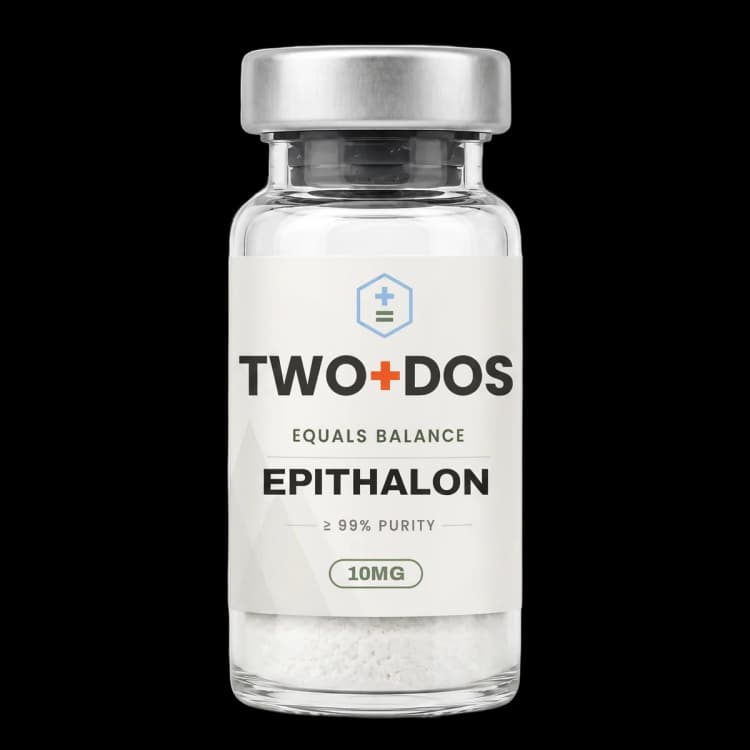
Chemical and physical properties of Epithalon
| Peptide class | Linear synthetic tetrapeptide, four L-residues joined by standard alpha-peptide bonds |
|---|---|
| Sequence | Ala-Glu-Asp-Gly, conventionally abbreviated AEDG |
| Molecular formula | C14H22N4O9 (free peptide) |
| Molecular weight | 390.35 g/mol (PubChem computed, CID 219042) |
| CAS number | 307297-39-8 for the free peptide. Supplier catalogues list the acetate salt separately as 307297-40-1, C16H26N4O11, 450.4 g/mol. |
| InChIKey | HGHOBRRUMWJWCU-FXQIFTODSA-N |
| UNII | O65P17785G |
| ChEBI identifier | CHEBI:230091 |
| Ionizable groups | One alpha-amino group at the N-terminal alanine and three carboxyl groups: the glutamate and aspartate side chains plus the C-terminal glycine |
| Stereochemistry | Three asymmetric centres, giving eight possible stereoisomers. Published work characterizes only the all-L form (Araj et al. 2025) |
| Solution conformation | AMBER molecular dynamics describes two intramolecular salt bridges plus one intramolecular hydrogen bond that sharply restrict conformational freedom |
| Reported purity | Research-grade material is specified at 98 percent or higher by HPLC per supplier certificates of analysis |
What is Epithalon?
Epithalon is a linear tetrapeptide built from L-alanine, L-glutamic acid, L-aspartic acid and glycine, joined through standard alpha-peptide bonds. Its composition was derived from Epithalamin, a bovine pineal gland extract, and the peptide was covered by Russian Patent 2161501 in 2001. A 2025 review notes the tetrapeptide was later detected within natural pineal polypeptide complexes.
Naming is a practical hazard with this molecule. Epithalamin is the crude bovine extract; Epithalon is the four-residue synthetic peptide drawn from it. The two are chemically distinct, yet chemical databases have merged their synonym lists, so a single PubChem record for CID 219042 carries both the tetrapeptide names and the extract names alongside a second registry number, 64082-79-7. Literature searches on one name will return work on the other.
Structurally the peptide is small, highly polar and heavily anionic. Three of its four residues carry a free carboxyl group, against a single free alpha-amino group at the alanine terminus. Molecular dynamics simulation with the AMBER force field describes two intramolecular salt bridges, formed between the alanine nitrogen and the carboxyl groups of the glutamate and aspartate residues, plus one intramolecular hydrogen bond. Together these contacts substantially reduce the conformational freedom of a peptide that would otherwise be expected to be disordered in solution.
One structural caveat is recorded in the 2025 International Journal of Molecular Sciences review. The peptide contains three asymmetric centres, which permits eight stereoisomers, and only the all-L configuration has been characterized in published work. The same review reports that a single earlier publication proposed an alternative double-gamma-bonded connectivity that no other group has reproduced.
What has been reported about Epithalon and telomerase?
Epithalon has been examined for telomerase effects since 2003, when a Russian group reported that adding the peptide to telomerase-negative human fetal fibroblast cultures induced catalytic subunit expression, telomerase activity and telomere elongation. An independent group at Brunel University London revisited the question in human cell lines in Biogerontology in 2025.
That 2025 study used four cell types plus two reference lines: the breast cancer lines 21NT and BT474, the fibroblast line IBR.3, primary human mammary epithelial cells, with U2OS as an ALT-positive control and PC3-hTERT as a telomerase-positive control. Cancer lines were exposed to 0.1, 0.2, 0.5 and 1.0 micrograms per millilitre for four days; the normal lines were exposed to 1.0 micrograms per millilitre for three weeks.
The measured outcomes split by cell type, and that split is the interesting part. In the normal lines, TRAP telomerase activity rose roughly 26-fold in mammary epithelial cells and about fourfold in IBR.3 fibroblasts. In the two cancer lines, TRAP activity did not rise significantly; instead the C-circle assay showed roughly a tenfold rise in 21NT and a threefold rise in BT474, with PML body staining consistent with alternative lengthening of telomeres. Telomere length rose in both groups, from about 2.4 kb to about 4 kb in 21NT and to a maximum near 8 kb in BT474. hTERT mRNA rose about 12-fold in 21NT at 1 microgram per millilitre and about fivefold in BT474 at 0.5 micrograms per millilitre. Comparisons were made by one-way ANOVA at p less than 0.05.
Two qualifications belong on the record. First, the authors of that paper issued a correction in Biogerontology in November 2025 covering errors in the published figures; the correction notice is listed in the references below. Second, the finding that telomere extension in malignant lines ran through ALT rather than telomerase activation is a mechanistically distinct route from the one described in normal cells, and the paper reports them as separate observations rather than a single effect.
A second 2025 report worked in a reproductive model. Ullah and colleagues, publishing in Life Sciences, measured TERT protein and telomerase activity in bovine cumulus cells and cumulus-oocyte complexes, and reported that peptide exposure raised telomerase activity, lowered intracellular reactive oxygen species, improved mitochondrial measures, raised the oocyte maturation rate and raised post-thaw blastocyst hatching rate and implantation potential, each at p less than 0.05.
How does Epithalon interact with DNA and chromatin?
Epithalon is proposed to act on gene expression through direct nucleic acid and chromatin contact rather than a cell-surface receptor. The 2025 review describes binding to the DNA sequences ATTTG and ATTTC through hydrophobic contacts with thymine methyl groups plus hydrogen bonds, and a drop in double-stranded DNA melting temperature of up to 41 degrees Celsius.
That melting-point figure was recorded at 0.1 M NaCl, and a related mechanism concerns methylation. Ultrashort peptides of this family bind single- and double-stranded deoxyribonucleotides and associate with CNG and CG promoter sites, the targets of DNA cytosine methyltransferases in eukaryotes. Occupancy at those sites is proposed to render them less accessible to the methyltransferases, which would place the peptide upstream of transcription rather than at the promoter output.
The chromatin side of the picture comes from a 2020 study in Molecules. Khavinson and colleagues docked the AEDG peptide against six histone proteins and found suitable sites only on the linker histones, scoring minus 64.51 kcal/mol at histone H1/6, at the site Tyr-Arg-Lys-Thr-Gln, and minus 56.49 kcal/mol at H1/3. Core histones H2b, H3 and H4 returned no suitable site. In the same paper, human gingival mesenchymal stem cells exposed to 0.01 micrograms per millilitre for one week showed Nestin, GAP43, beta-tubulin III and doublecortin mRNA raised 1.6 to 1.8-fold against control at p less than 0.01.
Cytogenetic work points in a compatible direction. Lezhava and colleagues reported in Georgian Medical News in 2023 that Epitalon, Livagen and Vilon produced chromatin decondensation, described as deheterochromatinization, in cultured lymphocytes from elderly donors, replicating an observation the same group had published earlier. Taken together, the DNA-melting, methylation-site and linker-histone strands all describe an accessibility mechanism, though none of them has been resolved structurally.
What has Epithalon shown in oxidative-stress models?
Epithalon is characterized in the literature as an antioxidant peptide, and the clearest recent data come from a 2025 study in Stem Cell Reviews and Reports using ARPE-19 human retinal pigment epithelial cells. Cells were held at 35 mM glucose for 72 hours, with the peptide supplied at 20, 40 and 60 nanograms per millilitre.
Menadione at 20 micromolar served as the oxidative-stress positive control in that design. High glucose slowed scratch closure, raised intracellular reactive oxygen species and lowered antioxidant gene expression. At 40 and 60 nanograms per millilitre the peptide lowered glucose-driven hydrogen peroxide generation and attenuated the fall in SOD2, CAT and HMOX1 expression. The same exposure attenuated the glucose-induced epithelial-mesenchymal transition and the upregulation of fibrosis-associated genes. The authors state that further mechanistic work is required.
An earlier report in Aging examined mouse oocytes aged in vitro after ovulation, with the peptide at 0.1 mM in the culture medium and quality scored at 6, 12 and 24 hours. Intracellular reactive oxygen species fell, spindle defects and abnormal cortical granule distribution were less frequent at 12 and 24 hours, mitochondrial membrane potential and mitochondrial DNA copy number rose, and apoptosis at 24 hours of in vitro aging fell.
The 2025 review adds an invertebrate anchor and a concentration curiosity. Drosophila melanogaster given 0.00001 percent by weight at the early larval stage showed a 16 percent extension of adult lifespan, while murine thymocytes showed maximal proliferation between 10 to the minus 17 and 10 to the minus 15 molar, a range far below conventional pharmacological concentrations. The same review reports acetylcholinesterase and butyrylcholinesterase activity raised 10 to 25 percent in SH-SY5Y neuroblastoma cells, with soluble amyloid precursor protein secretion raised about 20 percent.
What has been reported in neuronal and cellular aging models?
Epithalon appears in several models of neuronal and cellular aging, and 2024 work in the International Journal of Molecular Sciences is the most methodologically careful. Kraskovskaya and colleagues transdifferentiated dermal fibroblasts from three elderly donors, aged 61, 66 and 68, into induced cortical neurons, then applied AEDG, EDR and KED peptides at 10 micrograms per millilitre.
Exposure ran for 10 days during differentiation, with analysis on day 11. For the AEDG peptide, the number of primary processes rose 34 percent, from 4.59 plus or minus 0.3 to 6.18 plus or minus 0.4 at p equal to 0.0046, and total dendrite length rose 32 percent, from 270.2 plus or minus 25.5 to 357.8 plus or minus 30 at p equal to 0.05. The negative results in that paper are equally informative: changes in p16, LaminB1, 8-OHdG oxidative DNA damage, mitochondrial activity and lysosomal activity did not reach statistical significance for this peptide. Reduction in oxidative DNA damage was specific to the EDR tripeptide.
A 2024 review in Advances in Gerontology surveyed buccal epithelium as a marker tissue and reported associations between pineal polypeptides, the AEDG peptide and expression of circadian genes Cry2, AANAT, ASMT and CLOCK, alongside changes in p16, p21 and p53 and modulation of TERF-1, prohibitin, SIRT1 and SIRT6.
The most recent framing comes from a narrative review published in Frontiers in Aging in 2026. Mavrych and colleagues searched PubMed, Scopus and regulatory registers through January 2026 and grouped nine peptides by the aging hallmark each addresses, placing this one under telomere biology. Their assessment of the evidence base is direct: unapproved compounds in the set rest on preclinical and limited clinical data, lack systematic confirmation, and carry gaps in toxicology data and in validated biomarkers for effect assessment. That is the fairest summary of where the compound sits in 2026.
Summary of published research
Findings below are reported as published by the cited authors, in the model systems they used. They describe laboratory research, and none of them characterize use in humans.
Al-Dulaimi S, Thomas R, Matta S, Roberts T. Epitalon increases telomere length in human cell lines through telomerase upregulation or ALT activity. Biogerontology (2025)
- Model system
- Human cell lines: 21NT and BT474 breast cancer, IBR.3 fibroblasts, primary mammary epithelial cells; U2OS and PC3-hTERT reference lines
- Conditions
- 0.1 to 1.0 micrograms per millilitre for 4 days in cancer lines; 1.0 micrograms per millilitre for 3 weeks in normal lines; qPCR telomere length, hTERT mRNA, TRAP assay, C-circle assay, PML immunofluorescence
- Reported finding
- Telomere length rose in a concentration-dependent manner, from about 2.4 kb to about 4 kb in 21NT and to a maximum near 8 kb in BT474. hTERT mRNA rose about 12-fold in 21NT at 1 microgram per millilitre and about fivefold in BT474 at 0.5 micrograms per millilitre. TRAP telomerase activity rose about 26-fold in mammary epithelial cells and fourfold in IBR.3 but not significantly in the cancer lines, where C-circle signal instead rose about tenfold in 21NT and threefold in BT474. One-way ANOVA, p less than 0.05. A correction covering figure errors was published in November 2025.
Gatta M, et al. The Antioxidant Tetrapeptide Epitalon Enhances Delayed Wound Healing in an in Vitro Model of Diabetic Retinopathy. Stem Cell Reviews and Reports (2025)
- Model system
- ARPE-19 human retinal pigment epithelial cell line
- Conditions
- 35 mM glucose for 72 h; peptide at 20, 40 and 60 nanograms per millilitre; menadione at 20 micromolar as oxidative-stress positive control
- Reported finding
- High glucose slowed scratch closure, raised intracellular reactive oxygen species and lowered antioxidant gene expression. Peptide exposure at 40 and 60 nanograms per millilitre lowered glucose-driven hydrogen peroxide generation, attenuated the fall in SOD2, CAT and HMOX1 expression, and attenuated the glucose-induced epithelial-mesenchymal transition and fibrosis-associated gene upregulation.
Ullah S, Haider Z, Perera CD, Lee SH, Idrees M, Park S, Kong IK. Epitalon-activated telomerase enhance bovine oocyte maturation rate and post-thawed embryo development. Life Sciences (2025)
- Model system
- Bovine cumulus cells and cumulus-oocyte complexes; in vitro embryo production
- Conditions
- Peptide supplied in the in vitro maturation medium; TERT protein expression, telomerase activity, mitochondrial measures and intracellular reactive oxygen species assessed
- Reported finding
- Telomerase activity rose in bovine cumulus cells and cumulus-oocyte complexes. Oocyte maturation rate rose against the control group at p less than 0.05, intracellular reactive oxygen species fell, mitochondrial measures improved, and post-thaw blastocyst hatching rate and implantation potential rose at p less than 0.05.
Araj SK, Madra-Gackowska K, Szeleszczuk L, et al. Overview of Epitalon-Highly Bioactive Pineal Tetrapeptide with Promising Properties. International Journal of Molecular Sciences (2025)
- Model system
- Narrative review of in vitro, in vivo and in silico work
- Conditions
- Synthesis of roughly 25 years of published studies, with attention to physicochemical and structural gaps
- Reported finding
- The authors catalogued geroprotective, neuroendocrine, antioxidant and antimutagenic effects across models, including a reduction in double-stranded DNA melting temperature of up to 41 degrees Celsius at 0.1 M NaCl, maximal murine thymocyte proliferation between 10 to the minus 17 and 10 to the minus 15 molar, acetylcholinesterase and butyrylcholinesterase activity raised 10 to 25 percent in SH-SY5Y cells, and a 16 percent lifespan extension in Drosophila at 0.00001 percent by weight. They concluded that the precise mechanism remains unverified and that physicochemical, structural and toxicology data are sparse.
Mavrych V, et al. Therapeutic peptides in gerontology: mechanisms and applications for healthy aging. Frontiers in Aging (2026)
- Model system
- Narrative review
- Conditions
- Structured search of PubMed, Scopus and regulatory registers from inception through January 2026; nine peptides appraised across aging hallmarks
- Reported finding
- The tetrapeptide was grouped under telomere biology among nine peptides mapped to distinct aging hallmarks. The authors reported that unapproved compounds in the set rest on preclinical and limited clinical data, lack systematic confirmation, and carry gaps in toxicology data and in validated biomarkers for effect assessment.
Kraskovskaya N, et al. Short Peptides Protect Fibroblast-Derived Induced Neurons from Age-Related Changes. International Journal of Molecular Sciences (2024)
- Model system
- Induced cortical neurons transdifferentiated from dermal fibroblasts of human donors aged 61, 66 and 68
- Conditions
- AEDG, EDR and KED peptides at 10 micrograms per millilitre for 10 days during differentiation; analysis on day 11
- Reported finding
- The AEDG peptide raised the number of primary processes by 34 percent, from 4.59 plus or minus 0.3 to 6.18 plus or minus 0.4 at p equal to 0.0046, and total dendrite length by 32 percent, from 270.2 plus or minus 25.5 to 357.8 plus or minus 30 at p equal to 0.05. Changes in p16, LaminB1, 8-OHdG, mitochondrial activity and lysosomal activity did not reach statistical significance for this peptide.
Lezhava T, et al. EPIGENETIC MODIFICATION UNDER THE INFLUENCE OF PEPTIDE BIOREGULATORS ON THE 'OLD' CHROMATIN. Georgian Medical News (2023)
- Model system
- Cultured human lymphocytes from elderly donors
- Conditions
- Peptide bioregulators Epitalon, Livagen and Vilon applied to lymphocyte cultures; structural and facultative heterochromatin scored cytogenetically
- Reported finding
- The authors reported chromatin decondensation, described as deheterochromatinization, in lymphocytes from elderly donors exposed to the peptide bioregulators, replicating an earlier report from the same group.
Ivko OM, Trofimova SV, Trofimov AV, Sharkovich Z, Mogilev VA. Peptidergic regulation of expression of cellular aging marker proteins in buccal epithelium. Advances in Gerontology (2024)
- Model system
- Review of buccal epithelium marker studies
- Conditions
- Synthesis of long-term work from the Saint Petersburg Institute of Bioregulation and Gerontology alongside international findings
- Reported finding
- The review reported associations between pineal polypeptides, the AEDG peptide and expression of the circadian genes Cry2, AANAT, ASMT and CLOCK, alongside reductions in p16, p21 and p53 and modulation of TERF-1, prohibitin, SIRT1 and SIRT6 as buccal epithelium markers of cellular aging.
Khavinson V, Diomede F, Mironova E, Linkova N, Trofimova S, Trubiani O, Caputi S, Sinjari B. AEDG Peptide (Epitalon) Stimulates Gene Expression and Protein Synthesis during Neurogenesis: Possible Epigenetic Mechanism. Molecules (2020)
- Model system
- Human gingival mesenchymal stem cells, with molecular docking against six histone proteins
- Conditions
- Peptide at 0.01 micrograms per millilitre for 1 week; qPCR of neuronal differentiation markers
- Reported finding
- Nestin, GAP43, beta-tubulin III and doublecortin mRNA rose 1.6 to 1.8-fold against control at p less than 0.01. Docking favoured the linker histones, returning minus 64.51 kcal/mol at histone H1/6 at the site Tyr-Arg-Lys-Thr-Gln and minus 56.49 kcal/mol at H1/3, while core histones H2b, H3 and H4 showed no suitable site.
Yue X, Liu SL, Guo JN, Meng TG, Zhang XR, Li HX, Song CY, Wang ZB, Schatten H, Sun QY, Guo XP. Epitalon protects against post-ovulatory aging-related damage of mouse oocytes in vitro. Aging (Albany NY) (2022)
- Model system
- Mouse oocytes aged in vitro after ovulation
- Conditions
- 0.1 mM peptide in the culture medium; oocyte quality scored at 6, 12 and 24 h
- Reported finding
- Intracellular reactive oxygen species fell. Spindle defects and abnormal cortical granule distribution were less frequent at 12 and 24 h, mitochondrial membrane potential and mitochondrial DNA copy number rose, and apoptosis at 24 h of in vitro aging fell.
Khavinson VKh, Bondarev IE, Butyugov AA. Epithalon peptide induces telomerase activity and telomere elongation in human somatic cells. Bulletin of Experimental Biology and Medicine (2003)
- Model system
- Telomerase-negative human fetal fibroblast culture
- Conditions
- Peptide supplied in culture; telomerase catalytic subunit expression, enzyme activity and telomere length measured
- Reported finding
- The peptide induced expression of the telomerase catalytic subunit, enzymatic telomerase activity and telomere elongation in a telomerase-negative human somatic cell culture. The authors framed the result as reactivation of the telomerase gene in somatic cells. This is the canonical first report of the effect and the anchor for most later work.
What laboratory handling information is published?
Epithalon is supplied as a lyophilized solid, and the first handling question is salt form rather than storage. Commercial material exists as the acetate or trifluoroacetate salt, and those are separate chemical entities from the free peptide: the free peptide is C14H22N4O9 at 390.35 g/mol under CAS 307297-39-8, while catalogues list the acetate as C16H26N4O11 at 450.4 g/mol under CAS 307297-40-1. Gravimetric calculations that assume the free-peptide mass will be roughly 13 percent off when the material is an acetate. Certificates of analysis that report peptide content separately from HPLC purity resolve this; those that report only purity do not.
Identity confirmation has a documented pitfall specific to this sequence. The 2025 review describes an isomeric impurity, EADG (Glu-Ala-Asp-Gly), which differs only in the order of the first two residues and therefore shares the exact mass of the target peptide. Liquid chromatography with tandem mass spectrometry distinguishes the two by exploiting heat-induced cyclization of an N-terminal glutamic acid to pyroglutamate, which lowers the observed mass in the isomer but not in Ala-Glu-Asp-Gly. The review reports this method being applied to commercial preparations between 2012 and 2017, so the isomer is a real-world contaminant rather than a theoretical one.
Chemically the molecule is polar and anionic, carrying three free carboxyl groups against one free amino group, which is consistent with aqueous solubility and with the hygroscopic behaviour typical of lyophilized acidic peptides. Suppliers specify storage of the solid at minus 20 degrees Celsius. These are catalogue specifications rather than published stability measurements; no peer-reviewed degradation kinetics, pH-dependent solubility curve or isoelectric point determination for this peptide was located, and the 2025 review states directly that physicochemical and structural investigation of the molecule remains limited.
Two further gaps are worth recording before designing work with the material. Stereochemical purity is rarely specified even though eight stereoisomers are possible and only the all-L form has been studied. And the same review states that information on short- and long-term toxicity, including genotoxicity and carcinogenic potential, is missing from the literature. Research use only; not for human or veterinary use.
Frequently asked research questions
What is the amino acid sequence of Epithalon?
Ala-Glu-Asp-Gly, abbreviated AEDG. All four residues are L-configured and joined through standard alpha-peptide bonds, giving the formula C14H22N4O9 and a molecular weight of 390.35 g/mol under PubChem CID 219042.
Is Epithalon the same compound as Epithalamin?
No. Epithalamin is a crude polypeptide extract of the bovine pineal gland. Epithalon is the four-residue synthetic peptide whose composition was modelled on that extract. Chemical databases have merged their synonym lists, so the same PubChem record carries names for both, which is a frequent source of citation error.
What did the 2025 independent telomerase study measure?
TRAP telomerase activity, hTERT mRNA, qPCR telomere length, C-circle signal and PML bodies across four human cell types. Telomerase activity rose in the normal lines, roughly 26-fold in mammary epithelial cells, while the two breast cancer lines showed alternative lengthening of telomeres instead, with C-circle signal up about tenfold in 21NT.
What mechanism is proposed for the gene expression effects?
Direct nucleic acid and chromatin contact rather than a cell-surface receptor. Reported components include sequence binding at ATTTG and ATTTC, occupancy of CNG and CG promoter sites that are methyltransferase targets, a fall in double-stranded DNA melting temperature of up to 41 degrees Celsius, and docking to linker histones H1/6 and H1/3 at minus 64.51 and minus 56.49 kcal/mol.
How current is the evidence base?
Mixed. The foundational telomerase report dates to 2003 and originates from a single research programme, but independent work appeared in 2022, 2024, 2025 and 2026, including cell-line, oocyte and retinal epithelial models. A 2026 narrative review in Frontiers in Aging concluded that systematic confirmation and toxicology data remain outstanding.
Epithalon at TWO+DOS
TWO+DOS supplies Epithalon as a research-use-only compound, third-party tested, with certificates of analysis emailed immediately on request.
View the Epithalonlisting →Related research overviews
References
- PubChem CID 219042: formula, mass, InChIKey, UNII and synonym list
- Araj et al. 2025, International Journal of Molecular Sciences: 25-year review (PMID 40141333)
- Al-Dulaimi et al. 2025, Biogerontology: telomere length in human cell lines (PMID 40908429)
- Correction notice to Al-Dulaimi et al. 2025, Biogerontology (PMID 41240216)
- Gatta et al. 2025, Stem Cell Reviews and Reports: ARPE-19 high-glucose model (PMID 40493162)
- Ullah et al. 2025, Life Sciences: bovine cumulus-oocyte complexes (PMID 39788414)
- Mavrych et al. 2026, Frontiers in Aging: peptides mapped to aging hallmarks (PMID 42021992)
- Kraskovskaya et al. 2024, IJMS: induced neurons from aged donor fibroblasts (PMID 39518916)
- Khavinson et al. 2020, Molecules: histone docking and neurogenesis markers (PMID 32019204)
- Yue et al. 2022, Aging: post-ovulatory mouse oocyte model (PMID 35413689)
- Khavinson et al. 2003, Bulletin of Experimental Biology and Medicine (PMID 12937682)
- Lezhava et al. 2023, Georgian Medical News: chromatin decondensation (PMID 37042594)
For research use only. Not for human or veterinary use. Not for diagnostic or therapeutic use.