
GHK-Cu: Copper Coordination Chemistry and Published Research Literature
By the TWO+DOS Research Team · Published 2026-08-12
For research use only. Not for human or veterinary use. Not for diagnostic or therapeutic use.
GHK-Cu is the copper(II) complex of glycyl-L-histidyl-L-lysine, a three-residue peptide first isolated from human serum in 1973. The complex has a molecular weight of 402.92 grams per mole and is catalogued at PubChem CID 71587328 under CAS 89030-95-5, separately from the metal-free tripeptide.
This overview sets out what the published record establishes about the molecule: its identity data and coordination chemistry, the concentration ranges at which effects have been measured in cultured cells, its catalytic behaviour in cell-free assays, its degradation profile, and what recent whole-organism work in nematode and zebrafish models reported. Findings appear as their authors published them, in the model systems used.
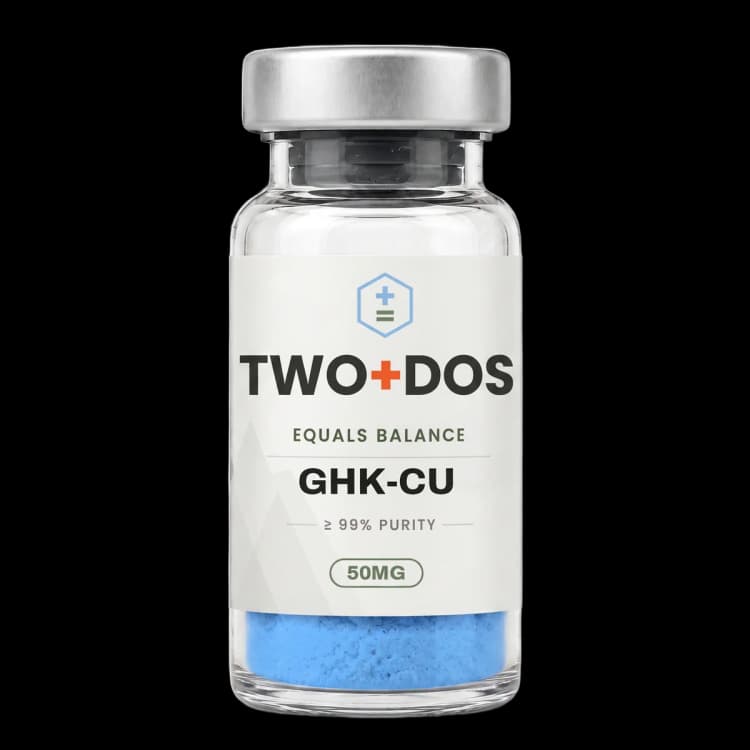
Chemical and physical properties of GHK-Cu
| Peptide sequence | Gly-His-Lys, written GHK. Three residues, linear, with a free N-terminal amine, an imidazole side chain at histidine and an epsilon-amino group at lysine. All three groups participate in metal coordination chemistry. |
|---|---|
| Molecular formula (copper complex) | C14H23CuN6O4+, the cationic 1:1 copper(II) species catalogued at PubChem CID 71587328 |
| Molecular weight (copper complex) | 402.92 g/mol; exact mass 402.107675 Da |
| Molecular formula and mass (metal-free tripeptide) | C14H24N6O4, 340.38 g/mol; exact mass 340.18590327 Da, PubChem CID 73587 |
| CAS numbers | 89030-95-5 for the copper complex and 49557-75-7 for the metal-free tripeptide. The two registry numbers describe chemically distinct materials and are not interchangeable on procurement records. |
| InChIKey | NZWIFMYRRCMYMN-ACMTZBLWSA-M for the copper complex; MVORZMQFXBLMHM-QWRGUYRKSA-N for the metal-free tripeptide |
| Metal stoichiometry | One copper(II) ion per tripeptide, a 1:1 complex. PubChem represents the species as a monocation. |
| Computed polarity descriptors (metal-free tripeptide) | XLogP minus 4.4; topological polar surface area 176 square angstroms; 6 hydrogen-bond donors; 7 acceptors; 11 rotatable bonds (PubChem computed) |
| Measured distribution coefficient | log D between minus 2.38 and minus 2.49 in octanol against phosphate-buffered saline across pH 4.5 to 7.4, measured on the copper complex |
| Optical behaviour | pH titration of the copper complex resolved three optical transitions with apparent pK values of 3.6, 9.2 and 11.4 |
| Other database identifiers | UNII 6BJQ43T1I9; DrugBank DB14683; cosmetic ingredient nomenclature lists the complex as Copper tripeptide-1 |
What is GHK-Cu?
GHK-Cu is the copper(II) complex of glycyl-L-histidyl-L-lysine, a tripeptide isolated from human serum in 1973. The complex carries a molecular weight of 402.92 grams per mole, CAS number 89030-95-5 and PubChem CID 71587328, while the metal-free tripeptide is catalogued separately as CAS 49557-75-7 and CID 73587.
The origin citation is Pickart and Thaler, publishing in Nature New Biology in 1973 on a tripeptide in human serum that prolonged survival of normal liver cells in culture. Fifteen years later Maquart and colleagues noted that the same GHK triplet occurs within the alpha-2 chain of type I collagen, and proposed that proteolysis at a site of tissue damage could liberate the sequence locally. That structural observation, rather than any identified receptor, remains the usual explanation offered for why the sequence appears in mammalian extracellular matrix at all.
Nomenclature around this compound is unusually loose, and it matters for laboratory records. Suppliers, ingredient listings and the primary literature all apply the label copper peptide to at least three different things: the metal-free tripeptide, the 1:1 copper complex, and acylated derivatives such as palmitoyl-GHK-Cu. Recording the registry number rather than the trivial name removes the ambiguity.
How does GHK-Cu coordinate copper, and how tightly?
GHK-Cu binds a single copper(II) ion through the nitrogen donors of the tripeptide. Spectroscopic work published in Biochemistry in 1982 placed two or three nitrogen atoms in the equatorial coordination sphere at neutral pH, and pH titration of the complex resolved three optical transitions with apparent pK values of 3.6, 9.2 and 11.4.
That 1982 study, using optical, electron paramagnetic resonance and electron spin-echo methods, reached a conclusion at odds with earlier crystallographic work: the solution species is nitrogen-coordinated rather than the oxygen-bridged copper pair described for the solid state. Anyone reasoning from a published crystal structure to solution behaviour should account for that difference.
The competition question was settled earlier. Lau and Sarkar, in Biochemical Journal in 1981, used equilibrium dialysis at pH 7.5 and reported that at equimolar albumin roughly 42 percent of the copper(II) remained bound to the peptide, while at physiological concentrations approximately 6 percent of copper(II) associated with low-molecular-weight components. The epsilon-amino group of lysine raised stability constants relative to comparable dipeptides, and ternary complex formation was extensive.
Two recent papers extend the binding chemistry with new methods. Distefano and colleagues in 2025 immobilised GHK-containing peptides on photoluminescent hydrogels and derived binding constants from fluorescence quenching, finding that greater distance between the GHK sequence and the surface lowered the binding constant. A 2026 computational study in Physical Chemistry Chemical Physics built boron-nitrogen substituted carbonless analogues of the tripeptide and reported at the DFT level that the analogue stabilised copper more strongly than the natural sequence.
At what concentrations has GHK-Cu shown activity in fibroblast culture?
GHK-Cu was reported to raise collagen synthesis in cultured fibroblasts at picomolar to nanomolar concentrations. Maquart and colleagues, publishing in FEBS Letters in 1988, measured stimulation beginning between 10(-12) and 10(-11) molar, reaching a maximum at 10(-9) molar, and independent of any change in cell number. The concentration window is the most-cited quantitative result in this literature.
The independence from cell number matters methodologically. It separates a change in synthetic output per cell from a change in population size, a distinction a proliferation assay alone cannot make. Reports describing the compound as simply raising fibroblast numbers are not what that experiment measured.
More recent connective-tissue work has moved to conjugates rather than the free complex. Greco and colleagues, in Bioconjugate Chemistry in 2025, synthesised hyaluronan conjugates of GHK at several peptide loadings, showed that they bind copper(II), and reported expression and release of brain-derived neurotrophic factor, vascular endothelial growth factor and bone morphogenetic protein-2, linked to nuclear translocation of the copper chaperones CCS and Atox1. Those results describe the conjugate, and should not be reported as properties of the unmodified complex.
What catalytic and redox chemistry has been measured for GHK-Cu?
GHK-Cu has measurable catalytic activity in its own right. A 2026 study in Biosensors characterised the complex as a laccase mimic, reporting a Michaelis constant of 0.061 millimolar and a maximum velocity of 1.735 x 10(-4) millimolar per second. Those constants place the complex in the working range of nanozyme chemistry rather than in the range of trace metal contamination.
The same group built two colorimetric assays on that activity. Epinephrine gave a linear response from 20 to 240 micromolar with a limit of detection of 9.5 micromolar. 2-aminophenol gave 14 to 100 micromolar in ultrapure water and 2 to 120 micromolar in seawater, with limits of detection of 2.56 and 1.65 micromolar. A cotton-based sensor read by smartphone reached 0.033 millimolar. These figures of merit are the most precisely quantified properties published for this complex.
On the redox side, a 2025 review in Antioxidants covering carnosine and GHK glycoconjugates reported that GHK-Cu quenches 4-hydroxy-trans-2-nonenal and acrolein, both products of lipid peroxidation, and that copper complexes of hyaluronan-GHK derivatives displayed higher superoxide dismutase 1-like activity than the copper complexes of either hyaluronan or GHK alone.
How stable is GHK-Cu, and what degrades it?
GHK-Cu stability has been characterised under forced-degradation conditions. A preformulation study in Pharmaceutical Development and Technology reported the complex stable in water and in buffers across pH 4.5 to 7.4 for at least two weeks at 60 degrees Celsius, while basic and oxidative stressors produced hydrolytic cleavage with first-order degradation profiles, and acidic stress did so to a lesser extent.
The same study identified three key degradation products by liquid chromatography with mass spectrometry, one of which was the constituent amino acid histidine. Compatibility screening found the complex stable with Span 60 based niosomes but less stable with the negatively charged lipid dicetyl phosphate.
Biological matrices are a different picture. The 2025 Antioxidants review states plainly that GHK shows low survival capacity in human serum and that GHK-Cu undergoes rapid degradation in a weakly acidic environment or under peptidase attack. That instability, rather than any shortage of measured activity, is the stated reason the field has turned to hyaluronan conjugates, liposomal encapsulation and hydrogel carriers.
What did recent whole-organism studies of GHK-Cu measure?
GHK-Cu entered whole-organism screening in 2026. A Biogerontology study in Caenorhabditis elegans reported extended lifespan alongside greater resistance to oxidative and thermal stress, improved motility, pharyngeal pumping and defecation rhythm, and reduced lipofuscin and lipid accumulation, with mitochondrial and transcription-factor endpoints measured in parallel.
The mechanistic readouts in that study were specific. Mitochondrial membrane potential increased, age-related fragmentation of the network was reduced, dynamics shifted toward fusion through drp-1 and fzo-1 expression, and ATP biosynthesis rose. The DAF-16 and SKN-1 pathways were activated and the downstream genes sod-3, gst-4, gcs-1, lys-7 and lys-8 were upregulated, which the authors described as the first mechanistic evidence tying the compound to both pathways at once.
A second 2026 report, in European Journal of Pharmacology, used zebrafish larvae challenged with copper sulfate or lipopolysaccharide. GHK-Cu decreased migration of neutrophils and macrophages, suppressed tnf-a, il-1b and il6, and increased il-10. Nitric oxide and reactive oxygen species levels fell while superoxide dismutase activity rose, with downregulation of the JAK1 pathway identified as the associated signalling change. Both studies are model-organism work; neither extends to mammals.
Summary of published research
Findings below are reported as published by the cited authors, in the model systems they used. They describe laboratory research, and none of them characterize use in humans.
Pickart L, Thaler MM. Tripeptide in human serum which prolongs survival of normal liver cells and stimulates growth in neoplastic liver. Nature New Biology (1973)
- Model system
- Human serum fractionation with cultured liver cell assay
- Conditions
- Serum-derived fraction applied to normal and neoplastic liver cell cultures
- Reported finding
- A tripeptide present in human serum was identified and reported to prolong survival of normal liver cells in culture. This is the origin citation for the Gly-His-Lys sequence; the record carries no abstract.
Lau SJ, Sarkar B. The interaction of copper(II) and glycyl-L-histidyl-L-lysine, a growth-modulating tripeptide from plasma. Biochemical Journal (1981)
- Model system
- Cell-free equilibrium dialysis and speciation analysis
- Conditions
- pH 7.5 equilibrium dialysis against albumin at equimolar and physiological concentrations
- Reported finding
- Roughly 42 percent of the copper(II) remained bound to the peptide at equimolar albumin, and approximately 6 percent of copper(II) associated with low-molecular-weight components at physiological concentrations. The epsilon-amino group of lysine raised stability constants relative to comparable dipeptides, and extensive ternary complexes were characterised.
Freedman JH, Pickart L, Weinstein B, Mims WB, Peisach J. Structure of the glycyl-L-histidyl-L-lysine-copper(II) complex in solution. Biochemistry (1982)
- Model system
- Cell-free spectroscopy: optical, electron paramagnetic resonance, electron spin-echo
- Conditions
- Neutral pH with full pH titration of the copper complex, volume 21, pages 4540 to 4544
- Reported finding
- The electron paramagnetic resonance spectrum was consistent with copper(II) equatorially coordinated by two or three nitrogen atoms at neutral pH. pH titration resolved three optical transitions with apparent pK values of 3.6, 9.2 and 11.4. The solution structure differed from the oxygen-bridged copper pairs previously reported for the solid state.
Maquart FX, Pickart L, Laurent M, Gillery P, Monboisse JC, Borel JP. Stimulation of collagen synthesis in fibroblast cultures by the tripeptide-copper complex glycyl-L-histidyl-L-lysine-Cu2+. FEBS Letters (1988)
- Model system
- Cultured fibroblasts
- Conditions
- Concentration series spanning 10(-12) to 10(-9) molar; collagen synthesis and cell number measured in parallel
- Reported finding
- Collagen synthesis rose beginning between 10(-12) and 10(-11) molar and reached a maximum at 10(-9) molar, with no accompanying change in cell number. The authors noted that a GHK triplet occurs in the alpha-2 chain of type I collagen and proposed local liberation of the sequence by proteases.
Badenhorst T, Svirskis D, Wu Z. Physicochemical characterization of native glycyl-l-histidyl-l-lysine tripeptide for wound healing and anti-aging: a preformulation study for dermal delivery. Pharmaceutical Development and Technology (2016)
- Model system
- Cell-free preformulation study with validated stability-indicating RP-HPLC
- Conditions
- Octanol against phosphate-buffered saline across pH 4.5 to 7.4; forced degradation under acidic, basic and oxidative stress; two weeks at 60 degrees Celsius
- Reported finding
- Distribution coefficients of minus 2.38 to minus 2.49 indicated a highly hydrophilic complex. The material held in water and in pH 4.5 to 7.4 buffers for at least two weeks at 60 degrees Celsius, but underwent hydrolytic cleavage under basic and oxidative stress with first-order profiles. Three degradation products were identified, one of them histidine.
Distefano A, Corsaro P, Tuccitto N, Laneri F, Monasson O, Peroni E, Grasso G. Intrinsically photoluminescent hydrogels to measure peptides-copper binding affinities. Journal of Inorganic Biochemistry (2025)
- Model system
- Cell-free biosensor surface chemistry
- Conditions
- Amino-decorated photoluminescent hydrogels functionalised by EDC/NHS coupling; copper titration with quenching efficiency and fluorescence lifetime measurement
- Reported finding
- Binding constants were derived for immobilised peptides sharing the GHK copper-binding residues but differing in chain length. Increasing the distance of the GHK sequence from the surface lowered the binding constant and reduced quenching efficiency, while lifetime measurements indicated an unchanged binding mechanism.
Greco V, Lanza V, Tomasello B, Naletova I, Cairns WRL, Sciuto S, Rizzarelli E. Copper Complexes with New Glycyl-l-histidyl-l-lysine-Hyaluronan Conjugates Show Antioxidant Properties and Osteogenic and Angiogenic Synergistic Effects. Bioconjugate Chemistry (2025)
- Model system
- In vitro assays with synthesised GHK-hyaluronan conjugates, volume 36, pages 662 to 675
- Conditions
- Conjugates prepared at several tripeptide loadings and loaded with copper(II)
- Reported finding
- The conjugates bound copper(II) and, in the authors' assessment, potentiated the chemical and biological properties of both components. Expression and release of brain-derived neurotrophic factor, vascular endothelial growth factor and bone morphogenetic protein-2 were reported, linked to nuclear translocation of the copper chaperones CCS and Atox1.
Ogorek K, Nowak K, Wadych E, Ruzik L, Timerbaev AR, Matczuk M. Are We Ready to Measure Skin Permeation of Modern Antiaging GHK-Cu Tripeptide Encapsulated in Liposomes? Molecules (2025)
- Model system
- Review of permeation methodology, volume 30, article 136
- Conditions
- Literature review; no new experimental work
- Reported finding
- The review characterised the complex as fairly hydrophilic with limited permeation through the lipophilic stratum corneum, surveyed methods for measuring transport of free and liposome-encapsulated material, and concluded that transport of liposomes containing the complex has received little attention, identifying a methodological gap.
Naletova I, Rizzarelli E. Protective Functions of β-Alanyl-L-Histidine and Glycyl-L-Histidyl-L-Lysine Glycoconjugates and Copper in Concert. Antioxidants (2025)
- Model system
- Review of coordination chemistry and conjugate literature, volume 14, article 1512
- Conditions
- Literature review covering copper complexes of carnosine and GHK derivatives
- Reported finding
- The review reported quenching of 4-hydroxy-trans-2-nonenal and acrolein by the copper complex, and higher superoxide dismutase 1-like activity for copper complexes of hyaluronan-GHK derivatives than for those of hyaluronan or GHK alone. It also stated that GHK shows low survival capacity in human serum and that the copper complex degrades rapidly in weakly acidic conditions or under peptidase attack.
Chen JS, Zhu H, Chai TQ, Yang FQ. The Laccase-like Property of GHK-Cu and Its Applications in Colorimetric Sensing of Phenolic Compounds. Biosensors (2026)
- Model system
- Cell-free enzyme-mimetic kinetics and colorimetric sensing
- Conditions
- Michaelis-Menten kinetics; colorimetric assays in ultrapure water and seawater; cotton-based sensor read by smartphone
- Reported finding
- Laccase-like activity was measured with a Michaelis constant of 0.061 millimolar and a maximum velocity of 1.735 x 10(-4) millimolar per second. Epinephrine gave a detection limit of 9.5 micromolar over 20 to 240 micromolar; 2-aminophenol gave 2.56 micromolar in water and 1.65 micromolar in seawater. The cotton sensor reached 0.033 millimolar.
Wen H, Zhao K, Luo X, Pu J, Li Y, Dou Y, He J, Nie X, Ke Y, Zhou W. The GHK-Cu delays aging in Caenorhabditis elegans via coordinated regulation of mitochondrial function and activation of DAF-16/SKN-1 pathways. Biogerontology (2026)
- Model system
- Caenorhabditis elegans
- Conditions
- Lifespan assay with oxidative and thermal stress challenge; mitochondrial membrane potential, network morphology, ATP and transcript measurements
- Reported finding
- Lifespan was extended and several age-related phenotypes were altered, including stress resistance, motility, pharyngeal pumping and reduced lipofuscin accumulation. Mitochondrial membrane potential rose, network fragmentation fell, dynamics shifted toward fusion through drp-1 and fzo-1, ATP biosynthesis increased, and DAF-16 and SKN-1 were activated with sod-3, gst-4, gcs-1, lys-7 and lys-8 upregulated.
Hu J, Zhang C, Wang F. Glycyl-L-histidyl-L-lysine-Cu2+ (GHK-Cu) Attenuates CuSO4 or LPS induced-inflammation in Zebrafish larvae model. European Journal of Pharmacology (2026)
- Model system
- Zebrafish larvae, volume 1023, article 178880
- Conditions
- Copper sulfate or lipopolysaccharide challenge; immune cell migration, cytokine transcripts, nitric oxide, reactive oxygen species and superoxide dismutase activity measured
- Reported finding
- Migration of neutrophils and macrophages decreased, tnf-a, il-1b and il6 expression was suppressed and il-10 increased. Nitric oxide and reactive oxygen species levels fell while superoxide dismutase activity rose. Downregulation of the JAK1 pathway was identified as the associated signalling change.
Skurski P, Anusiewicz I. Carbonless amino acids and a carbonless GHK peptide. Physical Chemistry Chemical Physics (2026)
- Model system
- Cell-free computational chemistry, volume 28, pages 8675 to 8691
- Conditions
- DFT at the wB97XD/aug-cc-pVDZ level with aqueous PCM solvation, comparing boron-nitrogen substituted analogues against the natural sequence
- Reported finding
- Carbonless analogues of glycine, histidine and lysine and of the GHK tripeptide were characterised computationally. Boron-nitrogen substitution altered conformational behaviour and metal-binding thermodynamics, and copper complexation was more strongly stabilised by the carbonless analogue than by the natural GHK sequence.
What laboratory handling information is published?
GHK-Cu handling follows from its measured hydrophilicity. Octanol against phosphate-buffered saline gave distribution coefficients between minus 2.38 and minus 2.49 across pH 4.5 to 7.4, and PubChem computes an XLogP of minus 4.4 with a topological polar surface area of 176 square angstroms for the metal-free tripeptide. Both figures point to aqueous rather than organic working solutions.
The published stability picture is matrix-dependent and worth separating from supplier claims. Aqueous buffers between pH 4.5 and 7.4 held the complex for at least two weeks at 60 degrees Celsius, but basic and oxidative conditions caused first-order hydrolytic breakdown, and human serum and weakly acidic conditions were reported to degrade it rapidly. Storage temperatures printed on vial labels come from individual supplier specifications, not from peer-reviewed stability studies, and belong in a certificate of analysis rather than in a citation.
For reading methods sections, the concentration ranges in the cited work vary by several orders of magnitude according to the assay. Fibroblast collagen work operated at 10(-12) to 10(-9) molar. Cell-free catalytic and sensing assays operated in the micromolar to millimolar range. Carrier compatibility has been tested with Span 60 niosomes, which was favourable, and with the negatively charged lipid dicetyl phosphate, which was not.
Frequently asked research questions
What is the difference between GHK and GHK-Cu?
GHK is the metal-free tripeptide glycyl-L-histidyl-L-lysine, C14H24N6O4, 340.38 grams per mole, PubChem CID 73587. GHK-Cu is its 1:1 copper(II) complex, C14H23CuN6O4+, 402.92 grams per mole, PubChem CID 71587328. Published assays sometimes use one and report the other, so the distinction should be checked in each methods section.
Which CAS number belongs to GHK-Cu?
89030-95-5 designates the copper complex, and 49557-75-7 designates the metal-free tripeptide. Both circulate under the informal label copper peptide, which is why the registry number rather than the trivial name should be recorded on procurement and inventory documents.
How does GHK-Cu coordinate the copper ion?
Solution spectroscopy published in Biochemistry in 1982 indicated copper(II) equatorially coordinated by two or three nitrogen atoms at neutral pH, with three optical transitions at apparent pK values of 3.6, 9.2 and 11.4. That solution geometry differs from the oxygen-bridged copper pairs described in earlier solid-state work.
Does GHK-Cu have catalytic activity of its own?
Yes. A 2026 study in Biosensors characterised the complex as a laccase mimic with a Michaelis constant of 0.061 millimolar and a maximum velocity of 1.735 x 10(-4) millimolar per second, and used that activity to build colorimetric assays for epinephrine and 2-aminophenol with detection limits in the low micromolar range.
Is GHK-Cu an approved drug product?
No approved drug product exists. The complex appears in chemical and cosmetic ingredient databases under the name Copper tripeptide-1, with UNII 6BJQ43T1I9 and DrugBank identifier DB14683, and material sold to laboratories carries research-use labelling stating it is not for human or veterinary use.
GHK-Cu at TWO+DOS
TWO+DOS supplies GHK-Cu as a research-use-only compound, third-party tested, with certificates of analysis emailed immediately on request.
View the GHK-Culisting →Related research overviews
References
- PubChem CID 71587328: copper complex formula, mass, InChIKey and synonyms
- PubChem CID 73587: metal-free tripeptide identity and computed descriptors
- Pickart and Thaler 1973, Nature New Biology: origin report (PMID 4349963)
- Lau and Sarkar 1981, Biochemical Journal: copper binding and albumin competition (PMID 7340824)
- Freedman et al. 1982, Biochemistry: solution coordination structure (PMID 6291585)
- Maquart et al. 1988, FEBS Letters: fibroblast collagen concentration series (PMID 3169264)
- Badenhorst et al. 2016, Pharmaceutical Development and Technology: preformulation study (PMID 25384620)
- Distefano et al. 2025, Journal of Inorganic Biochemistry: hydrogel binding constants (PMID 40203644)
- Greco et al. 2025, Bioconjugate Chemistry: hyaluronan conjugate copper complexes (PMID 40123442)
- Ogorek et al. 2025, Molecules: permeation methodology review (PMID 39795193)
- Naletova and Rizzarelli 2025, Antioxidants: coordination and conjugate review (PMID 41462712)
- Chen et al. 2026, Biosensors: laccase-like kinetics and sensing figures of merit (PMID 42041438)
- Wen et al. 2026, Biogerontology: Caenorhabditis elegans mitochondrial and pathway data (PMID 42084774)
- Hu et al. 2026, European Journal of Pharmacology: zebrafish larvae signalling data (PMID 41997403)
- Skurski and Anusiewicz 2026, Physical Chemistry Chemical Physics: carbonless GHK computational study (PMID 41859865)
For research use only. Not for human or veterinary use. Not for diagnostic or therapeutic use.