
IGF-1 LR3: Structure, Binding-Protein Affinity and Receptor Pharmacology
By the TWO+DOS Research Team · Published 2026-08-13
For research use only. Not for human or veterinary use. Not for diagnostic or therapeutic use.
IGF-1 LR3 is an 83-residue recombinant analogue of human insulin-like growth factor I, built from the 70-residue IGF-1 chain carrying an arginine-for-glutamate swap at position 3 plus a 13-residue N-terminal extension. The two edits collapse its affinity for IGF-binding proteins while leaving type 1 IGF receptor agonism intact.
The molecule was engineered as a bioprocess reagent rather than as a probe of endocrine biology. Marketed since the 1990s under the LONG R3 IGF-I name, it is added to serum-free mammalian culture at microgram-per-litre concentrations, where the low binding-protein affinity keeps almost all of the added material free to reach the receptor. This overview covers sequence and mass, binding-protein and receptor pharmacology, bioprocess use, animal-model reports published through 2026, and the mass-spectrometric methods that identify it.
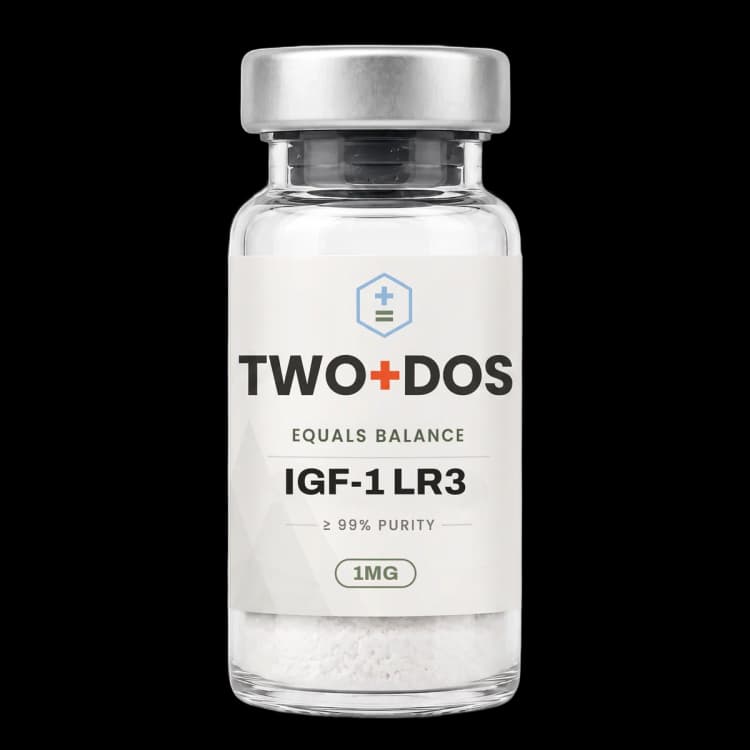
Chemical and physical properties of IGF-1 LR3
| Molecule class | 83-residue single-chain recombinant analogue of human insulin-like growth factor I, engineered as a cell culture reagent |
|---|---|
| Amino acid sequence | MFPAMPLSSLFVNGPRTLCGAELVDALQFVCGDRGFYFNKPTGYGSSSRRAPQTGIVDECCFRSCDLRRLEMYCAPLKPAKSA (13-residue extension plus the 70-residue IGF-I chain) |
| Engineered modifications | Arginine replaces glutamate at IGF-I position 3; a 13-residue N-terminal extension, MFPAMPLSSLFVN, derived from a porcine growth hormone fusion partner |
| Molecular formula | C400H619N111O115S9 for the oxidised, three-disulfide form as catalogued by Sigma-Aldrich (I1271) |
| Molecular mass | 9111.45 g/mol; migrates near 9.1 kDa on SDS-PAGE. Native IGF-I is roughly 7.65 kDa, so the analogue is about 19 percent heavier |
| CAS registry | 143045-27-6 in reagent-supplier catalogues. A second number, 946870-92-4, circulates alongside the reduced-chain formula C400H625N111O115S9 (9117.60 g/mol); the six-hydrogen gap is exactly the three disulfide bridges |
| PubChem CID | None indexed. PUG-REST name lookups for IGF-1 LR3, Long R3 IGF-1 and mecasermin all return no matching compound record, as expected for a protein of this size |
| Disulfide architecture | Six cysteines forming three intrachain bridges in the IGF-I numbering: Cys6-Cys48, Cys18-Cys61 and Cys47-Cys52. The extension peptide contributes no cysteine |
| IGF-binding-protein affinity | Roughly 689-fold weaker than IGF-I in competition assays against L6 myoblast-conditioned medium; reagent documentation quotes greater than 1000-fold reduction |
| Type 1 IGF receptor affinity | About 3.2-fold weaker than IGF-I, with full agonist behaviour retained |
| Expression hosts | Escherichia coli inclusion bodies is the established route; Pichia pastoris secretion as a xylanase fusion has been reported at roughly 1 g/L |
What is IGF-1 LR3 and how does its sequence differ from native IGF-1?
IGF-1 LR3 carries the full 70-residue human IGF-1 chain with two engineered changes: arginine replaces glutamate at position 3, and a 13-residue extension, MFPAMPLSSLFVN, is fused to the N-terminus. The result is an 83-residue single chain of 9111.45 g/mol, about 19 percent heavier than the roughly 7.65 kDa parent hormone.
Folding is unchanged from the parent. Six cysteines close three intrachain bridges, Cys6-Cys48, Cys18-Cys61 and Cys47-Cys52 in IGF-I numbering, so the B, C, A and D domain arrangement that presents the receptor-contact surface survives the modifications. The extension peptide adds no cysteine and no glycosylation site. Two molecular formulas appear in supplier catalogues, C400H619N111O115S9 at 9111.45 g/mol and C400H625N111O115S9 at 9117.60 g/mol; the difference of six hydrogens is precisely the oxidised versus reduced state of those three bridges.
The extension is a fossil of how the molecule was made. An Adelaide group expressing IGF-I in Escherichia coli fused the hormone to N-terminal sequence from porcine growth hormone with a hydroxylamine-cleavable linker, then found that leaving the extension attached, combined with the Glu3 substitution, produced a markedly more potent species in cell assays. What began as a purification handle became the product.
Why does the Arg3 substitution lower IGF-binding-protein affinity?
IGF-1 LR3 binds the six IGF-binding proteins roughly 689-fold more weakly than IGF-I in competition assays against L6 myoblast-conditioned medium, and reagent documentation for LONG R3 IGF-I quotes a greater than 1000-fold reduction. Because IGFBP-3 normally sequesters most circulating IGF-I in a ternary complex, that loss of affinity is the analogue's defining property.
Two structural facts explain it. The first three residues of IGF-I, Gly-Pro-Glu, sit at the binding-protein interface, and the acidic Glu3 side chain contributes directly; removing that tripeptide altogether yields Des(1-3)-IGF-I, which shows the same shift, while swapping Glu3 for the basic arginine yields R3-IGF-I. The second contribution is steric: the 13-residue extension adds bulk immediately adjacent to that interface. Combining both edits is what pushes the reduction into the several-hundred-fold range.
The functional consequence is a shift in the free fraction. In culture medium containing binding proteins secreted by the cells themselves, far more of the added analogue remains unbound and available to the receptor, which is why the material is described as roughly three times as potent as IGF-I in vitro. Reagent specifications quote an ED50 below 10 ng/mL in an L6 myoblast protein-synthesis assay, corresponding to a specific activity near 100,000 units per milligram.
How does IGF-1 LR3 engage the type 1 IGF receptor?
IGF-1 LR3 acts as a full agonist at the type 1 IGF receptor, a disulfide-linked (αβ)2 receptor tyrosine kinase. Cryo-EM work on IGF1R describes a Γ-shaped asymmetric dimer in which a single ligand bridges the L1 and CR domains of one protomer and the α-CT and FnIII-1 domains of the other, with an L1-FnIII-2 contact holding the membrane-proximal region together.
Affinity at that site is modestly lower for the analogue than for the parent, about 3.2-fold, so the potency gain is not receptor-driven. Occupancy triggers trans-autophosphorylation of the intracellular kinase domains, recruitment of IRS-1 and SHC, and signalling through PI3K-AKT and RAS-ERK. In the liganded receptor the two α-CT segments form a rigid beam that obstructs the conformational change a second ligand would need, which is the structural account of the negative cooperativity long observed in binding data.
The reduced binding-protein affinity does not make the analogue immune to regulation. Work on IGF1R phosphorylation showed that recombinant IGFBP-3 inhibited receptor phosphorylation induced by IGF-I, IGF-II, Des(1-3)IGF-I and Long(R3)IGF-I across a similar concentration range, attributing the effect to sequestration in the extracellular compartment. Reagent literature also notes that the modified molecule still engages the insulin receptor, so selectivity between the two closely related kinases is relative rather than absolute.
Why is IGF-1 LR3 used as a mammalian cell culture supplement?
IGF-1 LR3 is supplied as a serum-free culture supplement for Chinese hamster ovary and other mammalian lines, where it substitutes for insulin. Manufacturer documentation describes it as roughly 200 times more potent than insulin in culture and about twice as stable, with reported gains of up to 62 percent in volumetric productivity over unsupplemented CHO culture.
The same documentation puts the margin over insulin-supplemented culture at 40 percent, and independent bioprocess reports back the general direction. A comparison of insulin against LongR3 in two serum-free CHO lines expressing recombinant proteins found the analogue sustained viability better under production conditions. A CHO41K microarray study reported enhanced expansion and delayed cell death with LongR3, and read the transcriptome as showing reduced cellular investment in cytoskeletal assembly. A separate industrial study of an Fc-fusion line reported higher sialic acid content and a lower proportion of asialylated N-linked glycans with LongR3 present at microgram-per-litre levels, making glycan quality, not only titre, part of the argument.
Supply economics shape the interest. Escherichia coli inclusion-body expression remains standard, and a 2023 report fused both IGF-1 and LR3 IGF-1 to xylanase for secretion from Pichia pastoris, reaching roughly 0.5 g/L and 1 g/L respectively in bioreactor fermentation with bioactivity matching a reference IGF-1. Reviews of serum-free media for cultivated meat identify recombinant growth factors as a dominant media cost, which keeps yield and purification work on this class of protein active.
What have animal-model studies of IGF-1 LR3 reported?
IGF-1 LR3 has been infused into late-gestation fetal sheep across several published studies. A 90-minute infusion lowered fetal plasma insulin, and insulin concentrations measured during a hyperglycaemic clamp ran 66 percent below vehicle controls, yet islets isolated afterwards secreted insulin normally, pointing to a reversible effect rather than an intrinsic islet defect.
The same model produced a negative result at one week. In growth-restricted late-gestation fetal sheep, a week-long infusion did not increase growth relative to vehicle, circulating amino acids fell with branched-chain species most affected, and insulin concentrations along with glucose-stimulated secretion were unchanged between groups. Earlier work in normally grown fetal sheep had reported organ-specific responses without increased nutrient transfer across the placenta, so the effect is model-dependent and not uniformly anabolic.
Recent work has explored delivery from materials rather than systemic exposure. A 2025 conduit study combined a decellularised Alstroemeria stem scaffold with GelMA and controlled IGF-1 LR3 release across a 1 cm rat sciatic nerve defect, reporting axonal regeneration comparable to autologous nerve graft controls on gait, electrophysiology and histology without systemic toxicity. A 2026 rat study loaded IGF1-LR3 into a poly(ethylene glycol)-acrylate void filler for volumetric muscle loss and found higher wet weight of the affected muscle at 28 days but no gain in isometric torque or histological markers.
Central-nervous-system exposure has also been examined. Male 5XFAD transgenic mice given intranasal LR3-IGF-1 for seven months showed remodelled cortical amyloid, with fewer filamentous plaques and a larger inert plaque fraction, while behavioural testing detected no preservation of cognitive function. The authors framed the compound as a candidate component of combination approaches rather than as a standalone intervention.
How is IGF-1 LR3 identified and measured analytically?
IGF-1 LR3 is identified by immunoaffinity capture followed by liquid chromatography and high-resolution tandem mass spectrometry, which separates it from IGF-I, R3-IGF-I and Des(1-3)-IGF-I on intact mass and on characteristic proteolytic fragments. Anti-doping laboratories run the same workflow because IGF-1 and its analogues sit in the WADA prohibited class, banned at all times.
A 2021 method development study characterised all three analogues and their degradation products, and reported that market-sourced material carried abundant oxidised peptide forms. In rats, after delivery into skeletal muscle, Des(1-3)-IGF-I and R3-IGF-I remained detectable to 24 hours while the LongR3 signal disappeared after roughly 4 hours. That short window makes retrospective identification in a biological matrix considerably harder for this analogue than for its shorter cousins.
Product-identity work has turned up material that does not match its label. Mass spectrometry on the contents of one market vial identified a His-tagged Long-R3-IGF-I bearing a C-terminal hexahistidine tag, a construct made for biochemical assays rather than for any other purpose. On the urine side, a 2024 method covering peptidic analytes between 2 and 10 kDa reported long-R3-IGF-I, R3-IGF-I and des1-3-IGF-I among its target list and met the minimum required performance levels for initial testing procedures. In bioprocess settings, immunoassays specific to LONG R3 IGF-I are used instead, to track carry-over of the supplement through downstream purification of the expressed product.
Summary of published research
Findings below are reported as published by the cited authors, in the model systems they used. They describe laboratory research, and none of them characterize use in humans.
Francis GL, Ross M, Ballard FJ, Milner SJ, Senn C, McNeil KA, Wallace JC, King R, Wells JR. Novel recombinant fusion protein analogues of insulin-like growth factor (IGF)-I indicate the relative importance of IGF-binding protein and receptor binding for enhanced biological potency. Journal of Molecular Endocrinology. (1992)
- Model system
- Cultured rat L6 myoblasts and other cell lines; E. coli-expressed fusion analogues
- Conditions
- N-terminal porcine growth hormone extension with Gly or Arg substituted for Glu3; protein and DNA synthesis endpoints
- Reported finding
- All extended analogues were more potent than authentic IGF-I at stimulating protein and DNA synthesis, and the authors attributed the difference to reduced binding-protein interaction rather than to increased receptor affinity.
Morris AE, Schmid J. Effects of insulin and LongR(3) on serum-free Chinese hamster ovary cell cultures expressing two recombinant proteins. Biotechnology Progress. (2000)
- Model system
- Two recombinant-protein-expressing CHO lines in serum-free suspension culture
- Conditions
- Insulin versus LongR3 supplementation under production conditions
- Reported finding
- LongR3 sustained viability of both cell lines better than insulin under production conditions, supporting its use as the growth-factor component of serum-free media for recombinant protein manufacture.
Devi GR, Graham DL, Oh Y, Rosenfeld RG. Effect of IGFBP-3 on IGF- and IGF-analogue-induced insulin-like growth factor-I receptor (IGFIR) signalling. Growth Hormone and IGF Research. (2001)
- Model system
- Cultured cells expressing the type 1 IGF receptor with recombinant IGFBP-3
- Conditions
- IGF-I, IGF-II, Des(1-3)IGF-I and Long(R3)IGF-I compared across a concentration series
- Reported finding
- IGFBP-3 inhibited receptor phosphorylation induced by every ligand tested, including Long(R3)IGF-I, over a similar concentration range, which the authors attributed to sequestration of ligand in the extracellular compartment.
Mongongu C, Coudoré F, Domergue V, Ericsson M, Buisson C, Marchand A. Detection of LongR(3)-IGF-I, Des(1-3)-IGF-I, and R(3)-IGF-I using immunopurification and high resolution mass spectrometry for antidoping purposes. Drug Testing and Analysis. (2021)
- Model system
- Rat in vivo plus analysis of market-sourced product vials
- Conditions
- Immunopurification with high-resolution mass spectrometry; plasma sampling to 24 hours
- Reported finding
- Market-sourced material showed abundant oxidised peptide forms, and after delivery into rat skeletal muscle the LongR3-IGF-I signal disappeared after about 4 hours while Des(1-3)-IGF-I and R3-IGF-I stayed detectable to 24 hours.
White A, Stremming J, Brown LD, Rozance PJ. Attenuated glucose-stimulated insulin secretion during an acute IGF-1 LR3 infusion into fetal sheep does not persist in isolated islets. Journal of Developmental Origins of Health and Disease. (2023)
- Model system
- Late-gestation fetal sheep, with islets isolated after the in vivo phase
- Conditions
- 90-minute infusion of IGF-1 LR3 or vehicle, followed by a hyperglycaemic clamp
- Reported finding
- Fetal plasma insulin fell during infusion and clamp insulin concentrations were 66 percent below vehicle controls, but islets isolated afterwards secreted insulin comparably, indicating a reversible effect rather than an intrinsic islet defect.
Lu Z, Liu N, Huang H, et al. Recombinant expression of IGF-1 and LR3 IGF-1 fused with xylanase in Pichia pastoris. Applied Microbiology and Biotechnology. (2023)
- Model system
- Pichia pastoris expression host, bioreactor fermentation
- Conditions
- Xylanase used as a fusion partner to improve secretion and folding
- Reported finding
- Fermentation reached roughly 0.5 g/L for IGF-1 and 1 g/L for LR3 IGF-1, and the purified proteins showed bioactivity comparable to a reference IGF-1 standard.
Thomas A, Walpurgis K, Thevis M. Chromatographic-mass spectrometric analysis of peptidic analytes (2-10 kDa) in doping control urine samples. Journal of Mass Spectrometry. (2024)
- Model system
- Human urine; analytical method development and validation
- Conditions
- Immunoaffinity purification with LC-HRMS/MS; five internal standards across five analyte classes
- Reported finding
- The method covered long-R3-IGF-I, R3-IGF-I and des1-3-IGF-I among its targets, met the minimum required performance levels set by the anti-doping authority, and was validated for initial testing procedures.
Engel MG, Narayan S, Cui MH, et al. Intranasal long R3 insulin-like growth factor-1 treatment promotes amyloid plaque remodeling in cerebral cortex but fails to preserve cognitive function in male 5XFAD mice. Journal of Alzheimer's Disease. (2025)
- Model system
- Male 5XFAD transgenic mice
- Conditions
- Intranasal LR3-IGF-1 or vehicle over seven months, with behavioural and histological endpoints
- Reported finding
- Cortical amyloid was remodelled, with fewer filamentous plaques and a larger inert plaque fraction, while behavioural testing showed no preservation of cognitive function across the assays used.
White A, Stremming J, Wesolowski SR, et al. IGF-1 LR3 does not promote growth in late-gestation growth-restricted fetal sheep. American Journal of Physiology - Endocrinology and Metabolism. (2025)
- Model system
- Growth-restricted late-gestation fetal sheep
- Conditions
- One-week infusion of IGF-1 LR3 or vehicle
- Reported finding
- Growth was not increased relative to vehicle, circulating amino acids declined with branched-chain species most affected, and insulin concentrations and glucose-stimulated insulin secretion did not differ between groups.
Yavuz E, Sağır MS, Ercan A, et al. Revolutionary decellularized Alstroemeria stem-based nerve conduit integrated with GelMA and controlled IGF-1 LR3 release for enhanced rat sciatic nerve regeneration. International Journal of Biological Macromolecules. (2025)
- Model system
- Rat sciatic nerve defect, 30 animals across six groups
- Conditions
- 1 cm nerve gap bridged by a plant-derived decellularised conduit with GelMA and controlled IGF-1 LR3 release
- Reported finding
- Axonal regeneration was improved and comparable to autologous nerve graft controls on gait analysis, electrophysiology, histology and immunohistochemistry, with no systemic toxicity observed.
Clark AR, Adams AT, McKinley TO, Natoli RM, Dearth CL, Goldman SM. Provisional Treatment of Volumetric Muscle Loss With Insulin-like Growth Factor 1 Releasing Muscle Void Fillers. Journal of Surgical Research. (2026)
- Model system
- Rat volumetric muscle loss model
- Conditions
- In situ forming poly(ethylene glycol)-acrylate void filler carrying free or PLGA-encapsulated IGF1-LR3 at two loadings; 28-day endpoint
- Reported finding
- Higher-loading PLGA-encapsulated IGF1-LR3 raised wet weight of the affected muscle at 28 days, but isometric torque and histological markers did not differ from controls, and the authors called for further optimisation.
Dominikowski A, Rękoś Z, Olejarz M, Szczepanek-Parulska E, Domin R, Ruchała M. The emerging landscape of performance-enhancing peptides modulating GH-IGF1 axis: bridging the gap between clinical evidence and patient self-administration. Frontiers in Endocrinology. (2026)
- Model system
- Narrative review of the published literature and case reports
- Conditions
- Compounds acting on the growth hormone and IGF-1 axis, including IGF-1 LR3
- Reported finding
- The review placed IGF-1 LR3 among unregulated compounds circulating outside legitimate supply chains, stratified the supporting evidence as low quality, and catalogued endocrine, metabolic, fluid-retention and musculoskeletal disturbances reported in case material.
What laboratory handling information is published?
IGF-1 LR3 is distributed as a sterile-filtered lyophilised powder, typically from a dilute phosphate buffer near pH 7.2, at 98 percent or greater purity by SDS-PAGE and reversed-phase HPLC. Supplier documentation specifies desiccated storage below minus 18 degrees Celsius, with the sealed vial kept dry and brought to ambient temperature before opening.
Published preparation notes describe dissolving the lyophilisate in sterile 18 megohm-centimetre water at around 100 micrograms per millilitre. Working solutions below that concentration are commonly carried in a buffer containing a carrier protein, because dilute solutions of a 9 kDa protein lose material to container surfaces. Documented stability for the redissolved stock is two to seven days at 4 degrees Celsius, or below minus 18 degrees Celsius for longer periods, with aliquoting used to avoid repeated freeze-thaw cycles.
Two chemistry constraints follow from the structure. Three disulfide bridges mean reducing agents change the molecular identity and the measured mass by six hydrogens, so reduced and oxidised forms should not be treated as interchangeable in analytical work. Methionine oxidation is the reported degradation signature in poorly stored material, which makes intact-mass confirmation worth running alongside a purity gel. Material of this class is supplied for laboratory research use only and is not for human or veterinary use.
Frequently asked research questions
What do the letters LR3 in IGF-1 LR3 stand for?
Long refers to the 13-residue N-terminal extension peptide, MFPAMPLSSLFVN, and R3 refers to the arginine substituted for glutamate at position 3 of the IGF-I chain. Together the two modifications take the molecule from 70 residues to 83.
How does IGF-1 LR3 differ from Des(1-3)-IGF-I and R3-IGF-I?
All three are IGF-I variants that weaken binding-protein interaction at the same N-terminal region. R3-IGF-I carries only the Glu3-to-Arg substitution, Des(1-3)-IGF-I deletes the Gly-Pro-Glu tripeptide entirely, and IGF-1 LR3 combines the Arg3 substitution with the extension peptide. Mass spectrometry resolves all three on intact mass.
Does IGF-1 LR3 have a PubChem CID?
No PubChem compound record is indexed for it. Name lookups through the PubChem PUG-REST endpoint return no match for IGF-1 LR3, Long R3 IGF-1 or mecasermin, which is the expected result for a 9 kDa protein. Identification relies on CAS 143045-27-6, the formula and the sequence instead.
Why do laboratories use IGF-1 LR3 rather than insulin in CHO media?
Insulin degrades quickly in culture and acts at the insulin receptor with lower potency in this context. IGF-1 LR3 is documented as roughly 200 times more potent than insulin and about twice as stable in culture, so far less protein is needed per litre and supplementation schedules are simpler in long fed-batch runs.
Has IGF-1 LR3 been developed as a human medicine?
No. It was engineered as a cell culture reagent and has not been authorised as a medicine in any jurisdiction. IGF-1 and its analogues are prohibited at all times under the WADA list, and a 2026 narrative review catalogues the compound among unregulated substances circulating outside legitimate supply chains.
IGF-1 LR3 at TWO+DOS
TWO+DOS supplies IGF-1 LR3 as a research-use-only compound, third-party tested, with certificates of analysis emailed immediately on request.
View the IGF-1 LR3 (1mg)listing →Related research overviews
References
- Francis GL et al. Novel recombinant fusion protein analogues of insulin-like growth factor (IGF)-I indicate the relative importance of IGF-binding protein and receptor binding for enhanced biological potency. J Mol Endocrinol 1992;8(3):213-23
- Sigma-Aldrich catalogue entry for LONG R3 IGF-I human (I1271), CAS 143045-27-6, empirical formula C400H619N111O115S9
- ProSpec CYT-022 LR3 IGF-1 human recombinant datasheet: 83-residue sequence, E. coli source, purity, ED50 and storage specifications
- Repligen LONG R3 IGF-I cell culture supplement product documentation
- World Anti-Doping Agency Prohibited List, section S2 (peptide hormones and growth factors)
- Kohler M et al. Detection of His-tagged Long-R3-IGF-I in a black market product. Growth Horm IGF Res 2010;20(5):386-90
- Becker J et al. Transcriptome analyses of CHO cells with the next-generation microarray CHO41K: development and validation by analysing the influence of the growth stimulating substance IGF-1 substitute LongR3. J Biotechnol 2014;178:23-31
- Qian Y et al. LongR3 enhances Fc-fusion protein N-linked glycosylation while improving protein productivity in an industrial CHO cell line. Process Biochemistry 2017
- Mongongu C et al. Detection of LongR3-IGF-I, Des(1-3)-IGF-I, and R3-IGF-I using immunopurification and high resolution mass spectrometry for antidoping purposes. Drug Test Anal 2021;13(7):1256-69
- Lu Z et al. Recombinant expression of IGF-1 and LR3 IGF-1 fused with xylanase in Pichia pastoris. Appl Microbiol Biotechnol 2023;107(14):4543-51
- Mainali P et al. Enhancing recombinant growth factor and serum protein production for cultivated meat manufacturing. Microb Cell Fact 2025;24(1):41
- Dominikowski A et al. The emerging landscape of performance-enhancing peptides modulating GH-IGF1 axis: bridging the gap between clinical evidence and patient self-administration. Front Endocrinol 2026;17:1822475
For research use only. Not for human or veterinary use. Not for diagnostic or therapeutic use.