
Ipamorelin: Receptor Selectivity, Chemistry and Published Assay Data
By the TWO+DOS Research Team · Published 2026-08-12
For research use only. Not for human or veterinary use. Not for diagnostic or therapeutic use.
Ipamorelin, also designated NNC 26-0161, is a synthetic pentapeptide with the sequence Aib-His-D-2-Nal-D-Phe-Lys-NH2 and a molecular weight of 711.9 g/mol. It acts as an agonist at the growth hormone secretagogue receptor 1a, the same class A G protein-coupled receptor that the endogenous peptide ghrelin activates.
The published record on this molecule is unusually well bounded. It runs from the 1998 characterization at Novo Nordisk through rodent and porcine endocrine pharmacology, one human pharmacokinetic modelling study, mass-spectrometric metabolite mapping, and a 2025 wave of cryo-electron microscopy structures of the receptor itself. This overview reports those findings in the species, cell lines and preparations where they were measured.
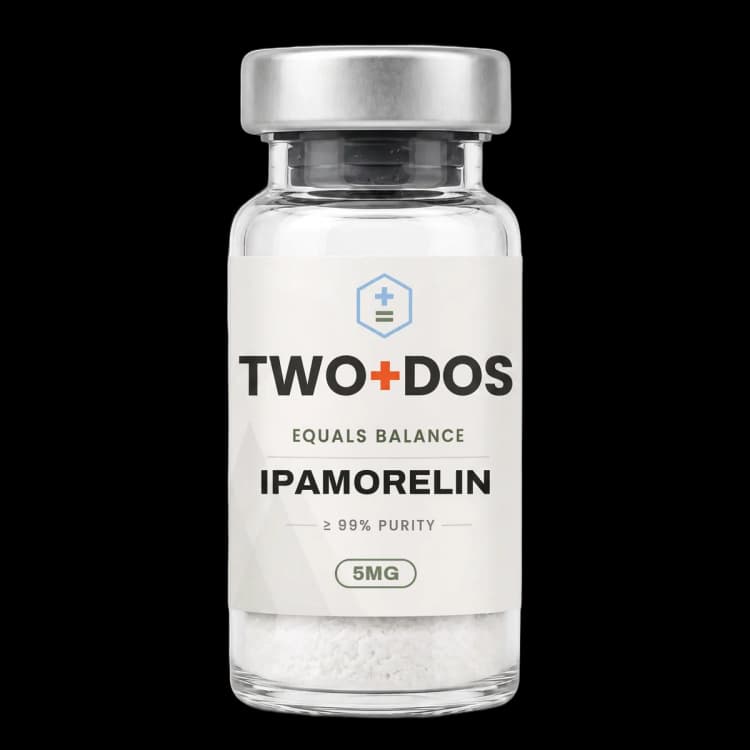
Chemical and physical properties of Ipamorelin
| Peptide class | Synthetic C-terminally amidated pentapeptide; agonist at the growth hormone secretagogue receptor 1a |
|---|---|
| Sequence | Aib-His-D-2-Nal-D-Phe-Lys-NH2 (five residues, amidated at the C-terminus) |
| Molecular formula | C38H49N9O5 (free peptide). The acetate salt is listed by suppliers as C38H49N9O5 with a variable acetate component. |
| Molecular weight | 711.9 g/mol; exact mass 711.3857 Da; monoisotopic mass 711.3857 Da |
| CAS number | 170851-70-4 (free peptide) |
| PubChem CID | 9831659 |
| InChIKey | NEHWBYHLYZGBNO-BVEPWEIPSA-N |
| Registry identifiers | UNII Y9M3S784Z6; ChEMBL CHEMBL58547; DTXSID80168955 |
| Non-proteinogenic residues | Position 1 is 2-aminoisobutyric acid (Aib); positions 3 and 4 are D-2-naphthylalanine and D-phenylalanine |
| Computed descriptors | XLogP 1.8; topological polar surface area 240 square angstroms; 8 hydrogen-bond donors; 8 acceptors; 19 rotatable bonds; 52 heavy atoms (PubChem computed) |
| Reported in vitro potency | EC50 1.3 nM for growth hormone release in primary rat pituitary cells; EC50 46.9 nM for inositol trisphosphate accumulation in BHK cells |
What is ipamorelin?
Ipamorelin is a C-terminally amidated pentapeptide first described by Raun and colleagues at Novo Nordisk in 1998 under the development code NNC 26-0161. Its five residues are 2-aminoisobutyric acid, L-histidine, D-2-naphthylalanine, D-phenylalanine and L-lysine, giving the formula C38H49N9O5 and a molecular weight of 711.9 g/mol.
Three of the five positions are non-proteinogenic. Position 1 carries 2-aminoisobutyric acid, a quaternary alpha-methylated glycine that constrains backbone conformation, and positions 3 and 4 carry D-configured aromatic residues, D-2-naphthylalanine and D-phenylalanine. The C-terminus is an amide rather than a free acid. Each of these features is a departure from ordinary L-amino-acid peptide chemistry, and together they are why the molecule survives peptidase exposure long enough to be measurable in circulation.
The 1998 paper describes how the compound was found. Its authors were working through a series that lacked the central dipeptide of GHRP-1, and ipamorelin emerged from that series as the member combining high growth hormone releasing potency with an unusually narrow hormonal footprint. The molecule therefore has a documented structural lineage within the growth hormone releasing peptide family rather than an independent origin. PubChem lists its exact and monoisotopic mass as 711.3857 Da and its XLogP as 1.8.
How does ipamorelin interact with the ghrelin receptor?
Ipamorelin acts as an agonist at the growth hormone secretagogue receptor 1a (GHS-R1a), a class A G protein-coupled receptor whose endogenous ligand is acyl-ghrelin. In primary rat pituitary cells the compound released growth hormone with an EC50 of 1.3 nM, and in BHK cells expressing the receptor it drove inositol trisphosphate accumulation with an EC50 of 46.9 nM.
The gap between those two numbers is informative: growth hormone release from a native pituitary cell is roughly thirty-six-fold more sensitive than a second-messenger readout in a recombinant fibroblast line, the signature of signal amplification downstream of receptor occupancy. Raun and colleagues also showed pharmacologically that the compound acts through a GHRP-like receptor rather than the growth hormone releasing hormone receptor.
No cryo-electron microscopy structure of ipamorelin bound to GHS-R1a has been published. What exists is a body of structural work on the receptor with other agonists, and the most recent of it is directly relevant. Wang and colleagues reported structures of GHSR in complex with Gq proteins bound to macimorelin at 2.63 angstroms and anamorelin at 2.52 angstroms in 2025. Both ligands occupied a bifurcated binding pocket split by a conserved salt bridge between E124 (3.33) and R283 (6.55).
A 2025 review by Polishchuk and colleagues synthesized that structural picture, describing recent cryo-electron microscopy structures as revealing a bipartite binding pocket that frames biased signalling and constitutive receptor activity, and distinguishing acyl-ghrelin as the high-potency agonist from des-acyl ghrelin, which predominates in circulation at low potency.
What makes ipamorelin selective among growth hormone secretagogues?
Ipamorelin was designated the first selective growth hormone secretagogue because, in conscious swine, it released growth hormone without changing FSH, LH, prolactin or TSH, and without raising ACTH or cortisol beyond what growth hormone releasing hormone itself produced. That separation held at exposure levels 200-fold above the ED50 for growth hormone release.
The comparison that gives the claim its force is internal to the same study. GHRP-6 and GHRP-2, tested alongside, did raise ACTH and cortisol. All three peptides act through the same receptor class, so the difference is not receptor identity but ligand structure. That is the defining published property of this molecule and the reason its name carries the word selective in the original title.
Selectivity here describes one measured hormone panel in one species. The 1998 panel covered FSH, LH, prolactin, TSH, ACTH and cortisol, and endpoints outside it were never part of the claim. Gouda and Ganesh reported in 2024 that cichlid fish given 5 or 30 µg of ipamorelin acetate over 21 days showed raised serum luteinizing hormone and 11-ketotestosterone, a teleost result sitting outside that mammalian panel.
Reviews published in 2026 continue to place the compound within the growth hormone secretagogue class rather than as an outlier. Dominikowski and colleagues stratified growth hormone releasing hormone analogues, growth hormone secretagogues including ipamorelin, and IGF-1 variants by evidence tier, and contrasted the peer-reviewed pharmacology against protocols circulated online.
What endpoints has ipamorelin changed in animal models?
Ipamorelin has been examined in rats, swine, ferrets and fish. The reported endpoints cluster into three groups: longitudinal bone growth in adult female rats, gastrointestinal motility in rodent and ferret preparations, and hypothalamic-pituitary-testicular signalling in a cichlid. Each result below is stated in the species and preparation where it was measured.
On bone, Johansen and colleagues gave adult female rats 0, 18, 90 or 450 µg per day, split across three daily applications for 15 days, and measured longitudinal growth rate as the distance between intravital tetracycline bands laid down on days 0, 6 and 13 in the proximal tibial metaphysis. The rate rose from 42 µm per day in the vehicle group to 44, 50 and 52 µm per day across the three ascending exposure levels, with P less than 0.0001.
On gastrointestinal motility, Venkova and colleagues used a rat model of postoperative ileus in which fasted males underwent laparotomy with intestinal manipulation. A single 1 mg/kg exposure by infusion shortened the time to first bowel movement relative to vehicle. A repeated regimen at 0.1 or 1 mg/kg significantly increased cumulative fecal pellet output over 48 hours, whereas the single exposure did not.
Lu and colleagues added a direct enteric measurement in 2024. Working with isolated ferret ileum, they compared inhibition of contractions evoked by electrical field stimulation and found ipamorelin inhibited them by 54.4 percent against 94.4 percent for anamorelin. The two GHS-R1a agonists therefore separate cleanly on a tissue-level endpoint that requires no intact endocrine axis.
In the cichlid Oreochromis mossambicus, Gouda and Ganesh reported that both 5 µg and 30 µg exposures over 21 days raised counts of primary spermatocytes, secondary spermatocytes and early spermatids relative to controls, alongside raised serum luteinizing hormone and 11-ketotestosterone. Only the 30 µg level raised late spermatid counts and androgen receptor protein expression, giving a two-point separation between the exposure levels.
What pharmacokinetic values have been published for ipamorelin?
Ipamorelin has one published human pharmacokinetic and pharmacodynamic modelling study. Gobburu and colleagues used five infusion rates with eight healthy volunteers at each rate and reported a terminal half-life of 2 hours, a clearance of 0.078 L/h/kg and a steady-state volume of distribution of 0.22 L/kg, with kinetics proportional across the range studied.
The pharmacodynamic side of that work is equally specific. Growth hormone rose as a single episode peaking at 0.67 hours and then declining exponentially. Fitting an indirect response model gave an SC50 of 214 nmol/L and a maximal growth hormone production rate of 694 mIU/L/h. Between-individual variability was larger for the pharmacodynamic parameters than for the pharmacokinetic ones, meaning circulating concentrations were more predictable than the hormonal response they produced.
A steady-state volume of distribution of 0.22 L/kg sits close to extracellular fluid volume, the signature of a small polar peptide that does not partition into tissue. Metabolic fate has been mapped separately. Thomas and colleagues profiled the growth hormone releasing peptide class across rat in vivo samples and human serum in vitro and identified 28 metabolites overall, at least three for each peptide, arising from exopeptidase, amidase and endopeptidase activity. That metabolite panel, rather than the parent peptide alone, is what analytical laboratories screen against.
How is ipamorelin identified and confirmed analytically?
Ipamorelin is identified by its exact mass of 711.3857 Da, its InChIKey NEHWBYHLYZGBNO-BVEPWEIPSA-N and CAS number 170851-70-4. Laboratories separate it by reversed-phase liquid chromatography and confirm it by high-resolution tandem mass spectrometry, the standard approach for small C-terminally amidated peptides below 2 kDa.
Two features make that confirmation straightforward. The D-2-naphthylalanine residue gives strong ultraviolet absorbance and a distinctive fragment, and the C-terminal amide shifts the parent mass by one dalton relative to the free acid, so amide loss is directly visible in the mass spectrum. Purity is conventionally reported as area percent by HPLC.
Coutinho and colleagues, reviewing peptide and peptide-analogue drugs in 2026, reported that the largely unregulated supply chain leaves products often mislabeled or contaminated, and that analytical detection remains difficult because these peptides resemble endogenous hormones structurally and have short half-lives. Independent lot-level confirmation by chromatography and mass spectrometry is the only way to close that gap for a given batch.
For literature searching, note that the discovery-era record was published under the development code NNC 26-0161, so a search on the common name alone will miss part of it.
Summary of published research
Findings below are reported as published by the cited authors, in the model systems they used. They describe laboratory research, and none of them characterize use in humans.
Raun K, Hansen BS, Johansen NL, Thøgersen H, Madsen K, Ankersen M, Andersen PH. Ipamorelin, the first selective growth hormone secretagogue. European Journal of Endocrinology (1998)
- Model system
- Primary rat pituitary cell culture, anesthetized rats and conscious swine
- Conditions
- In vitro growth hormone release from cultured rat pituitary cells; in vivo comparison against GHRP-6 and GHRP-2, with a six-hormone panel measured in swine at exposure levels up to 200-fold above the ED50 for growth hormone release
- Reported finding
- The pentapeptide released growth hormone with potency and efficacy similar to GHRP-6 and acted through a GHRP-like receptor rather than the growth hormone releasing hormone receptor. In swine, FSH, LH, prolactin and TSH were unchanged, and ACTH and cortisol were not raised beyond the levels produced by growth hormone releasing hormone, whereas GHRP-6 and GHRP-2 raised both.
Gobburu JV, Agersø H, Jusko WJ, Ynddal L. Pharmacokinetic-pharmacodynamic modeling of ipamorelin, a growth hormone releasing peptide, in human volunteers. Pharmaceutical Research (1999)
- Model system
- Healthy human volunteers; population pharmacokinetic and pharmacodynamic modelling
- Conditions
- Escalating design across five infusion rates with eight volunteers at each rate; an indirect response model fitted to the growth hormone time course
- Reported finding
- Terminal half-life 2 hours, clearance 0.078 L/h/kg and steady-state volume of distribution 0.22 L/kg, proportional across the range studied. Growth hormone rose as a single episode peaking at 0.67 hours before declining exponentially, with an SC50 of 214 nmol/L and a maximal growth hormone production rate of 694 mIU/L/h. Between-individual variability exceeded that of the pharmacokinetic parameters.
Johansen PB, Nowak J, Skjaerbaek C, Flyvbjerg A, Andreassen TT, Wilken M, Orskov H. Ipamorelin, a new growth-hormone-releasing peptide, induces longitudinal bone growth in rats. Growth Hormone and IGF Research (1999)
- Model system
- Adult female rats
- Conditions
- 0, 18, 90 or 450 µg per day split across three daily applications for 15 days; longitudinal growth rate measured as the distance between intravital tetracycline bands laid down on days 0, 6 and 13 in the proximal tibial metaphysis
- Reported finding
- Longitudinal bone growth rate rose from 42 µm per day in the vehicle group to 44, 50 and 52 µm per day across the three ascending exposure levels, with P less than 0.0001.
Venkova K, Mann W, Nelson R, Greenwood-Van Meerveld B. Efficacy of ipamorelin, a novel ghrelin mimetic, in a rodent model of postoperative ileus. Journal of Pharmacology and Experimental Therapeutics (2009)
- Model system
- Rat model of postoperative ileus
- Conditions
- Fasted male rats underwent laparotomy with intestinal manipulation, then received ipamorelin at 0.01 to 1 mg/kg, GHRP-6 or vehicle by infusion, under either a single or a repeated regimen
- Reported finding
- A single 1 mg/kg exposure shortened the time to first bowel movement relative to vehicle but did not change cumulative output at 48 hours. A repeated regimen at 0.1 or 1 mg/kg significantly increased cumulative fecal pellet output over the same window.
Thomas A, Delahaut P, Krug O, Schänzer W, Thevis M. Metabolism of growth hormone releasing peptides. Analytical Chemistry (2012)
- Model system
- Rat in vivo samples and human serum in vitro
- Conditions
- A class of small C-terminally amidated peptides of four to seven residues profiled by liquid chromatography coupled to high-resolution mass spectrometry
- Reported finding
- Twenty-eight metabolites were identified across the peptide set, at least three for each compound, arising from exopeptidase, amidase or endopeptidase activity. The resulting metabolite panel is the reference set against which these peptides are confirmed in biological matrices.
Lu Z, Ngan MP, Liu JYH, Yang L, Tu L, Chan SW, Giuliano C, Lovati E, Pietra C, Rudd JA. The growth hormone secretagogue receptor 1a agonists, anamorelin and ipamorelin, inhibit cisplatin-induced weight loss in ferrets: Anamorelin also exhibits anti-emetic effects via a central mechanism. Physiology and Behavior (2024)
- Model system
- Ferret, in vivo work plus isolated ileum preparations
- Conditions
- Contractions of isolated ferret ileum evoked by electrical field stimulation, with the two GHS-R1a agonists compared directly in the same preparation
- Reported finding
- Electrical field stimulation-evoked contractions of isolated ferret ileum were inhibited by 54.4 percent by ipamorelin and by 94.4 percent by anamorelin, separating the two receptor agonists on a tissue-level enteric endpoint.
Gouda M, Ganesh CB. The influence of ghrelin agonist ipamorelin acetate on the hypothalamic-pituitary-testicular axis in a cichlid fish, Oreochromis mossambicus. Animal Reproduction Science (2024)
- Model system
- Cichlid fish, Oreochromis mossambicus
- Conditions
- 5 µg or 30 µg of ipamorelin acetate over 21 days, with testis histology, androgen receptor protein expression and serum hormone measurement against vehicle controls
- Reported finding
- Both exposure levels raised counts of primary spermatocytes, secondary spermatocytes and early spermatids relative to controls, and raised serum luteinizing hormone and 11-ketotestosterone. Only the 30 µg level raised late spermatid counts and androgen receptor protein expression.
Wang RL, Sun J, Liu H, Guo SM, Zhang Y, Hu W, Wang J, Liu H, Zhuang YW, Jiang Y, Xie X, Xu HE, Wang Y. Molecular recognition of two approved drugs Macimorelin and Anamorelin by the growth hormone secretagogue receptor. Acta Pharmacologica Sinica (2025)
- Model system
- Cell-free cryo-electron microscopy of purified GHSR-Gq complexes, with mutagenesis and functional assays
- Conditions
- Structures resolved at 2.63 angstroms with macimorelin and 2.52 angstroms with anamorelin; systematic mutagenesis of pocket residues; structural comparison across G protein subtypes
- Reported finding
- Both agonists occupied a bifurcated binding pocket divided by a conserved salt bridge between E124 (3.33) and R283 (6.55). Mutagenesis identified the residues underlying the higher binding affinity of anamorelin relative to macimorelin, and the cross-subtype comparison described the structural basis of G protein selectivity at this receptor.
Polishchuk H, Guzik K, Kantyka T. Beyond Hunger: The Structure, Signaling, and Systemic Roles of Ghrelin. International Journal of Molecular Sciences (2025)
- Model system
- Review
- Conditions
- Synthesis of ghrelin biogenesis, GHSR1a signalling, synthetic ligand pharmacology and recent cryo-electron microscopy structures
- Reported finding
- Acyl-ghrelin generated by ghrelin O-acyltransferase was described as the high-potency GHSR1a agonist, with des-acyl ghrelin predominating in circulation while acting at low potency or independently of the receptor, and truncated mini-ghrelins acting as competitive antagonists. Recent cryo-electron microscopy structures were reported as revealing a bipartite binding pocket that frames biased signalling and constitutive receptor activity.
Dominikowski A, Rękoś Z, Olejarz M, Szczepanek-Parulska E, Domin R, Ruchała M. The emerging landscape of performance-enhancing peptides modulating GH-IGF1 axis: bridging the gap between clinical evidence and patient self-administration. Frontiers in Endocrinology (2026)
- Model system
- Review
- Conditions
- Narrative review stratifying growth hormone releasing hormone analogues, growth hormone secretagogues including ipamorelin, and IGF-1 variants by evidence tier
- Reported finding
- The review placed ipamorelin among growth hormone secretagogues circulating outside regulatory approval and contrasted peer-reviewed pharmacology against protocols circulated online, recording documented endocrine and metabolic disturbances, fluid retention and musculoskeletal symptoms across the compound classes reviewed.
Coutinho LFD, De Oliveira Neves LF, Camilo RP. A new era of doping? Use of peptide and peptide-analog drugs in recreational and professional sport and bodybuilding: a critical review. Journal of Sports Medicine and Physical Fitness (2026)
- Model system
- Review
- Conditions
- Critical review of peptide and peptide-analogue compounds covering supply-chain integrity and analytical detection
- Reported finding
- The authors reported that the largely unregulated supply chain leaves products often mislabeled or contaminated, and that analytical detection remains difficult because these peptides resemble endogenous hormones structurally and carry short circulating half-lives.
What laboratory handling information is published?
Published handling figures for ipamorelin come from supplier specifications rather than from peer-reviewed measurement. Suppliers describe the acetate salt as a white to off-white lyophilized solid at 98 percent or higher purity by HPLC, stored at minus 20 degrees Celsius, and shipped at ambient temperature within the continental United States.
Reported solubility for the acetate is 20 mg/mL in dimethylformamide, 20 mg/mL in dimethyl sulfoxide, 30 mg/mL in ethanol and 10 mg/mL in phosphate-buffered saline at pH 7.2. Those are supplier specifications, and the aqueous figure is the one most relevant to buffer work. A computed XLogP of 1.8 is consistent with a peptide that dissolves in aqueous buffer without requiring an organic co-solvent.
Salt form matters for documentation. CAS number 170851-70-4 and PubChem CID 9831659 describe the free peptide with formula C38H49N9O5 and molecular weight 711.9 g/mol. Suppliers commonly ship the acetate, which carries a variable acetate component and therefore a different measured mass per vial. Records should state which form the material is, because peptide content by weight differs between them.
Two chemical features bear on storage. The C-terminal amide can hydrolyse to the free acid, a one-dalton shift detectable by mass spectrometry and the most useful degradation marker for this molecule. The lysine side-chain amine is the reactive handle most likely to participate in unwanted acylation.
Frequently asked research questions
What is the molecular weight of ipamorelin?
711.9 g/mol for the free peptide, with an exact and monoisotopic mass of 711.3857 Da and the formula C38H49N9O5 (PubChem CID 9831659). The acetate salt supplied by most vendors carries an additional variable acetate component and therefore a higher measured mass per vial.
What receptor does ipamorelin act on?
The growth hormone secretagogue receptor 1a (GHS-R1a), a class A G protein-coupled receptor whose endogenous ligand is acyl-ghrelin. Reported in vitro potency is an EC50 of 1.3 nM for growth hormone release in primary rat pituitary cells and 46.9 nM for inositol trisphosphate accumulation in BHK cells expressing the receptor.
Why is ipamorelin described as selective?
Because in the 1998 characterization in conscious swine it released growth hormone without changing FSH, LH, prolactin or TSH, and without raising ACTH or cortisol above the levels produced by growth hormone releasing hormone, at exposure levels 200-fold above the ED50. GHRP-6 and GHRP-2, tested in the same study, did raise ACTH and cortisol.
Has a structure of ipamorelin bound to its receptor been published?
No. The published cryo-electron microscopy structures of GHS-R1a cover ghrelin, ibutamoren, macimorelin and anamorelin. The 2025 macimorelin and anamorelin structures, resolved at 2.63 and 2.52 angstroms with Gq, define a bifurcated pocket split by an E124 (3.33) to R283 (6.55) salt bridge, which is the current structural frame for interpreting ipamorelin binding.
What is the reported half-life of ipamorelin in humans?
A terminal half-life of 2 hours, reported by Gobburu and colleagues in healthy volunteers alongside a clearance of 0.078 L/h/kg and a steady-state volume of distribution of 0.22 L/kg. That volume is close to extracellular fluid volume, indicating little peripheral tissue partitioning.
Ipamorelin at TWO+DOS
TWO+DOS supplies Ipamorelin as a research-use-only compound, third-party tested, with certificates of analysis emailed immediately on request.
View the Ipamorelinlisting →Related research overviews
References
- PubChem CID 9831659: formula, exact mass, InChIKey and computed descriptors
- Raun et al. 1998, European Journal of Endocrinology (PMID 9849822)
- Gobburu et al. 1999, Pharmaceutical Research (PMID 10496658)
- Johansen et al. 1999, Growth Hormone and IGF Research (PMID 10373343)
- Venkova et al. 2009, Journal of Pharmacology and Experimental Therapeutics (PMID 19289567)
- Thomas et al. 2012, Analytical Chemistry (PMID 23101768)
- Lu et al. 2024, Physiology and Behavior (PMID 39043357)
- Gouda and Ganesh 2024, Animal Reproduction Science (PMID 38996787)
- Wang et al. 2025, Acta Pharmacologica Sinica (PMID 40542284)
- Polishchuk et al. 2025, International Journal of Molecular Sciences (PMID 41303478)
- Dominikowski et al. 2026, Frontiers in Endocrinology (PMID 42395176)
- Coutinho et al. 2026, Journal of Sports Medicine and Physical Fitness (PMID 41880199)
For research use only. Not for human or veterinary use. Not for diagnostic or therapeutic use.